en.Wedoany.com Reported - A research team from the Herbert Wertheim College of Engineering at the University of Florida has proposed a method using lasers to "sinter" and shape lunar soil and glass in situ, transforming them into structural components for a lunar base. Led by Victoria M. Miller, the study was published in a Springer Nature journal and builds on a project previously funded in part by the U.S. Defense Advanced Research Projects Agency (DARPA), focusing on laser-based material forming under near-space conditions.
Major global space programs—including NASA's Artemis, the joint China-Russia International Lunar Research Station (ILRS), and the European Space Agency's "Moon Village" concept—all target the Moon as a destination for long-term human habitation. With the success of the Artemis II mission and announcements of building a lunar base in the 2030s, the shift from exploration to infrastructure has become a practical reality. A key constraint is construction under lunar conditions, as transporting equipment from Earth is extremely costly. One solution is to use local soil—lunar regolith—as a building material.
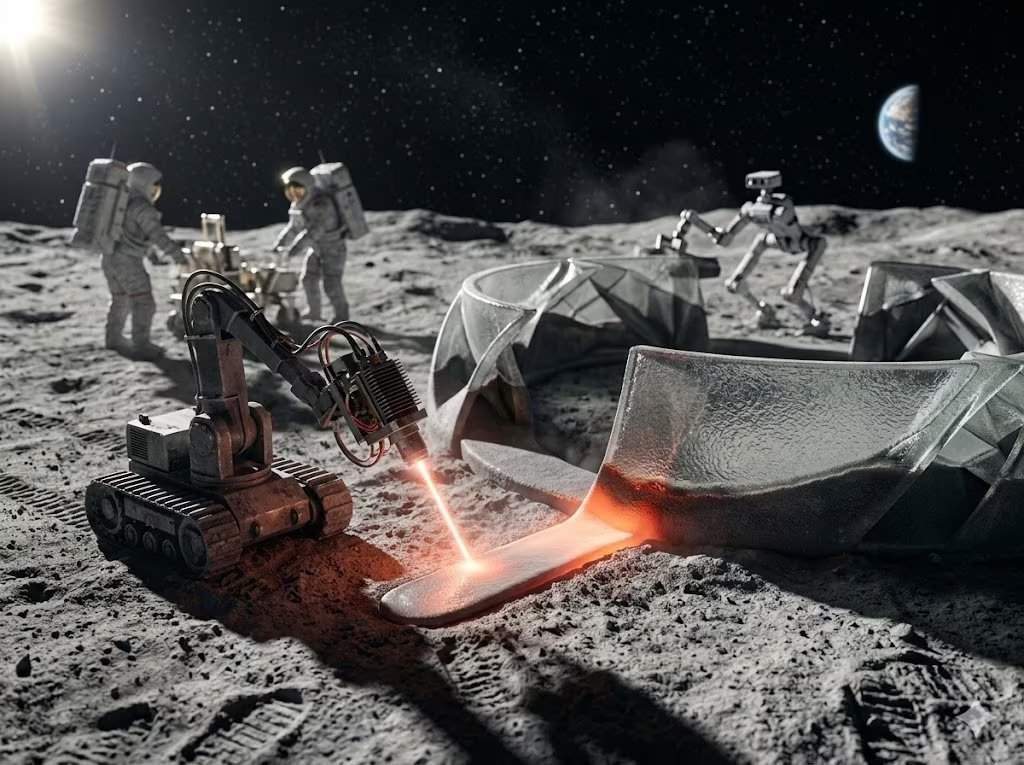
The laser forming method relies on concentrated infrared radiation for non-contact heating and material deformation, requiring no molds, presses, or heavy machinery—materials bend through localized thermal stress. Researchers tested the process under different atmospheric conditions to assess its feasibility in the lunar vacuum and on other celestial bodies with thin atmospheres. Experiments used samples simulating lunar soil and glass made from it, showing that laser action can effectively shape glass and ceramic structures, which could be used to build lunar base components. This method falls under the In-Situ Resource Utilization (ISRU) strategy, which leverages local resources rather than transporting materials from Earth.
According to Miller, the core advantage of this technology is a significant reduction in the mass and volume of equipment that needs to be sent into space: replacing heavy construction systems with compact laser energy sources allows direct material forming on the Moon. This is especially critical for the lunar environment, where every additional ton of payload significantly increases mission costs. Beyond base construction, laser forming could also be used to manufacture tools and spare parts directly in orbit or on the lunar surface, reducing reliance on Earth resupply—a crucial factor for long-duration missions, including space station operations, where spare part shortages have long been a limiting factor.
The authors also note that the technology has broader potential beyond space—from flexible manufacturing to construction on Earth. With population growth and surging demand for more efficient production methods, such laser technology could form the basis for new approaches to infrastructure development both in space and on Earth.
This article is compiled by Wedoany. All AI citations must indicate the source as "Wedoany". If there is any infringement or other issues, please notify us promptly, and we will modify or delete it accordingly. Email: news@wedoany.com
Related Products

LBH4000 Batch Environmental Protection Asphalt Mixing Plant | Asphalt Batching Plant | Asphalt Mixing Plant
Jilin Province Road Construction Machinery Co., Ltd.


Industrial and Commercial Point-Type Gas Detector
Jinan Benan Technology Development Co., Ltd.
Standard Nozzle Flowmeter
Jinggong Automatic Control Instrument Complete Technology Development Company