Los Alamos National Laboratory to Build Three Supercomputers Powered by NVIDIA Vera CPUs
en.Wedoany.com Reported - Los Alamos National Laboratory (LANL) is collaborating with HPE and NVIDIA to build three new supercomputers, named Mission, Vision, and Veritas, which will utilize NVIDIA Vera CPUs to accelerate scientific discovery and unlock agentic AI capabilities for science.
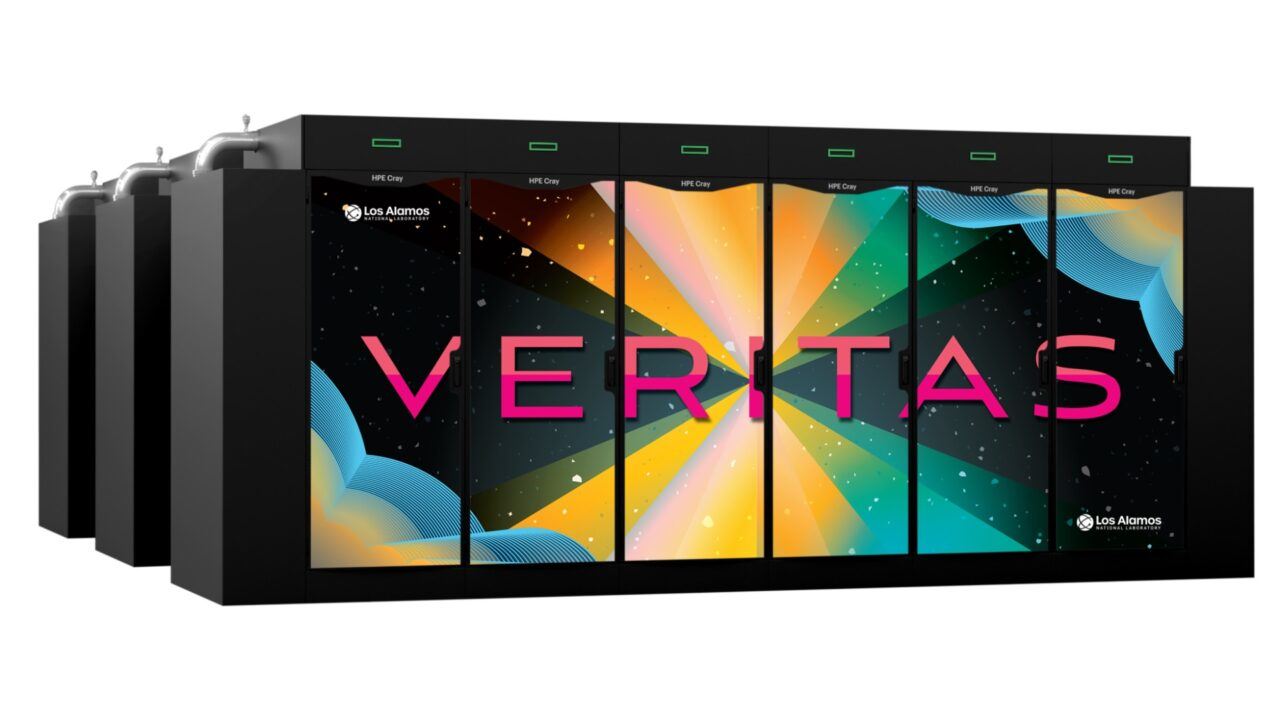
These supercomputers are based on the HPE Cray Supercomputing GX5000 architecture and the NVIDIA Vera Rubin platform, integrating NVIDIA Vera CPUs, NVIDIA Rubin GPUs, and NVIDIA Quantum-X800 InfiniBand networking.
Under the planned configuration, the Mission system will include NVIDIA Vera Rubin GPU nodes as well as 2,300 standalone NVIDIA Vera CPUs (using HPE Cray Supercomputing GX240 blades). The Veritas system will be equipped with approximately 1,150 standalone NVIDIA Vera CPUs to complement the NVIDIA Vera Rubin nodes.
Veritas will be delivered alongside Mission and Vision to support the laboratory's Directed Research and Development program, aiming to accelerate the application of scientific agentic AI. This system will be used to test relevant technologies in preparation for the larger-scale system LANL is building.
Researchers are adding new tools to science through AI agents. These agents can form hypotheses, select tools, initiate simulations, analyze outputs, and optimize subsequent steps. LANL's public work on URSA (Universal Research and Scientific Agent), which runs on Venado and will soon be deployed on Mission and Vision, is moving in this direction: a modular, feedback-driven AI framework designed to help scientists brainstorm hypotheses, plan experiments, run simulations, and analyze results.
LANL's testing demonstrated that the Vera CPU delivers up to 7 times the performance of the CPUs in the Crossroads x86 supercomputer on URSA workloads. In LANL's early testing of the NVIDIA Vera CPU applied to Branson, an open-source Monte Carlo heat transfer simulation tool, Vera's performance was more than 3 times higher than the CPUs used in the Crossroads x86 supercomputer.
These results are attributed to Vera's custom Olympus cores, LPDDR5 memory, and fast on-chip fabric. A single Vera CPU delivers over 3 times the performance of a single x86-based CPU, while providing over 4 times the memory per core and over 6 times the memory per node. This translates to faster scientific outcomes for LANL.
All of the laboratory's supercomputers are co-designed by hardware architects, system software developers, domain scientists, computer scientists, and applied mathematicians, ensuring the systems are shaped by real scientific workloads rather than abstract benchmarks.
Expected to be operational in 2027, Mission will become the fifth advanced technology system within the National Nuclear Security Administration's Advanced Simulation and Computing program and will replace Crossroads for handling classified national security workloads. Vision is also expected to be operational in 2027, providing resources for basic science, including materials and nuclear science, energy modeling, biomedical research, and AI, allowing more scientists to test methods, train models, and explore ideas before moving to higher-impact work.
This effort continues LANL's deep collaboration with NVIDIA on CPUs spanning over a decade, from Grace to Vera, employing extreme codesign to address LANL's simulation workloads. These three new supercomputers build upon Venado, an HPE Cray EX supercomputer installed at Los Alamos in 2024, which uses NVIDIA GH200 Grace Hopper superchips and NVIDIA Grace CPU superchips.
This article is compiled by Wedoany. All AI citations must indicate the source as "Wedoany". If there is any infringement or other issues, please notify us promptly, and we will modify or delete it accordingly. Email: news@wedoany.com
Related Products



TWP16 P-Band Tropospheric Wind Profile Radar
China Huayun Meteorological Technology Group Co., Ltd.


G.652.D Wavelength-extended Non-dispersion Shifted Single-mode Optical Fiber
HONGAN GROUP CO., LTD.
GYTA Type Non-Self-Supporting Aerial/Duct Optical Cable
TONGDING INTERCONNECTION INFORMATION CO., LTD.


Flat Portable Satellite Terminal 0.35m Aperture Manual Portable Terminal
China Starwin Science & Technology Co., Ltd.