India's SaaS Market Expected to Reach $50 Billion by 2030, Driven by AI Transformation
en.Wedoany.com Reported - The SaaS industry is undergoing a profound transformation rather than facing extinction. The integration of artificial intelligence with cloud-native platforms is driving traditional standalone applications toward integrated, AI-powered ecosystems. Microsoft CEO Satya Nadella's remarks in late 2024 sparked industry debate, but they should be understood as a metaphor for a major industry evolution. SaaS's core advantages—flexibility, scalability, and cost-effectiveness—remain highly relevant. AI and automation are not replacing SaaS but enhancing its capabilities by embedding intelligence into platforms, delivering smarter, more personalized solutions, automating workflows, and providing advanced analytics and decision support.

Artificial intelligence is at the forefront of SaaS innovation. By 2025, AI is seen as a game-changer, with platforms integrating advanced machine learning and automation to streamline business processes and deliver personalized experiences. AI-driven automation is simplifying core SaaS operations, including billing, data entry, customer onboarding, and DevOps, significantly reducing manual effort and maximizing efficiency. Beyond automation and personalization, AI supports advanced analytics and predictive insights, helping businesses make data-driven decisions. The rise of agentic AI is further accelerating SaaS innovation, enabling the automation of complex workflows and creating digital workforces that operate independently. As envisioned by Nadella, AI agents will manage tasks across platforms, access data, automate workflows, and provide insights, making SaaS a foundational component of smarter digital workspaces.
Several key trends are shaping the SaaS landscape in 2025 and beyond. Machine learning and AI have become central to business operations, automating critical processes such as customer service, onboarding, and workflow management. Vertical SaaS (industry-specific) solutions are proliferating in sectors like healthcare, finance, and manufacturing. Micro SaaS niche tools allow new entrants to quickly address specific customer needs. Integration and interoperability are becoming crucial, with SaaS providers prioritizing robust APIs and seamless compatibility with other business tools. Security and compliance are top priorities, with companies investing in advanced measures to protect data and meet stringent global standards. Super apps are consolidating multiple functions into unified ecosystems, usage-based pricing models offer greater flexibility, and sustainability is also becoming a key focus.
The global SaaS market is projected to reach $408 billion by 2025 and is expected to exceed $1.2 trillion by 2034. Adoption rates are soaring, with forecasts indicating that 85% of enterprise applications will be SaaS-based by 2025, up from 70% in 2023. Today, nearly all businesses rely on at least one SaaS solution, with large enterprises deploying an average of 177 SaaS applications.
India's SaaS industry is experiencing significant growth and transformation, emerging as a global leader in cloud software innovation. Driven by advanced technology adoption, a strong talent pool, and government support, the Indian SaaS market is expected to reach $50 billion by 2030 and could grow to $100 billion by 2035. Nearly 90% of early-stage SaaS startups have introduced AI-powered features, and vertical SaaS solutions are unlocking approximately $13 billion in opportunities across healthcare, education, and finance. Security and compliance are top priorities for Indian SaaS companies, with the domestic cybersecurity market valued at $6 billion in 2023 and projected to reach $13.6 billion by 2025. Over 70% of revenue for leading Indian SaaS companies comes from overseas sales, highlighting their global competitiveness.
Vertical SaaS solutions are rapidly gaining traction in India. In healthcare, platforms like Innovaccer and Zenoti are transforming patient management, telemedicine, and regulatory compliance. In the BFSI sector, SaaS supports digital lending, payments, fraud detection, and regulatory compliance, enabling real-time risk assessment and fraud monitoring. Manufacturing leverages SaaS for supply chain optimization, predictive maintenance, and quality control, with AI and IoT integration enabling real-time monitoring and reducing downtime. The education sector benefits from platforms that streamline admissions and student performance tracking. Hospitality and retail are adopting SaaS to automate point-of-sale systems and inventory management. Construction and logistics are also embracing platforms for project management and logistics tracking.
Indian SaaS companies are fully localizing internationally through in-depth market research, product customization, language and regulatory localization, and regional partnerships. Achieving the goal of a $100 billion AI-first SaaS industry by 2030 relies on a "service-as-software" model, deeply integrating artificial intelligence into SaaS solutions to deliver outcome-oriented business services. Indian companies need to prioritize vertical SaaS products, design products that are easy to localize, invest in top talent, foster an innovation ecosystem, and shift from traditional software licensing to outcome-based, AI-driven service models.
The SaaS industry faces dynamic challenges and opportunities in 2025. Generative AI is expected to dominate enterprise software spending by 2028, enabling hyper-personalized workflows and predictive analytics. AI-native startups are leveraging capabilities to disrupt traditional SaaS models. On the security front, providers face heightened risks from AI-driven malware and phishing, with the global cybersecurity market projected to grow to $13.6 billion by 2025. Stricter data privacy laws are forcing platforms to embed compliance tracking features. Budget constraints are prompting customers to prioritize tools with clear ROI, fueling the growth of micro SaaS and usage-based pricing models. Low-code/no-code platforms are expected to generate $187 billion by 2030, alleviating tech talent shortages. Vertical SaaS platforms (e.g., Procore in construction, Veeva in healthcare) now account for over 30% of industry growth, with micro SaaS startups driving 25% annual revenue growth in this segment. These trends underscore the importance of agility, specialization, and AI-driven innovation for maintaining competitiveness.
The SaaS industry is rapidly evolving, driven by AI, automation, and a focus on customer value. India is at the forefront of this transformation, with its SaaS industry poised to become a global powerhouse by 2030. The future lies in intelligent, integrated, and adaptable solutions that deliver real business outcomes and drive the digital economy to thrive.
This article is compiled by Wedoany. All AI citations must indicate the source as "Wedoany". If there is any infringement or other issues, please notify us promptly, and we will modify or delete it accordingly. Email: news@wedoany.com
Related Products


Mine Explosion-proof and Intrinsically Safe Industrial Ethernet Ring Network (10 Gigabit/Gigabit)
Chongqing Mas Sci&Tech Co., Ltd.
Comprehensive Mining Automation Control System
Beijing Tianma Intelligent Control Technology Co., Ltd.


G.652.D Wavelength-extended Non-dispersion Shifted Single-mode Optical Fiber
HONGAN GROUP CO., LTD.
Flat Portable Satellite Terminal 0.35m Aperture Manual Portable Terminal
China Starwin Science & Technology Co., Ltd.
Conveyor Belt Intelligent Monitoring System
LUO YANG WIRE ROPE INSPECTION TECHNOLOGY CO., LTD.
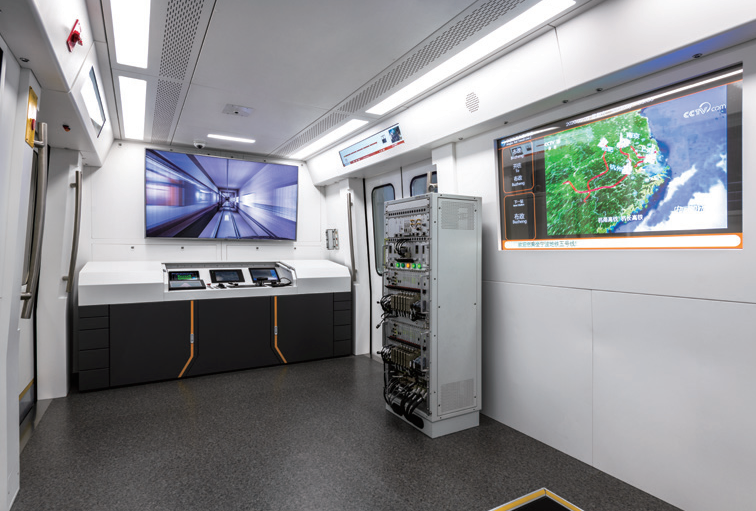

TWP16 P-Band Tropospheric Wind Profile Radar
China Huayun Meteorological Technology Group Co., Ltd.
20 Inch 1600*900 Full HD 60Hz TFT LED Monitor with VGA and DP Interfaces for Desktop Computers-Business Use
Guangzhou Zanying Optoelectronics Technology Co., Ltd.
GYTA Type Non-Self-Supporting Aerial/Duct Optical Cable
TONGDING INTERCONNECTION INFORMATION CO., LTD.