Retail Fertilizer Trends
Wedoany.com Report-Mar 20, Average retail prices for all eight major fertilizers continued to be higher than last month during the second week of March 2025, according to sellers surveyed by DTN. But for the first time in seven weeks, no fertilizer had a sizeable price change, which DTN designates as anything 5% or more.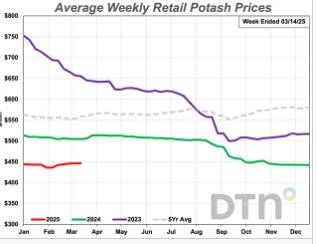
The average retail price of potash was $447 per ton during the second week of March 2025, up from $442 a month ago. However, the average price of potash is still 12% lower than it was a year ago.
DAP had an average price of $765 per ton, MAP $810/ton, potash $447/ton, urea $548/ton, 10-34-0 $646/ton, anhydrous $751/ton, UAN28 $354/ton and UAN32 $397/ton.
On a price per pound of nitrogen basis, the average urea price was $0.60/lb.N, anhydrous $0.46/lb.N, UAN28 $0.63/lb.N and UAN32 $0.62/lb.N.
President Donald Trump's tariff push risks increasing potash prices around the world, according to Dow Jones news service. Matt Simpson, chief executive of Brazil Potash Corp., told Dow Jones that Brazilian farmers are keeping a close eye on this situation considering Brazil is the world's largest importer of potash at 22% of the world's market share.
Another issue affecting the nutrient's global price is the continuing Russia and Ukraine war. Simpson said Brazil Potash and Brazilian agriculture in general strive for self-sufficiency in potash and other fertilizers, but getting there will be difficult.
Brazil has a national fertilizer plan designed to significantly increase production by 2050, and Simpson said, "It is possible to accelerate this production timeline but, realistically, it will take several decades and a focused effect for Brazil to be potash self-sufficient."
Two fertilizers are now higher in price compared to one year earlier. UAN32 is 1% higher, while 10-34-0 is 4% more expensive looking back to last year.
The remaining six fertilizers are lower. Both MAP and DAP are 1% less expensive, both urea and UAN28 are 3% lower, anhydrous is 5% lower and potash is 12% less expensive compared to last year.
DTN gathers fertilizer price bids from agriculture retailers each week to compile the DTN Fertilizer Index. DTN first began reporting data in November 2008.
Related Products