en.Wedoany.com Reported - INWIT has officially inaugurated its new INOC (INWIT Network Operations Center) at its Rome headquarters, aimed at centrally monitoring and managing its nationwide communication infrastructure. This marks a key step for the company in internalizing core operational activities.
The new operations center aims to integrate the monitoring of all telecommunications towers, DAS systems, IoT sensors, and gateways into a unified platform. Operating around the clock, the center is responsible for collecting various reports, calls, and alerts, managing work orders, and initiating corresponding processing procedures in the event of service interruptions or abnormal incidents.
For INWIT, this represents one of the most strategic investments in recent years. Internalizing asset management functions is intended to enhance operational efficiency, autonomy, and decision-making responsiveness, thereby directly improving customer service and opening up high-value-added business opportunities.
The launch of the operations center strengthens the company's already nationwide industrial model. INWIT must ensure the stable operation of approximately 26,000 mobile communication towers and around 850 indoor DAS (Distributed Antenna System) coverage points daily, the latter primarily deployed in stations, subways, tunnels, large buildings, and densely populated areas. This vast network requires structured processes that foster close collaboration between the headquarters and local teams. Maintenance work becomes crucial for ensuring asset reliability, aiming to reduce the impact of various abnormal events on operators and end-users. Asset management extends beyond fault handling to encompass planning, safety, operational condition verification, and the capability to operate in complex or remote environments.
The INOC's operational system relies on four integrated components. First are standardized processes involving fault management, escalation mechanisms, and the execution of service level agreements. Second is personnel capability, with teams composed of frontline operators, specialized technicians, and senior engineers responsible for handling the most complex anomalies. Third is near real-time event management, where the center analyzes alerts and metrics, filters them by priority, and correlates them to the most appropriate operational solutions. Fourth is the technology platform, including continuously running monitoring and work order systems that integrate automation and artificial intelligence functions for analyzing network element status and supporting preventive maintenance. This architecture drives the company's transition from a reactive response model to a proactive management model, enabling anomalies to be quickly captured, classified, and directed towards the most effective solutions. The core value of the INOC lies in directly linking technical data with operational decisions, shortening the response chain and duration.
The INOC in Rome is closely connected to INWIT's existing digital maintenance ecosystem. Its core is the maintenance management system, used for planning, managing, and tracking all asset intervention activities. The system tracks various activities within annual, semi-annual, and five-year plans, including incidental fault repairs, certifications, access requests, and safety measures, and supports INWIT and its tenants in downloading safety access risk cards according to company procedures. Data as of December 2025 illustrates the system's operational scale: the company recorded 47,000 on-site corrective interventions, 39,000 routine maintenance tasks, 44,500 non-routine maintenance tasks, and processed 44,000 maintenance reports from tenants. Additionally, there were 3,600 site access issues, over 5,200 energy meter interventions, and more than 2,100 activities related to the Security Operations Center and security agencies. In terms of operational metrics, the system coordinates thousands of reports monthly, with network average availability maintained above 99.5%. Each report is processed within an average of 30 minutes, and for critical infrastructure, the average recovery time is controlled between 6 and 10 hours.
The INOC is part of a broader network of specialized operations centers. The Security Operations Center (SOC) monitors the physical security of sites, managing access, intrusion detection, and video surveillance. The Network Operations Center (NOC) coordinates routine and corrective maintenance, tracking alerts, complaints, faults, and planned activities. Additionally, the DAS Operations Center (DOC) specializes in the remote management of small cells and DAS systems installed in stations, subways, and tunnels, performing Level 2 remote troubleshooting to quickly restore service and reduce on-site visits. Through this division of functions, different aspects of the network are monitored with specialization while maintaining clear accountability. Each report is traceable from generation to closure, information remains available throughout the intervention process, and historical records are kept for monthly assessments and trend analysis. This model enables INWIT to effectively combine a central asset view with the field work of technical teams across various regions. During peak hours, when multiple events occur simultaneously or external factors (such as weather, traffic, or power supply issues) affect processing times, coordination between the centers becomes critical. The priority at such times is not just dispatching orders, but also rationally allocating resources, tracking progress, and closing the loop with verifiable data.
The digital transformation of the operational model also extends to the teams performing on-site interventions. Technicians use a field service App connected to the maintenance management system to receive work orders, review safety documents, update job statuses, and transmit information back to the operations center in real time. This digital process covers the entire intervention cycle, from alarm testing to filling out planned maintenance checklists, effectively reducing information gaps between reporting, field operations, and task closure. On the busiest days, the system can simultaneously record over 2,000 active alarms, distributed by priority and geographic location. The integration between the center and field teams is key to enhancing system robustness; technicians are not isolated endpoints but nodes in the information update chain. The operations center can track work progress in real time, re-prioritize tasks, and intervene promptly when technical escalation is needed.
The physical security of sites is also ensured by digital systems. INWIT employs mechatronic solutions, such as digital lock cylinders and padlocks, to ensure only authorized personnel can access sites. Before opening a door, a risk card must be reviewed, and credentials are verified through the internal identity management system. This model significantly enhances the safety level for both operators and assets, especially in remote or hard-to-reach areas. Digital access management allows precise recording of who entered a site, when, and their authorization status. For a nationwide network, physical control of infrastructure is as important as technical monitoring. The INOC provides a more organized view of events for the entire system, enabling correlation analysis between any security anomaly and asset operational status. The convergence of monitoring, access control, and processes reduces the risk of coordination errors and accelerates collaboration with security agencies or field teams.
The next phase of development focuses on predictive maintenance. By integrating sensors, telemetry, and artificial intelligence, the system can proactively identify signs of equipment degradation or recurring anomalies, with the goal of intervening before a fault occurs. The benefits extend beyond improved reliability; more precise data analysis also helps reduce energy consumption, optimize maintenance schedules, and promote more sustainable asset management. In this model, the INOC will become a hub for collecting technical information, interpreting it, and translating it into decision-making instructions.
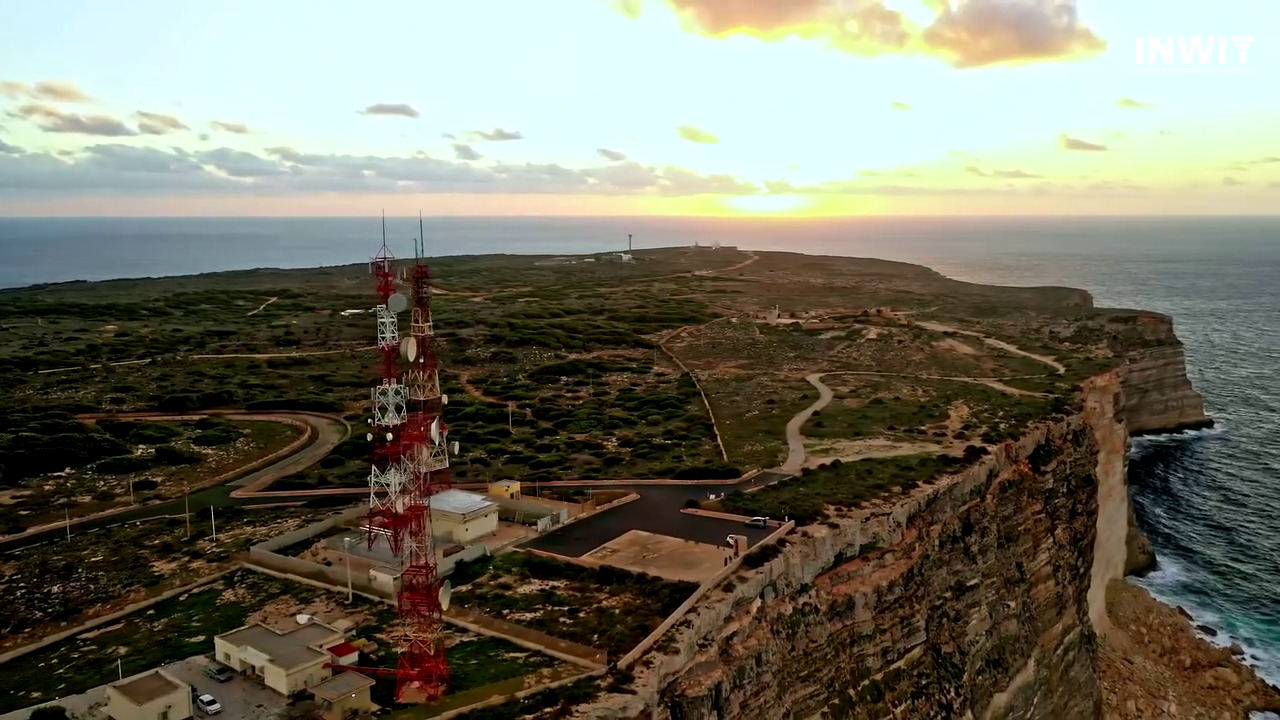
The value of infrastructure is particularly evident in hard-to-reach areas. In 2025, INWIT's communication tower on the island of Lampedusa became the focus of a significant maintenance and upgrade project. The company built a new tower next to the existing one, ensuring communication continuity and enabling the longest microwave link in Europe—a 147 km link connecting Lampedusa to Pantelleria, as well as a 50 km link from Lampedusa to Linosa. This infrastructure also houses equipment used by law enforcement for maritime safety and surveillance, providing a lifeline for the island when critical communication methods like submarine cables fail. This case demonstrates how shared towers and systems can support critical public services under extreme geographical conditions. The establishment of the INOC aims to consolidate this governance capability. Faced with distributed infrastructure, the company needs common tools, specialized personnel, and reliable data support. Bringing these critical functions into its own operations center means INWIT strengthens operational control, improves intervention quality, and lays the technical foundation for potentially extending service capabilities beyond the company's boundaries in the future.
This article is compiled by Wedoany. All AI citations must indicate the source as "Wedoany". If there is any infringement or other issues, please notify us promptly, and we will modify or delete it accordingly. Email: news@wedoany.com