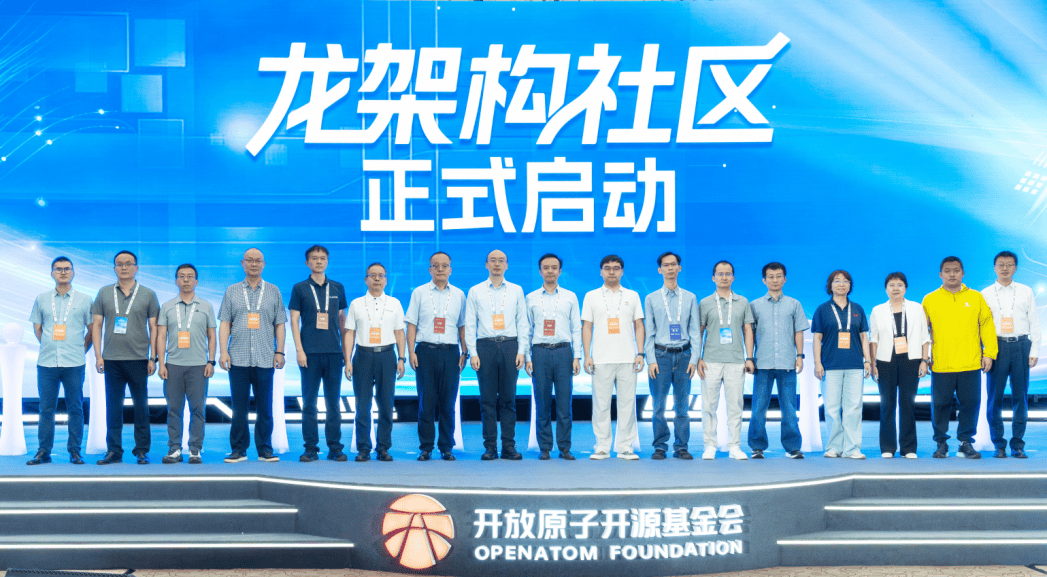
en.Wedoany.com Reported - On June 25, 2026, at the openKylin Open Source Ecosystem Forum during the 2026 OpenAtom Open Source Ecosystem Conference, the openKylin community unveiled multiple achievements in the field of artificial intelligence, including the official release of the openKylin Agent Operating System, and the simultaneous establishment of the openKylin Embodied Intelligence Working Group and the openKylin Mobile Intelligent Connectivity Working Group. The embodied intelligent humanoid robot driven by the openKylin system, as the first implementation project of the Embodied Intelligence Working Group, marks a critical leap for China's domestic open-source operating system in the RISC-V architecture humanoid robot domain, transitioning from technical adaptation to real-world deployment.
The current competition in artificial intelligence is shifting from model capabilities to the system capabilities required for agent deployment, with intelligent operating systems evolving natively towards agents. In August 2025, China's State Council issued the "Opinions on Deeply Implementing the 'Artificial Intelligence+' Action," proposing that by 2027, the adoption rate of new-generation intelligent terminals and agents should exceed 70%, and by 2030, surpass 90%. In May 2026, China's cyberspace authorities released the "Implementation Opinions on the Standardized Application and Innovative Development of Agents," guiding domestic AI open-source communities to strengthen agent deployment and carry out compatibility adaptation among agents, open-source chips, open-source operating systems, and open-source large models. Against this backdrop, openKylin has laid out its strategy in three major directions: Agent Operating Systems, Mobile Intelligent Connectivity, and Embodied Intelligence.
The openKylin community, incubated and operated by the OpenAtom Foundation, aims to "provide the world with an open-source operating system deeply integrated with artificial intelligence technology." At this forum, the community showcased a full-stack AI ecosystem layout covering "Agent - Mobile Terminal - Intelligent Terminal," advancing simultaneously in three directions, marking the extension of openKylin's AI integration strategy from a single desktop operating system to a full-stack intelligent terminal ecosystem.

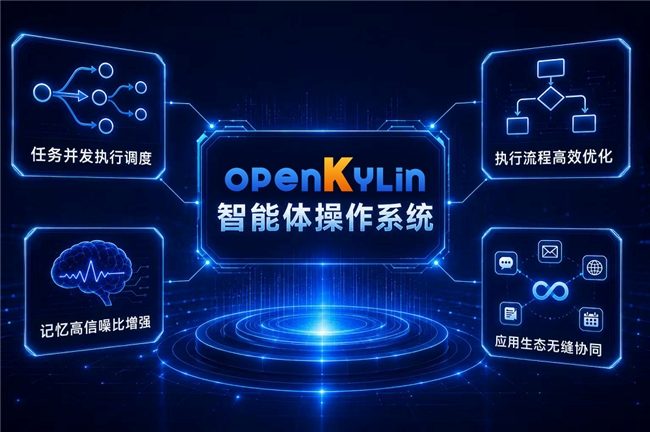
The AgentOS Special Interest Group (AgentOS SIG), jointly established by the National University of Defense Technology, Harbin Institute of Technology (Shenzhen), Kylinsoft Co., Ltd., and other units, officially released the open-source Agent Operating System. Built on openKylin 2.0, this system connects system agents, CUA agents, desktop application ecosystems, and unified model inference services, constructing foundational capabilities around four key directions: concurrent task execution scheduling, efficient execution flow optimization, high signal-to-noise ratio memory enhancement, and seamless application ecosystem collaboration. It reduces model switching frequency by 75% and task waiting time by 73.6% through unified model inference services; compresses token consumption via a "trunk-branch" collaborative execution architecture; improves the accuracy of historical experience reuse through a lightweight memory refinement model; and supports over 300 system operations and 900 application operations via API and CUA agent Skill encapsulation, along with over 30 categories of API-less desktop applications.
The openKylin Embodied Intelligence Working Group was concurrently established, comprising Shanghai Kuya Technology Co., Ltd., Chaorui Technology (Shanghai) Co., Ltd., the OpenLoong Open Source Community, the Haihe Laboratory of Advanced Computing and Key Software, Kylinsoft Co., Ltd., the National University of Defense Technology, and China Great Wall Technology Group Co., Ltd. This working group focuses on advancing cutting-edge embodied intelligence technologies and building an open-source ecosystem, empowering the deployment of the openKylin operating system in scenarios such as humanoid robots and intelligent terminals. Previously, the openKylin community, in collaboration with ecosystem partners, completed full-chain adaptation of the "Linglong" RISC-V embodied intelligent humanoid robot, overcoming key technologies such as underlying drivers, ROS integration, and real-time control, achieving stable operation on a physical platform.
The openKylin Mobile Intelligent Connectivity Working Group was officially established, jointly initiated by industry, academia, and domestic and international supply chain partners, including Kylinsoft Co., Ltd., the National University of Defense Technology, China Great Wall Technology Group Co., Ltd., Phytium Technology Co., Ltd., TPV Technology Co., Ltd., Sutai Kailing Technology (Tianjin) Co., Ltd., Cixi Technology Group Co., Ltd., and Qt Group. With a full-stack collaborative path of "Operating System · Complete Machine · Chip · Software" as its core strategy, the group has launched the Kylin 100 Intelligent Connectivity Operating System, achieving industrial deployment with a dual-kernel, dual-system, dual-ecosystem core architecture. This system features a dual-kernel security architecture, a full-stack national cryptography security system, and leverages lightweight virtualization technology for deep integration of desktop and mobile systems. Its products cover all categories of terminal devices, enabling inter-device and device-cloud collaborative connectivity, and natively includes offline on-device AI services.

Concurrently with the forum, the community presented the inaugural "openKylin Annual Person of the Year" awards, recognizing pioneers who have long been dedicated to community governance and ecosystem development. Following a comprehensive evaluation by the judging panel, openKylin Committee Vice Chairman Cao Xiannian, openKylin Committee Vice Chairman Zheng Chenming, and openKylin TOC Mentor Tan Zhongyi received the awards.
This article is compiled by Wedoany. All AI citations must indicate the source as "Wedoany". If there is any infringement or other issues, please notify us promptly, and we will modify or delete it accordingly. Email: news@wedoany.com