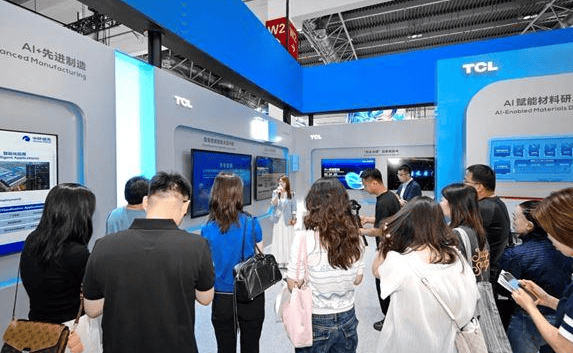
en.Wedoany.com Reported - The fourth China International Supply Chain Expo (CISCE) was held from June 22 to 26 at the China International Exhibition Center (Shunyi Hall) in Beijing. Gechuang Dongzhi, an industrial AI enterprise strategically incubated by TCL, participated as an exhibitor for the fourth consecutive year, showcasing its "Octopus Brain" industrial intelligent decision-making hub and a cluster of industrial intelligent agents covering areas such as equipment, quality, smart factory management, and smart logistics. This year's CISCE, themed "Connecting the World, Creating the Future," established an AI dedicated zone for the first time, attracting exhibitors including NVIDIA, Qualcomm, Alibaba, and iFLYTEK. A total of 676 Chinese and foreign chain-leading enterprises and over 1,200 upstream and downstream enterprises participated, covering 85 countries and regions.
Gechuang Dongzhi shifted its exhibition focus to the "decision-making + execution" domain of industrial AI, presenting the complete architecture of the "Octopus Brain" for the first time. This architecture evolves AI from an auxiliary tool into an intelligent decision-making hub capable of autonomously completing the full closed-loop process of perception, analysis, decision-making, and execution on real production lines.
The on-site demonstration showcased the six-step decision-making closed loop of the Octopus Brain: real-time perception of production anomalies, multi-agent collaborative root cause localization, automatic generation of optimization strategies, linkage with the manufacturing execution system for implementation, monitoring of execution effects, and automatic sedimentation of experience into enterprise knowledge, enabling continuous evolution of models and knowledge. This capability moves industrial AI from "making suggestions" to the stage of "closed-loop governance."
Another breakthrough of the Octopus Brain lies in building a team of industrial intelligent agents capable of collaborative work, covering business domains such as equipment, quality, factory management, and logistics. Each agent performs its specific duties and can collaborate around the same business objective. For example, when a production anomaly occurs, the production domain Agent identifies the anomaly, the equipment domain Agent analyzes the status, the quality domain Agent assesses the impact on yield, and the logistics domain Agent coordinates material flow. Ultimately, the Octopus Brain uniformly completes strategy orchestration and execution scheduling, achieving cross-business collaboration.
On-site data demonstrated the practical value of industrial intelligent agents: anomaly closed-loop processing time was reduced from 4 hours to 5 minutes; AI yield analysis achieved minute-level real-time warnings, cumulatively reducing quality losses by over 6 million RMB; the equipment maintenance decision Agent improved fault handling efficiency by 30% to 63%; the AI energy and carbon platform achieved energy savings of over 4 million RMB for a single plant; and the AI+AMHS smart logistics solution helped customers achieve intelligent scheduling for thousands of OHTs, reducing logistics manpower by 80% while supporting rapid capacity ramp-up to 300,000 wafers per month. Gechuang Dongzhi is building an industrial intelligent agent ecosystem covering the entire factory business process.
Currently, Gechuang Dongzhi has built over 300 industry benchmark cases, covering areas such as wafer manufacturing, advanced packaging and testing, panel display, and new energy. It successfully completed China's first seamless CIM replacement for a fully operational wafer fab and continues to export industrial AI capabilities to markets in Southeast Asia, the Middle East, the Americas, and Europe. At this year's expo, Gechuang Dongzhi also debuted an AI digital spokesperson named "Xiao Ge," driven by multimodal interaction capabilities, capable of answering audience questions about technology and cases in real time. As an industrial AI enterprise participating in the CISCE for four consecutive years, Gechuang Dongzhi believes that achieving self-sufficiency and control in China's semiconductor supply chain requires completing the full-chain capabilities from CIM systems to AI decision-making hubs, and the practical path of the Octopus Brain provides a replicable model for this.
This article is compiled by Wedoany. All AI citations must indicate the source as "Wedoany". If there is any infringement or other issues, please notify us promptly, and we will modify or delete it accordingly. Email: news@wedoany.com