en.Wedoany.com Reported - Researchers at the University of Michigan, in collaboration with automotive companies, battery developers, and policymakers, have developed a framework to help stakeholders drive electric vehicles toward a better, more economical, and more sustainable future.
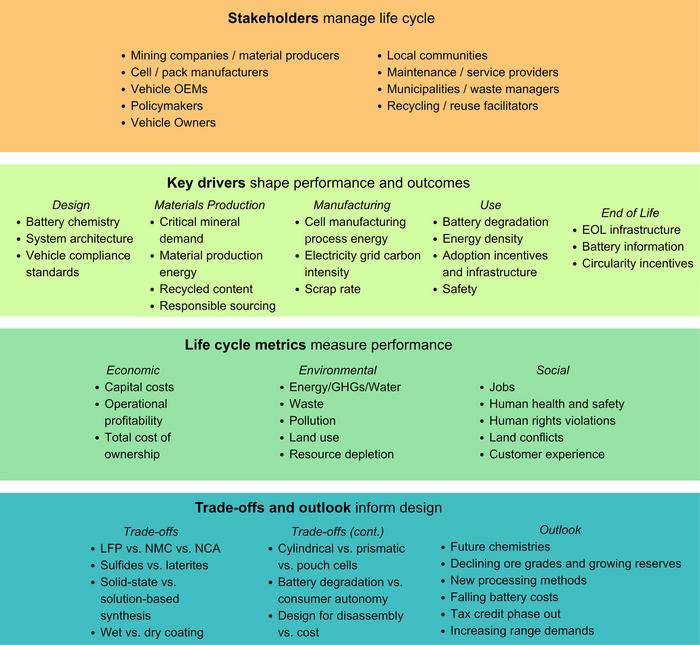
Greg Keoleian, a professor at the University of Michigan's School for Environment and Sustainability (SEAS) and co-director of the Center for Sustainable Systems (CSS), stated that the research, published in the Journal of Energy Storage, seeks to address the complex challenge of reconciling the diverse goals of various parties to simultaneously benefit the environment, help industries compete, and ensure value for consumers. Keoleian noted that different stakeholders may have different objectives and goals, and the framework helps them consider a range of factors from a holistic perspective to achieve better outcomes in batteries and electric vehicles.
With input from experts in academia, industry, and government, Keoleian and his colleagues assessed economic, environmental, and social trade-offs and prospects from the perspective of stakeholders across the entire battery lifecycle. The framework enables parties—from battery and vehicle manufacturers to drivers and battery recyclers—to better understand, predict, and prepare for various trade-offs and consequences when making decisions and setting priorities. The assessment also revealed multiple challenges facing electric vehicles from different angles, including the federally supported oil industry and the existing advantages of internal combustion engine vehicles in terms of infrastructure. However, Keoleian remains optimistic that the framework will accelerate the transition to electric vehicles, noting that they outperform internal combustion engine vehicles in terms of quietness, environmental friendliness, acceleration, maintenance costs, and total cost of ownership.
Case studies on different battery chemistries provide concrete examples of the trade-offs highlighted by the framework. In China, where over 60% of new car sales are electric vehicles, manufacturers have begun to rely on lithium iron phosphate (LFP) battery chemistry. Compared to NMC batteries, characterized by nickel, manganese, and cobalt, LFP is cheaper. Keoleian stated that batteries account for about 30% of the cost of an electric vehicle, and LFP is less expensive because it contains no cobalt or nickel. However, LFP requires a larger battery mass to achieve the same charge storage level as NMC, meaning shorter driving range. At the same time, because cobalt and nickel are valuable, there is a higher incentive to recycle these batteries, helping manufacturers produce more sustainably and reducing the amount of newly mined materials needed for each new battery.
U.S. automakers, including Ford and General Motors, are also developing lithium-manganese-rich (LMR) batteries, which have the potential to combine the low cost of LFP with the long range of NMC, though their durability is still being improved. Keoleian noted that the framework helps clarify these trade-offs from the perspectives of different stakeholders, avoiding problems upstream or downstream caused by a narrow viewpoint.
The research was funded by the Responsible Battery Coalition. The research team also includes CSS research area expert Christian Hitt, CSS and University of Michigan Electric Vehicle Center research assistant Elliot Busta, CSS research specialist Timothy Wallington, and Ford Motor Co. research scientist Hyung Chul Kim. The study also consulted experts from General Motors, Ford, Toyota, Dow Chemicals, the U.S. Environmental Protection Agency (U.S. EPA), the U.S. Geological Survey, and Clarios, a leader in automotive battery manufacturing.
This article is compiled by Wedoany. All AI citations must indicate the source as "Wedoany". If there is any infringement or other issues, please notify us promptly, and we will modify or delete it accordingly. Email: news@wedoany.com