en.Wedoany.com Reported - Hanwha Qcells will lead a nationwide project supported by the South Korean government, dedicated to commercializing next-generation high-efficiency tandem solar modules.
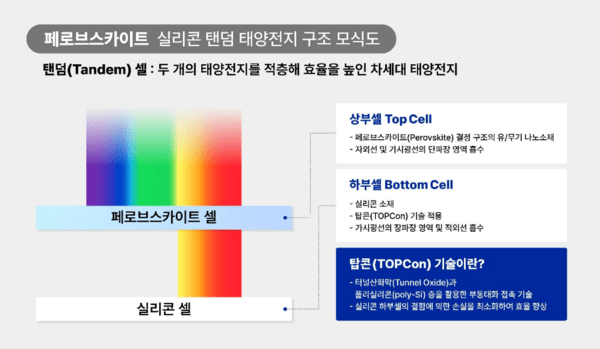
The project, named "Development and Demonstration of Commercial-Area Perovskite/Silicon Tandem Modules," is managed by the Korea Institute of Energy Technology Evaluation and Planning (KETEP) under the Ministry of Climate, Energy and Environment. Hanwha Qcells leads a consortium of eight other South Korean companies, research institutions, and universities, commencing a three-year R&D effort starting this April.
The project aims to demonstrate commercial-area tandem modules with an efficiency of at least 28% and an area exceeding 1.7 square meters. Tandem cells improve power generation efficiency by absorbing different bands of sunlight, with a theoretical maximum efficiency of 44%, approximately 1.5 times higher than the 29% of conventional silicon cells.
Hanwha Qcells will focus on developing tandem manufacturing technologies suitable for mass production, planning to align this R&D project with tandem pilot lines already operating in South Korea and Germany, accumulating demonstration data, gradually establishing a foundation for mass production technology, with a commercialization target set for 2029.
Moon Soo-jin, head of Hanwha Qcells' Pangyo R&D Center, stated that the company will accelerate the commercialization process of tandem technology while contributing to enhancing the global competitiveness of South Korea's solar industry ecosystem.
This article is compiled by Wedoany. All AI citations must indicate the source as "Wedoany". If there is any infringement or other issues, please notify us promptly, and we will modify or delete it accordingly. Email: news@wedoany.com