South Korea's Ministry of Science and ICT Advances Development of World Model with 1 Million Hours of Video Data
en.Wedoany.com Reported - The Ministry of Science and ICT (MSIT) of South Korea is pushing forward the development of a domestic World Model, planning to invest at least 100,000 hours and up to 1 million hours of video data to take the lead in the physical artificial intelligence market. For comparison, physical AI models from companies like NVIDIA learn for approximately 100,000 hours, typically using 600,000 one-minute short videos for 10,000 hours of training.
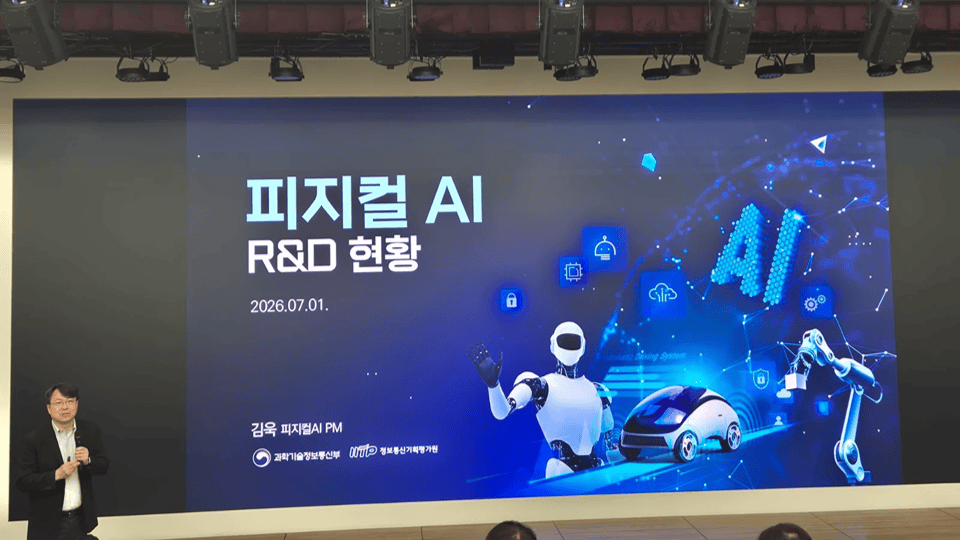
The Ministry of Science and ICT held a seminar on the "Strategy for Securing Core Competitive Advantages in Physical AI" at the KT Gwanghwamun WEST Building in Jongno-gu, Seoul on the 1st. Kim Wook (김욱), Physical AI and Innovation Project Manager at the Ministry, introduced the current status of domestic physical AI development. Currently, physical AI models such as NVIDIA's "Isaac GR00T" train for about 100,000 hours, with most foundation models learning from a 50-50 mix of synthetic and real data. The proportion of synthetic data is expected to increase significantly to 90% in the future, making the establishment of a system for accurately generating synthetic data a core task for the government.
For robot foundation models performing specific tasks, 10,000 to 20,000 hours of video data are typically used, while large-scale training requires up to 100,000 hours, usually achieved by learning from 600,000 one-minute short videos for 10,000 hours. In contrast, world models need to predict the future in more diverse environments, requiring higher technical depth and complexity, with data needs at least 10 to 100 times greater than those of robot foundation models. Therefore, development requires investment in at least 100,000 to over 1 million hours of data. The Ministry of Science and ICT plans to first secure core technologies for world model development and build a system in the simulator domain that can configure environments based on industrial sites and extract data.
The Ministry of Science and ICT has set the goal of becoming the global leader in the physical AI field, driven by structural differences from the large language model (LLM) market. In the LLM sector, South Korea lags significantly behind global pioneers, and as a latecomer, it faces limitations in catching up with the United States and China, which have invested heavily in capital and graphics processing unit (GPU) infrastructure. Thus, the Ministry has set the LLM goal of developing specialized models tailored to domestic conditions. In contrast, physical AI is still in its infancy globally, and the Ministry sees this as an opportune time to advance to a leading global position. Additionally, considering that operational data from core security facilities such as nuclear power plants, advanced semiconductors, and defense could be leaked through overseas platforms, the Ministry deems it necessary to secure a domestic world model.
In terms of data collection, large companies like Samsung and Hyundai are highly sensitive to process data leaks, posing challenges for the government in collecting data centered on these firms. However, regional small and medium-sized enterprises (SMEs) facing recruitment difficulties and severe labor shortages are open to providing data actively, as introducing physical AI robots to address manpower shortages becomes a key task. Lee Do-gyu (이도규), Director of the Information and Communication Policy Office at the Ministry of Science and ICT, stated, "Physical AI will be applied to a very wide range of fields, but the area that will generate added value first should be manufacturing," adding, "There are not many countries with manufacturing competitiveness like South Korea."
Related Products



GYTA Type Non-Self-Supporting Aerial/Duct Optical Cable
TONGDING INTERCONNECTION INFORMATION CO., LTD.
G.652.D Wavelength-extended Non-dispersion Shifted Single-mode Optical Fiber
HONGAN GROUP CO., LTD.

20 Inch 1600*900 Full HD 60Hz TFT LED Monitor with VGA and DP Interfaces for Desktop Computers-Business Use
Guangzhou Zanying Optoelectronics Technology Co., Ltd.

Conveyor Belt Intelligent Monitoring System
LUO YANG WIRE ROPE INSPECTION TECHNOLOGY CO., LTD.
One-Stop Steward Service for the Entire Logistics System Integration Chain
Zhongding Intelligent (Wuxi) Technology Co., Ltd.