Deutsche Telekom Plans to Phase Out Ericsson's 5G Core Network by 2028
en.Wedoany.com Reported - Ericsson's core network products face gradual elimination by Deutsche Telekom. At the FutureNet World conference in London this April, Deutsche Telekom showcased its self-developed Horizontal TelCo Cloud (HTC) platform, which supports multi-vendor applications, with Ericsson not appearing as a key supplier. By 2028, Deutsche Telekom plans to completely phase out its current non-standalone (NSA) 5G core network based on Ericsson's proprietary platform, transitioning to a standalone (SA) core network provided by Mavenir on HTC. This highlights growing doubts about whether major suppliers like Ericsson are willing to offer applications that can be hosted on other vendors' infrastructure platforms.
Laurent Leboucher, Chief Technology Officer of Orange Group, noted at the conference that persuading suppliers to participate in the open-source project Sylva, aimed at simplifying multi-platform deployment, is no easy task. He recalled that a year ago, some suppliers who had declared participation in Sylva did not actually engage during the bidding process. However, Jenny Lindqvist, Head of Ericsson's Cloud Software and Services business group, insisted that it is a misconception to think Ericsson refuses to adapt to this change. She expressed no concern, as Ericsson has both customers using its proprietary CNIS (Cloud Native Infrastructure Solution) platform and many others using different platforms.
CNIS differentiates Ericsson from competitor Nokia, which exited this business three years ago, transferring expertise and approximately 350 employees to Red Hat, owned by IBM. Nokia executives explained that they could not compete as cloud infrastructure developers against Red Hat and hyperscale cloud providers. Telecom operators tend to break down silos where each application is tied to its own infrastructure, consolidating all applications onto a multi-vendor cloud platform like Deutsche Telekom's HTC. Nokia participates in HTC, posing direct competition to Ericsson.
Although there were earlier speculations that Ericsson might follow Nokia's lead and exit this field, that has not been the case. Ericsson claims its core network applications on CNIS have over 50 live network deployments, with customers including Swisscom, Telefónica, Wind Tre, Telstra, SK Telecom, and Docomo. Additionally, the company has over 15 deployments on third-party clouds, with other customers using the on-demand core network service jointly launched by Ericsson and Google, and seven operators conducting trials. Lindqvist stated that customers have seen the value of the proprietary platform, which serves as a strong alternative when they need other platforms.
Nokia's exit has forced some customers, including Orange, to replan. Leboucher revealed that Orange's core network still runs on legacy infrastructure, but Nokia has decided to discontinue production and support for its self-built cloud infrastructure, forcing Orange to migrate. Orange is likely to run its 5G core network on its own Orange Telco Cloud in the future. Leboucher is more satisfied with the current state of supplier participation in the Sylva project than a year ago, believing the situation is improving and that it is now much easier to secure supplier involvement.
For Ericsson, responding to market demands and continuously investing in CNIS places immense resource pressure. Lindqvist's cloud software group has struggled to achieve profitability. The group posted its first operating profit in nine years last year, but an 8% operating margin lagged behind Nokia's corresponding division at 13%. Ericsson's cloud group only broke even in the most recent first quarter, with cumulative operating losses of 45.5 billion Swedish kronor (approximately $4.7 billion) since 2017. Lindqvist acknowledged the need for tough decisions to restore profitability but expressed confidence in the business segment's potential, believing it will play a key role in differentiated connectivity and operational simplification.
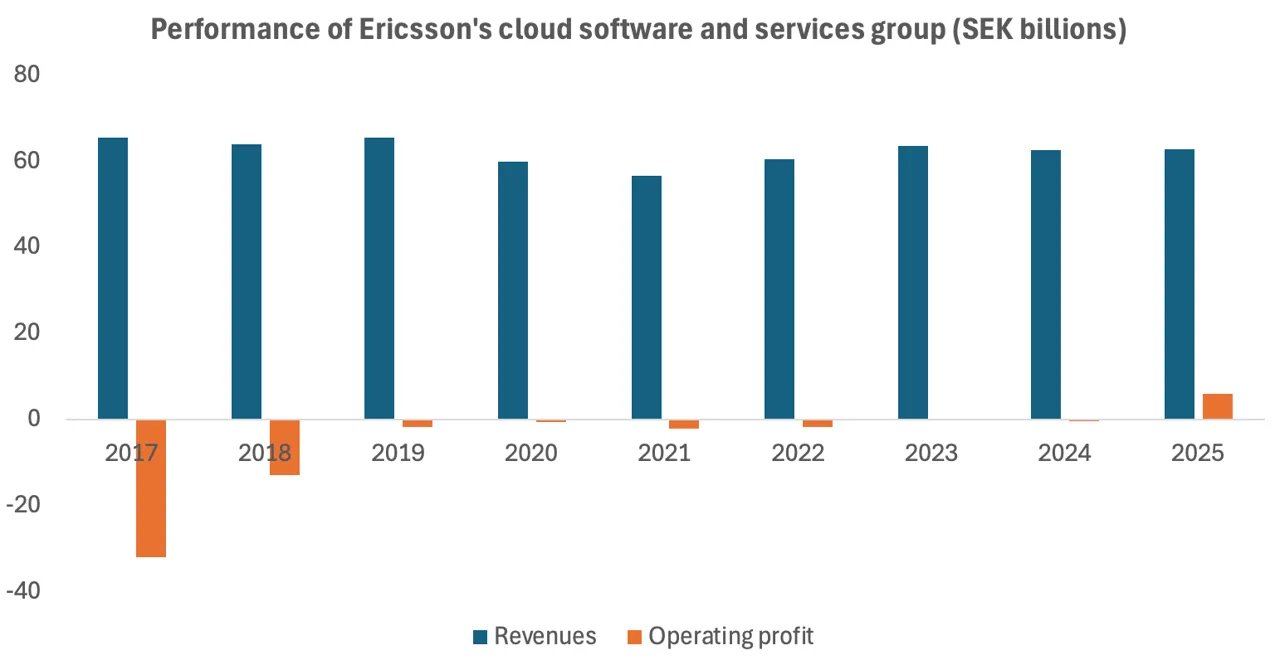
To curb losses, Ericsson has laid off approximately 18,000 employees company-wide since the end of 2022, accounting for over one-fifth of its total workforce, partly due to automation and artificial intelligence. Incoming CEO Per Narvinger stated that the transition to cloud-native technology enables the company to configure products more efficiently and manage them with fewer personnel.
Within Ericsson's cloud software and services portfolio, the value of mobile core network software also lies in its stimulating effect on the larger mobile networks division. Ericsson argues that to deliver seamless 5G services with a standalone core network, operators need to deploy mid-band radio equipment. However, many European operators have yet to do so. Ericsson's latest "Mobility Report" shows that mid-band coverage in Europe is only 60%, far below North America's 90% and India's 95%. Lindqvist cited large concerts as an example, noting that only mid-band standalone networks can provide the required uplink performance, which also involves network slicing technology.
Ericsson hopes customers can generate higher revenue from differentiated services, thereby driving more network investment. However, the current reality is that average revenue per user for smartphones continues to decline, and the 5G enterprise market has yet to take off. Ericsson's enterprise group posted first-quarter sales of only 4.2 billion Swedish kronor (approximately $430 million), with an operating loss of 1.8 billion Swedish kronor (approximately $190 million). Lindqvist suggested that European authorities could improve the situation by not blocking telecom operator mergers. She believes there are too many market players in Europe, making it difficult for operators to achieve the scale needed for investment returns. She noted that regulators prioritize the need for low consumer prices, and Ericsson believes that adjusting regulatory thinking would be a good start.
Related Products



Comprehensive Mining Automation Control System
Beijing Tianma Intelligent Control Technology Co., Ltd.
Multi-function Marine Monitoring Low-altitude Detection Radar Sea-air Boundary Ocean Dynamic Environment Measurement
Chengdu Dixin Technology Co., Ltd.

TWP16 P-Band Tropospheric Wind Profile Radar
China Huayun Meteorological Technology Group Co., Ltd.
D12 Humanoid Robot
Automation Research Institute Co., Ltd. of China South Industries Group Corporation

Hot Selling 10 Inch Intel N5100 I5 I7 FHD 8 +128GB 16+256GB Win10 Pro Win11 Pro 4G 5G Rugged Tablet PC Pad with NFC Barcode
Highton Electronics Co., Ltd.

MUX Series Communication Interface Device for Security and Stability Control System
Nanjing NR Electric Co., Ltd.
Automatic Aiming Laser Remote Obstacle Removal Robot
Pinggao Group Weihai High-Voltage Apparatus Co., Ltd.