en.Wedoany.com Reported - Port Polska has announced that Poland is preparing to introduce a Regular-Interval Timetable (HRJ), a system of regular-interval train services that will fundamentally change the way railway services are planned and operated.
Inspired by successful models in countries such as Switzerland and Austria, the system is based on trains running at fixed intervals and at easy-to-remember times, aiming to provide passengers with greater predictability and more efficient transfer experiences. The project is a response to the liberalization of the European passenger rail market legislation (as part of the Fourth Railway Package). Starting from December 2030, operators other than the national carrier PKP Intercity will also be permitted to enter the Polish long-distance rail service market.
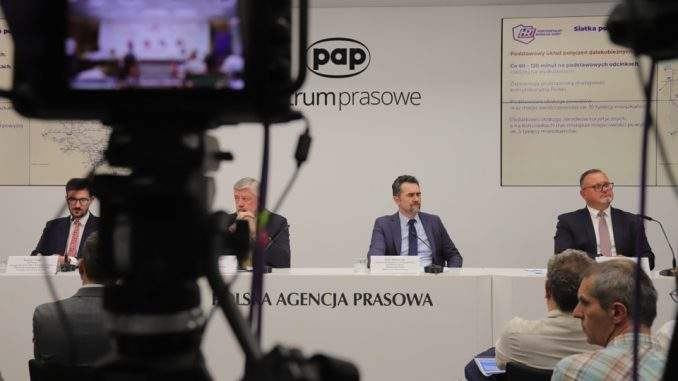
Piotr Malepszak, Secretary of State at the Ministry of Infrastructure, stated that implementing the Regular-Interval Timetable will address issues of irregular departure times and long waiting periods. By coordinating timetables, trains will arrive at stations at the same times, enabling fast and safe transfers between services. Poland is drawing on the most effective European railway systems, particularly the Swiss model. Trains on main lines will operate at fixed intervals (e.g., every hour or every two hours), making travel easier to plan and more attractive compared to road transport.
The new system will cover long-distance trains, regional, and metropolitan area services. For the first time, Polish authorities have collaborated with all regions nationwide to develop a unified national vision for railway transport organization for 2030–2040. Filip Czernicki, CEO of Centralny Port Komunikacyjny (CPK), stated that HRJ covers not only long-distance transport but also regional and metropolitan services. In Poland, a coherent national-level plan has been developed for the first time for 2030–2040. The plan requires extending rail connections to all regions of the country through direct trains or well-coordinated connections with regional services and buses.
Piotr Rachwalski, a member of the CPK management team, said that for passengers, the main advantage is the stability and predictability of services. If a passenger misses a train, they know exactly when the next one will arrive. The model has already been implemented on certain lines, and stakeholders hope to expand it nationwide. Authorities estimate that the new system will help increase passenger numbers and improve the efficiency of existing infrastructure usage.
In the long term, the Regular-Interval Timetable will also serve as a tool for railway investment planning, providing infrastructure managers with clearer grounds for developing lines, stations, signaling systems, and other elements needed to enhance network capacity. Starting from 2035, the future "Y"-shaped high-speed rail line will connect Warsaw to the new airport, Łódź, Wrocław, and Poznań, and will become the backbone of the national network, integrated into the new railway operational concept. Through this approach, Poland aims to create a more predictable, coordinated, and attractive railway transport system for passengers.