Spain's CNMC Proposes Urban Planning Reforms to Accelerate Land and Housing Access
en.Wedoany.com Reported - Spain's National Commission on Markets and Competition (CNMC) has proposed expanding the supply of developable land by reducing urban planning burdens, simplifying regulations, and introducing flexible planning to support the construction of new free-market housing, subsidized housing, and social housing. In a study numbered E/CNMC/001/25, the agency noted that ease of land acquisition is closely linked to shorter construction timelines, cost control, and enhanced housing supply capacity.
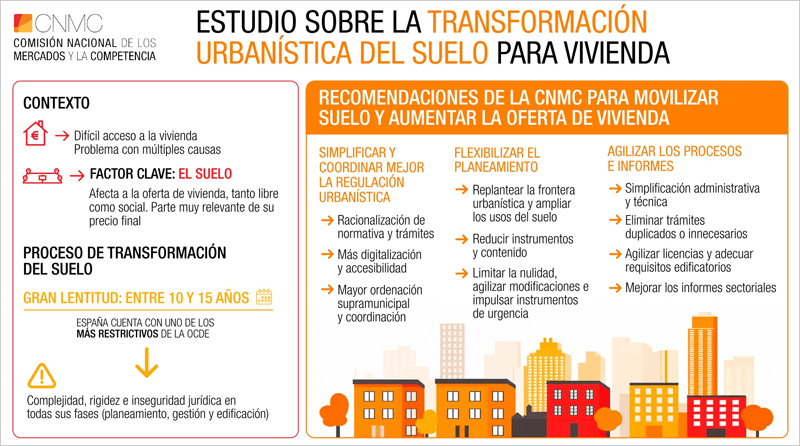
The CNMC analyzed the entire process of urban planning, land development, and construction, identifying land as one of the key factors affecting housing prices and supply. According to the agency's estimates, land costs can account for up to 45% of the final price of a home, meaning that improvements in administrative efficiency will directly impact development costs and housing accessibility. The study pointed out that Spain's land development process is slow and cumbersome, with various procedures potentially leading to project delays, cost increases, and limiting the housing market's ability to respond to demand. The CNMC ranked Spain among the OECD countries with the most stringent land use regulations, citing complex procedures, high legal uncertainty, rigid regulations, and low administrative efficiency.
In the planning phase, the study warned that detailed restrictions on developable land and its uses could weaken the ability to respond to changes in housing demand or other economic activities. Additionally, the low effectiveness of planning tools, difficulty in modifying them, and potentially redundant documentation requirements in some cases were also identified as obstacles. The CNMC also highlighted issues in the urbanization phase: the accumulation of technical and administrative requirements can extend construction timelines and increase project costs. In the construction phase, multiple controls and requirements can lead to delays in permit issuance, thereby postponing the start of new buildings. The study specifically focused on sectoral regulations in areas such as the environment, heritage, infrastructure, and others, which are increasingly influential in urban planning. The CNMC noted that while these controls serve legitimate objectives, a lack of coordination or proportionality can result in duplication, contradictions, and new delays.
In its recommendations, the CNMC proposed optimizing and harmonizing urban planning regulations through simplification and consolidation, while advancing digitalization and information transparency. Additionally, it suggested strengthening the consistency of governance rules and implementing cross-municipal master plans to reduce fragmentation of standards. The CNMC also advocated for flexible adjustments to urban planning by reviewing land classifications for non-protected areas, expanding the range of possible uses, and reducing the impact of planning on competition in other markets. At the same time, it proposed establishing more flexible special mechanisms for urban planning tools, limiting cases of total plan invalidation, accelerating revisions and partial adjustments, and promoting emergency tools for subsidized housing. The CNMC recommended reducing the complexity of planning tools and their formulation, processing, and approval procedures, including reducing the number of tools and the content burden of overall plans, as well as simplifying the approval process. In urban management, the study suggested adopting more flexible measures at the administrative, procedural, and technical levels, while establishing a regulatory framework for selecting management systems and strengthening existing mechanisms to address deadlocks. To facilitate construction, the CNMC proposed accelerating permit issuance, promoting declarations of responsibility, adjusting construction requirements and burdens, and avoiding duplication or disconnection in control stages. Regarding sectoral reports, it recommended clarifying their scope, avoiding contradictions, changing administrative silence from rejection to approval, justifying the necessity of each report, and improving the integration of environmental assessments into the urban planning process. The study also proposed recommendations regarding the involvement of public administrations in land matters, aiming to enhance predictability, transparency, and control over development agreements. Furthermore, it suggested reviewing public intervention tools, allocating appropriate resources to agencies responsible for urban planning, and seeking advisory opinions from the CNMC.
Related Products




High-toughness in-Situ Cold Recycling Technology for Original Structural Layers
Central Fortune Creation Technology Group Co., Ltd.


Bidirectional Metal Hard Sealed Seawater Butterfly Valve
Henan Quanshun Flow Control Science & Technology Co., Ltd.
300mm Segment Type Countdown Traffic Light (Core Type)
Yangzhou FAMA Intelligent Equipment Co., Ltd.
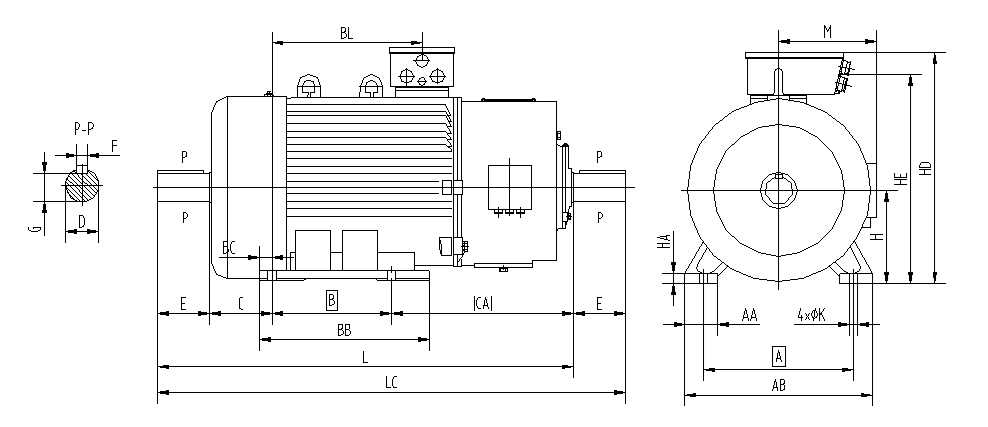
YZR (450-560) Series Wound Rotor Three-Phase Asynchronous Motors for Crane and Metallurgical Applications
Jiamusi Electric Machine Co., Ltd.