UNSW Develops Spectrally Selective Solar Module with 34% Increase in Electrical Output
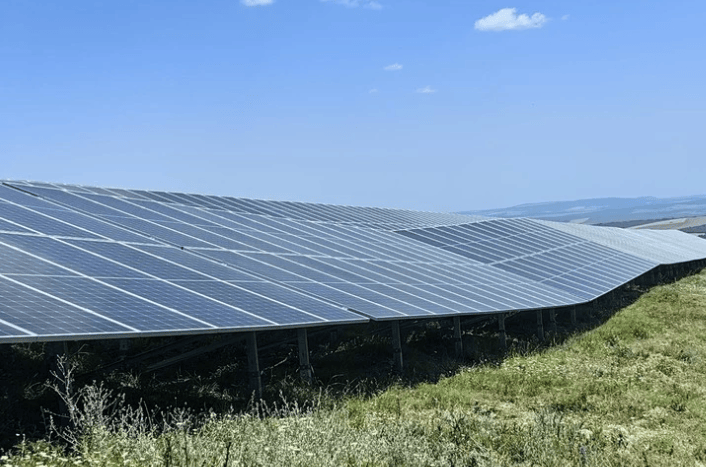
en.Wedoany.com Reported - Researchers at the University of New South Wales (UNSW) have developed a spectrally selective semi-transparent crystalline silicon (c-Si) solar module for agrivoltaics.
To ensure sufficient light for protected crops, current mainstream semi-transparent photovoltaic modules arrange opaque c-Si cells with gaps to allow sunlight through transparent glass areas. However, plants only utilize a limited portion of the solar spectrum (the photosynthetically active radiation, or PAR, approximately 400-700 nm) to drive photosynthesis. Existing modules transmit a large amount of solar spectrum not needed by crops (especially near-infrared wavelengths), which could otherwise be used for electricity generation—c-Si cells are highly efficient at converting near-infrared light. Corresponding author Ian L. Thomas stated that the team embedded spectrally selective optics into the gaps between cells in semi-transparent photovoltaic modules. "These embedded optics can redirect near-infrared light to c-Si cells for power generation while still allowing a high proportion of PAR to pass through. The particular appeal of this approach is that it cleverly combines existing large-area dichroic technology used in the building industry with current manufacturing processes used in photovoltaic module assembly."
The module employs TOPCon solar cells and distributed Bragg reflectors (DBR), embedded in a dual-glass structure, and adopts a flat-plate concentrator geometry to achieve efficient spectral separation through total internal reflection. DBR consists of alternating layers with different refractive indices. By precisely designing the layer thickness, constructive interference of reflected light waves occurs, achieving peak reflectivity exceeding 99.9% within the target wavelength range. The researchers evaluated two commercial DBR technologies—silver-dielectric coatings and multilayer polymer films. They found that multilayer polymer films provided higher near-infrared reflection, negligible light absorption, and sharper spectral selectivity, making them particularly attractive for the proposed module concept. The module also relies on a V-groove flat-plate concentrator, which uses a series of tilted reflective structures to redirect incident sunlight toward the central area. In the proposed configuration, these tilted surfaces direct near-infrared light toward the glass substrate at angles that achieve total internal reflection, thereby trapping light inside the module.
The researchers used MATLAB software to build a comprehensive optical model to evaluate annual module performance, comparing it with traditional opaque photovoltaic modules and semi-transparent photovoltaic modules with the same cell coverage. Performance was assessed based on optical efficiency, electrical conversion, and PAR transmission. The model assumed ideal operating conditions, simplifying several factors including cell voltage variations, temperature effects, rear-side illumination, and crop-specific light responses, focusing primarily on short-circuit current density. Simulations conducted at three locations in Australia showed that under direct irradiation, the module achieved a 34% increase in electrical output compared to traditional semi-transparent photovoltaic modules, while maintaining high PAR transmission. Performance strongly depended on the solar incidence angle relative to the V-groove orientation, with stable behavior along the groove direction but reduced efficiency laterally due to total internal reflection constraints. The design efficiently transmits PAR needed by crops while redirecting near-infrared light to photovoltaic cells for power generation.
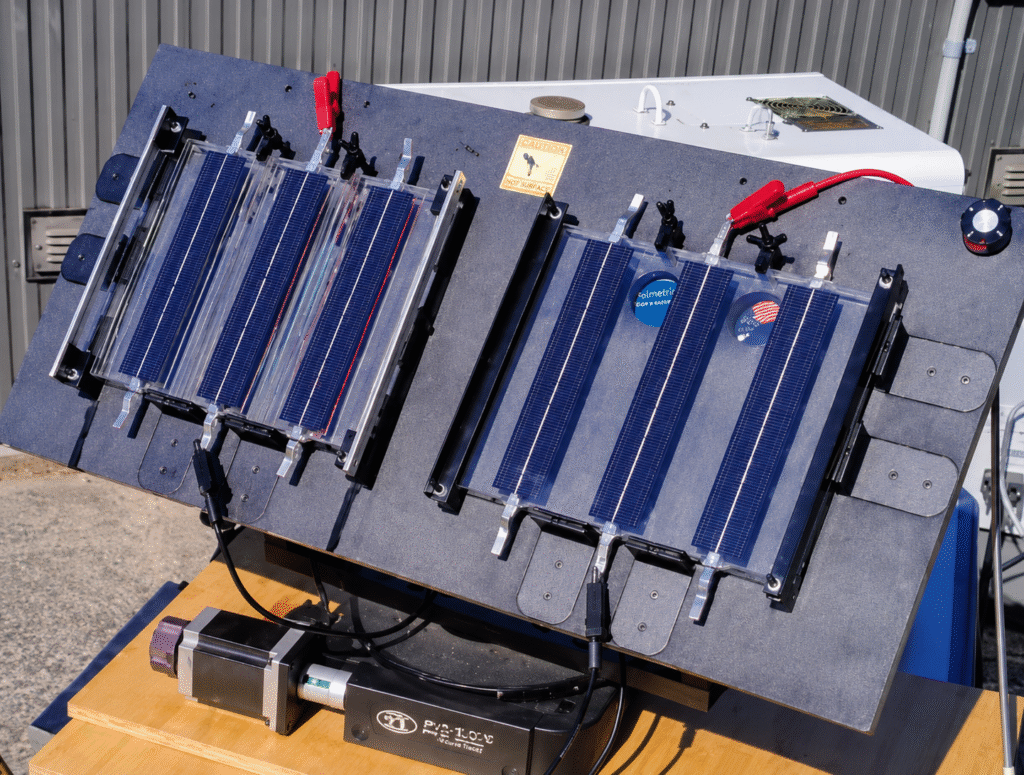
Results further indicated that multilayer polymer DBR films provided the best overall balance. For modules with 50% cell coverage, the annual short-circuit current increased by approximately 23-27%, while designs with 38% coverage achieved gains of 34-40%. In all cases, over 90% of PAR was retained, while approximately 80% of near-infrared radiation was redirected for power generation. Thomas stated that the team has built a first-stage prototype about half the size of an A4 sheet of paper and confirmed performance through testing; by filtering out approximately 80% of near-infrared light, the technology can reduce crop surface temperatures in semi-arid regions, thereby decreasing water consumption. The module technology is described in "Spectrally selective c-Si agrivoltaic modules: Evaluating a new approach," published in Applied Energy.