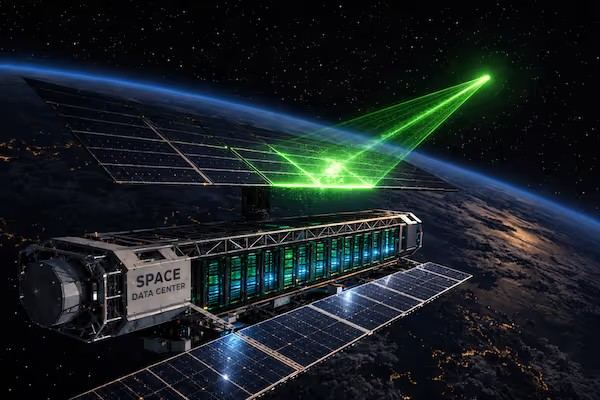
en.Wedoany.com Reported - US space energy infrastructure startup Mantis Space has proposed building the world's first "Orbital Power Grid," planning to transmit electricity to other satellites via lasers, aiming to change the current energy supply model that relies on large-capacity batteries.
Global consulting firm McKinsey & Company predicts that the space economy will reach $1.8 trillion by 2035. With declining launch costs and advancements in satellite technology, the competitive focus has shifted from rocket and satellite launches to infrastructure supporting a sustainable space economy, such as power grids, communications, and data centers. Currently, most satellites enter Earth's shadow approximately every 90 minutes, spending tens of minutes without sunlight, necessitating large-capacity batteries.
Founded in 2025 and headquartered in Albuquerque, New Mexico, USA, Mantis Space calls itself a "Space Energy Company." The company's vision involves satellites launched into Medium Earth Orbit (MEO) generating and storing solar power, then transmitting it via military-grade high-precision lasers to satellites with insufficient power. According to the company's website, once commercialized, this technology would eliminate the need for large-capacity batteries on satellites, reducing launch weight and freeing up space for more observation or communication equipment, extending satellite lifespan from the current 3 to 5 years to 10 to 12 years.
Co-founder and CEO Eric Truitt stated in Forbes magazine that SpaceX, through the Falcon 9 rocket, has ushered in an era where anyone can access space, with startup costs for space ventures dropping from hundreds of millions of dollars to between $5 million and $15 million. The company initially considered transmitting power to Earth, but co-founder and COO Jeremy Scheerer deemed that concept unrealistic, as it would require building ultra-large power generation facilities to compete with cheap ground-based electricity, leading them to pivot to supplying power in space.
The technology development team includes researchers who have worked on iPhone optical technology, the James Webb Space Telescope's optical system, and Google's next-generation display technology. Huch Wyman Howard III, who spent 32 years working on national security space projects for the U.S. Navy, joined as co-founder and Chairman, noting that the biggest limitation for national security missions in space is power, and a stable power supply would expand the scope of space utilization.
Mantis Space's partners include venture capital firms such as Mentor Capital, Rule 1 Ventures, Hatch Bridge Incubator, and Planet Ventures. Maureen Haverty, investment lead at space-focused VC Seraphim Space, pointed out that in the aerospace sector, it was previously sufficient to prove technical feasibility, but now commercial profitability must also be demonstrated. Additionally, the U.S. government's space defense system and the "Golden Dome" construction project, direct-to-cellphone services, and space computing technologies are considered next-generation investment areas, with orbital data centers seen as key infrastructure candidates for AI-era computing demands.
The space power grid concept faces multiple technical challenges, including energy loss during laser transmission, precise long-distance targeting, reception efficiency, and thermal management. The company plans to launch its first satellite in 2028 to validate space power transmission technology. If these challenges are resolved, the space power grid is expected to create new markets in areas such as AI data centers, lunar bases, deep space exploration, and military satellite operations.