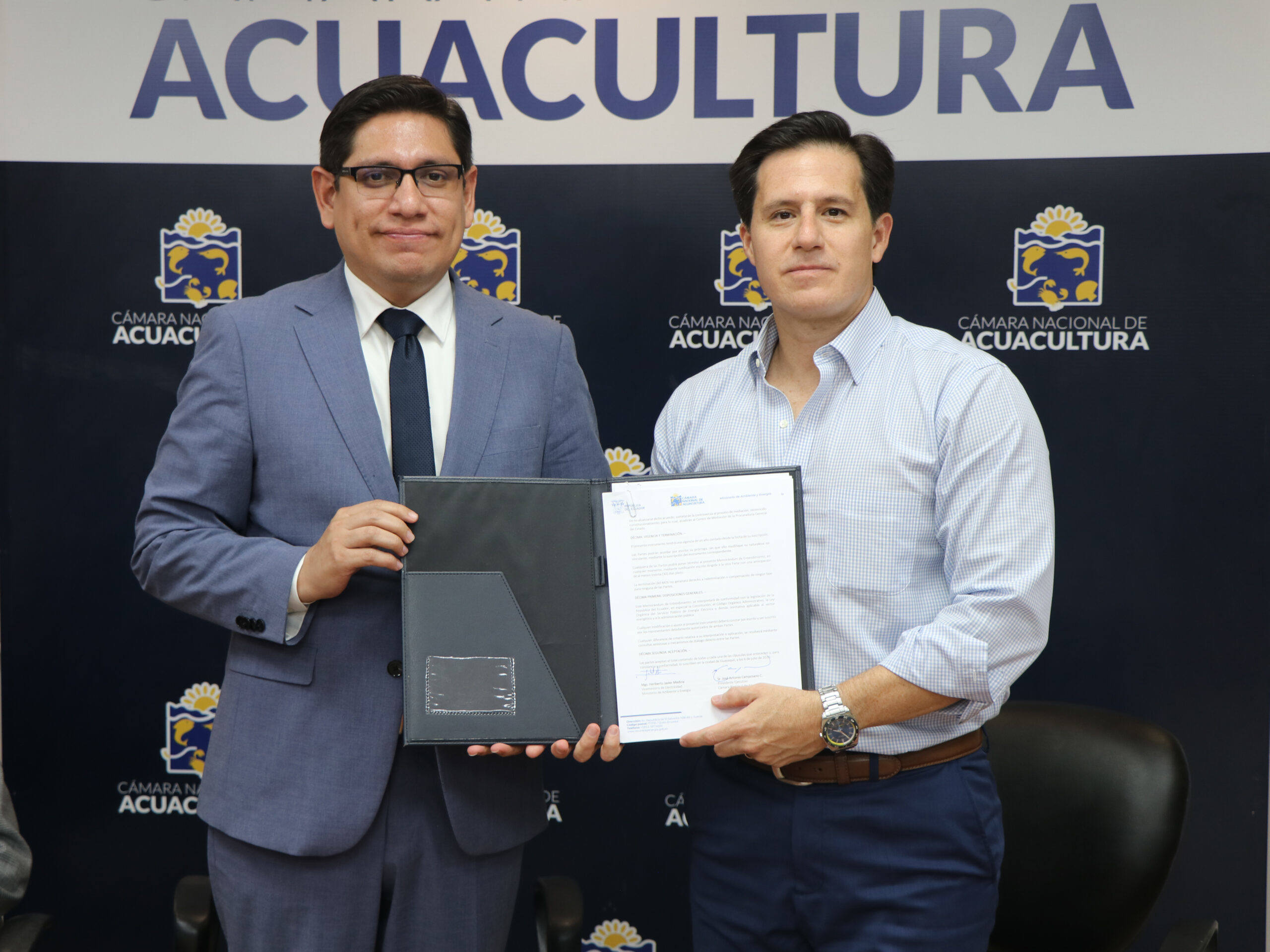
en.Wedoany.com Reported - The National Aquaculture Association of Ecuador (Cámara Nacional de Acuacultura, CNA) and the Ministry of Environment and Energy (Ministerio de Ambiente y Energía, MAE) have signed the "Memorandum of Understanding for Energy Strengthening of the Ecuadorian Aquaculture Sector" (Memorándum de Entendimiento para el Fortalecimiento Energético del Sector Acuícola Ecuatoriano). Both parties will jointly launch a work plan to promote electrification in the aquaculture industry, strengthen energy infrastructure, and facilitate investment to enhance the competitiveness of this key national export sector. This memorandum is the result of collaborative efforts among CNA, the Export and Investment Promotion Corporation (Corporación de Promoción de Exportaciones e Inversiones, Corpei), the Sustainable Shrimp Partnership (SSP), MAE, the National Electricity Regulatory Agency (Arconel), and the National Electricity Company (CNEL).
After more than six months of work by technical working groups, CNA, with support from Corpei and in coordination with the Energy Front (Frente Energético), developed a technical diagnostic report identifying the main barriers to accelerating industry electrification. This process resulted in a roadmap comprising 16 strategic actions organized around four pillars: Regulatory Strengthening and Connectivity; Technological Optimization and Critical Infrastructure; Electricity Tariffs and Environmental Sustainability; and Strategic Investment and New Energy Models.
During the signing, José Antonio Camposano, Executive President of the National Aquaculture Association, emphasized that this agreement represents a paradigm shift in the private sector's role in national energy development. He noted that electrification is a key factor in enhancing the competitiveness of Ecuadorian shrimp and stated that the roadmap aims to create conditions for active private investment participation in addressing national energy challenges. He also pointed out that this memorandum will accelerate the implementation of technical and regulatory mechanisms necessary for investments benefiting both the aquaculture sector and national energy development.
Heriberto Javier Medina, Vice Minister of Electricity and Renewable Energy at the Ministry of Environment and Energy, stated that strengthening the electricity system requires close collaboration between the public and private sectors. He reaffirmed MAE's willingness to participate in regulatory reviews, streamline processes, and create conditions to meet the growing energy demands of the production sector, emphasizing the national commitment to driving necessary regulatory adjustments to promote new investments and improve electricity system efficiency.
The plan comprises four action pillars. The first pillar prioritizes regulation and connectivity by standardizing electrical connection processes, establishing an industry technical committee, reviewing surplus electricity grid injection standards, and regulating new high-power aquaculture loads. The second pillar focuses on special situations and critical resources, with measures to accelerate agreement signing, coordinate transmission and distribution connections, introduce energy credits, and promote bilateral energy contracts. The third pillar addresses electricity tariffs and environmental sustainability, including developing standard contracts by power range, revising self-consumption and surplus electricity injection regulations, and establishing environmental windows to simplify procedures and avoid overlaps with local governments and municipalities. The fourth pillar encompasses strategic infrastructure and new models, leveraging investments from the Inter-American Development Bank (IDB) and the Andean Development Corporation (CAF) to strengthen substations and launching pilot projects for Autonomous Energy Districts (Distritos Autónomos de Energía) in key areas such as Durán, Posorja, and Isla Puná.
At the signing ceremony, key promoters of the initiative participated, including Pamela Nath, Director of the Sustainable Shrimp Partnership (SSP); Lourdes Luque de Jaramillo, Deputy Advisor at Corpei and General Coordinator of the National Aquaculture Association's projects; Vianna Maino, Head of Regulatory and Regulatory Affairs in the Energy Sector; and Iván Rodríguez, Head of Technical Affairs for the projects. Their work was crucial in developing the diagnostic report and roadmap, which now guide the sector's energy transition.
Currently, less than 10% of shrimp farming operations use electricity, while 90% still rely primarily on diesel to power pumps and aeration systems. This memorandum aims to lay the foundation for accelerating the transition to a more efficient, sustainable, and competitive energy structure by modernizing the regulatory framework, simplifying grid connection processes, strengthening electricity infrastructure, promoting self-consumption, and expanding private investment. These actions will help reduce operational costs, strengthen energy security in production areas, and consolidate the international competitiveness of Ecuadorian shrimp.