en.Wedoany.com Reported - Ant Lingbo Technology has upgraded and open-sourced the next-generation embodied foundation model, LingBot-VLA 2.0. This version incorporates 60,000 hours of high-quality real-world physical data during the pre-training phase, covering 20 robot configurations from 17 mainstream robot brands, and expands support for degrees of freedom including the head, waist, end-effector, and mobile chassis.
In the current embodied intelligence industry, the "cerebellum" and hardware bodies are evolving rapidly, but the industry's "general-purpose brain" remains the core bottleneck for large-scale industrial deployment. Breakthroughs are urgently needed in model capabilities, deployment efficiency, and cost.
According to the technical report, the robot brands supported by LingBot-VLA 2.0 during the pre-training phase include 17 manufacturers such as Leju, Zhiyuan, Yushu, Songling, Xinghaitu, Galaxy General, Xingchen, Realman, Franka, Ark, Beijing Humanoid, Fourier, Magic Atom, Qianxun, Zero Power, Flexiv, and Qinglong, covering various forms such as single-arm/dual-arm, bipedal/wheeled, and others.
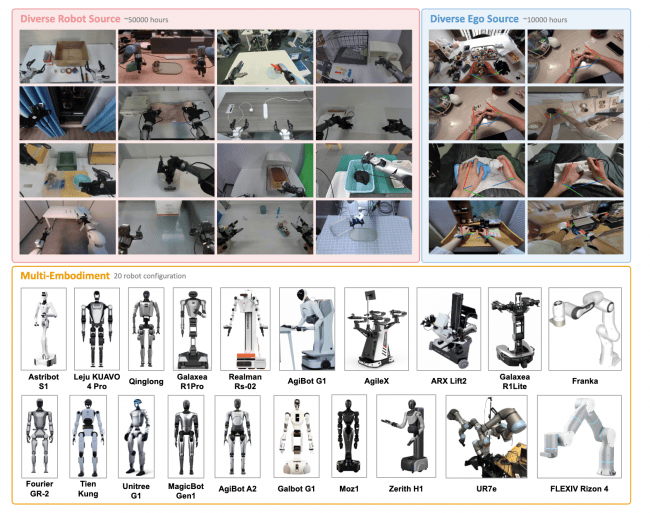
In terms of degree of freedom support, LingBot-VLA 2.0 has comprehensively expanded support for degrees of freedom including the head, waist, end-effector (hand), and mobile chassis.
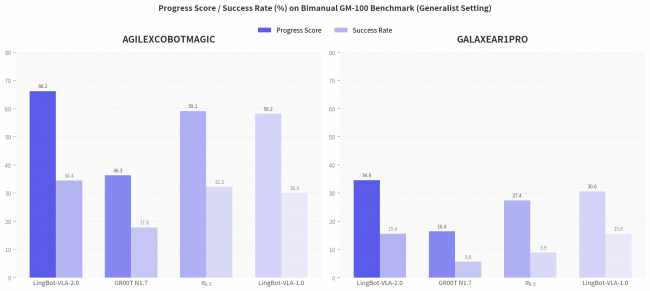
In dual-arm operation, based on the Shanghai Jiao Tong University GM-100 evaluation, on the AgileX Cobot Magic and Galaxea R1 Pro dual-arm robot platforms, LingBot-VLA 2.0's overall average task progress score and success rate both exceeded those of π0.5 and GR00T N1.7. In this evaluation, all participating models were deployed as a single general-purpose model without specific fine-tuning for particular tasks. This result indicates that LingBot-VLA 2.0 possesses stronger dual-arm collaborative operation capabilities and cross-embodiment, multi-task generalization abilities.
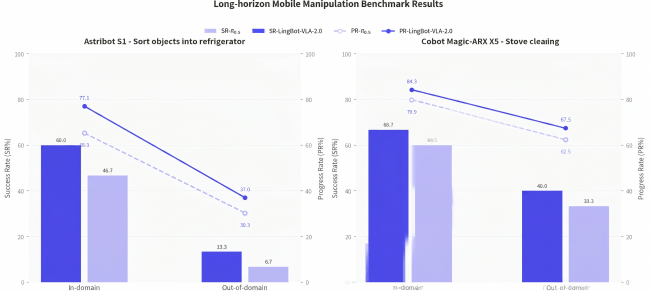
In terms of mobility, LingBot-VLA 2.0 was compared with π0.5 in preliminary tests using two configurations: the Ark robotic arm with a Songling chassis and the Xingchen Intelligent Astribot S1. The results show that LingBot-VLA 2.0 achieved improvements in both task progress score and success rate in long-horizon mobile manipulation tasks, particularly maintaining an advantage in more challenging cross-domain scenarios, demonstrating stronger long-sequence task progression capabilities and mobile manipulation generalization.
In the mobile manipulation evaluation, tasks were broken down into multiple consecutive sub-steps, each assigned a different score based on difficulty and importance. The robot earned corresponding scores upon completing each step, with the final total score reflecting its task progression ability in long-sequence tasks. Compared to simply calculating the final success rate, this scoring method provides a more detailed measure of the model's comprehensive capabilities in areas such as movement, dual-arm collaboration, grasping, placing, door opening, and cleaning.
Supporting these capability upgrades is a larger-scale, higher-quality data system and a better training architecture: Ant Lingbo cleaned 50,000 hours of high-quality real-world robot data from 90,000 hours of data, and extracted 10,000 hours of effective data from 20,000 hours of first-person human operation data, bringing the total pre-training data to 60,000 hours.
The industry is now gradually entering the pilot phase of industrial deployment, where efficient post-training has become a key limiting factor for deployment. LingBot-VLA 2.0 simultaneously open-sources a more efficient post-training version, with inference time controlled within 130 milliseconds on an RTX 4090.
Ant Lingbo, together with ecological hardware partners such as Leju and Taihu, as well as ecological customer partners like Guoda Pharmacy and Longsheng, has initiated comprehensive commercial deployment tests in scenarios such as retail sorting, logistics sorting, and industry. At the same time, Ant Lingbo, in collaboration with data alliance ecological partners like Jianzhi Technology, is building a standardized data system. An embodied intelligence ecosystem centered on a cross-configuration VLA foundation model, with deep participation from hardware manufacturers and data institutions, is taking shape.
Currently, LingBot-VLA 2.0 is open-source. Developers can obtain model weights on Hugging Face and ModelScope, and download the open-source code on GitHub. In the next step, Ant Lingbo will also launch a series of developer activities and simultaneously release a technical suite more suitable for developers.