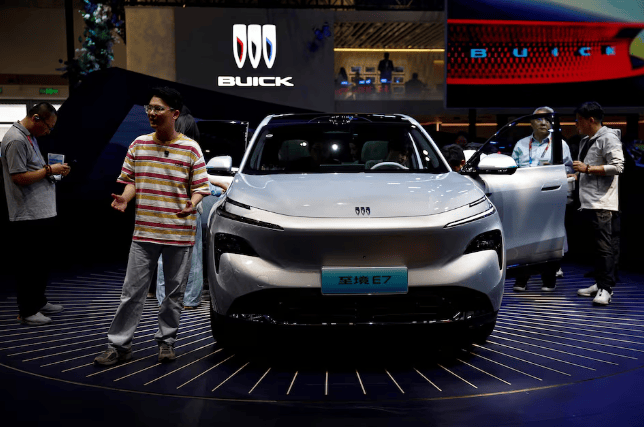
en.Wedoany.com Reported - General Motors has achieved a breakthrough in the Chinese market: the new Buick Electra E7 surpassed 10,000 units in sales during its first month on the market. Although the model bears the Buick brand, its development, design, and manufacturing were all completed in China, developed by a research center jointly operated by GM and its local partner SAIC Motor.
According to a source with direct knowledge, GM plans to export this model to South Korea and adopt its China-developed platform for the next-generation Cadillac Optiq. Currently, GM, Volkswagen, and Renault are entrusting development work to Chinese engineers, leveraging China's growing advantages in key technology areas such as electric drive systems and advanced software. Zhu Yulong, a former GM China engineer and now an independent automotive analyst, stated that for the Electra project, "product definition and technology roadmap were firmly in the hands of the Chinese team for the first time." A GM China spokesperson declined to comment on potential export plans or future market layouts but stated that the company is focused on developing vehicles and technologies that resonate with consumers in China and globally.
The new Buick Electra adopts the "Xiaoyao" platform developed by engineers at the Pan Asia Technical Automotive Center (PATAC), a joint venture between SAIC and GM. According to SAIC-GM, the center employs approximately 3,000 people. The term "Xiaoyao" originates from Taoism, meaning "unrestrained." The platform features a 900-volt supercharging system and a plug-in hybrid powertrain, with fuel economy reportedly leading the market. The Electra, based on the "Xiaoyao" platform, has achieved great success in the Chinese market, while models based on the Ultium platform have seen sluggish sales. Shifting R&D to China helps traditional automakers enhance their technological capabilities.
The Twingo E-Tech compact car, developed at Renault's Shanghai Technology Center, is already being produced and sold in Europe. The project took only 21 months from development to launch, a timeline Renault Chief Technology Officer Philippe Brunet called "outstanding." South Korea's Hyundai Motor is also investing in China, planning to make the country a hub for R&D and exports. Volkswagen's Audi brand has announced the establishment of an R&D center, which will have full autonomy over the development of its new brand "AUDI" in China. Stefan Poetzl of SAIC Audi stated that this move stems from the early success of the AUDI E5 Sportback, marking a shift from adapting German technology for China to a new development model. The vehicle is equipped with "intelligent air suspension," which uses sensors to predict vertical motion for a smoother ride—a feature popular among Chinese drivers. Its competitor, the Mercedes-Benz CLA (based on a globally developed German platform and adapted for China), lacks this feature. According to data from automotive consultancy ThinkerCar, since its launch at the end of 2025, the E5 has outperformed the CLA in the Chinese market, with average monthly sales of 910 units compared to 296 for the CLA. Audi currently has no plans to export the E5 from China, but European automotive enthusiasts questioned on social media late last year why the car is not sold in Europe.
Chang Yan, founder of electric vehicle blog Supercharged, stated that global automakers need to conduct R&D in China because overseas headquarters are often "not quick enough to respond to pain points in the Chinese market." The German Chamber of Commerce in China reported that the share of R&D conducted in China for both local and global markets within the German automotive industry has jumped from 12% to 33% in two years.
Delegating R&D to China has raised concerns among automakers about brand consistency, especially for brands known for "German engineering." Audi addresses this issue through a dual-brand strategy in China: technology from the new R&D center is used for the letter-based "AUDI" brand, while the traditional four-ring brand continues to use German-developed technology. In a statement to Reuters, Audi said the strategy "differentiates positioning, target customers, and corresponding technical solutions for each brand." Analysts and executives note that shifting R&D could also trigger internal cultural conflicts or even political backlash. Gartner's Pacheco stated that transferring too much intellectual resources could harm automakers' local ecosystems (including suppliers) and be politically perceived as a strategic loss. The Renault Twingo project faced questions from headquarters about quality standards and the long working hours of Chinese engineers, prompting Renault to begin rotating French engineers to China. Renault CTO Brunet said: "The more they come, the better it is for us, because when they return to France, they explain the situation here."