en.Wedoany.com Reported - Against the backdrop of a large-scale fleet renewal in the US passenger rail industry, experts from Amtrak, Hitachi Rail, and Arup agreed at the APTA Rail Conference that electrification remains the ideal solution where feasible. However, advancements in battery systems, hybrid technology, and modern rail vehicle technology are providing operators with more options to address aging fleets and partially electrified networks.
In the coming years, Amtrak will introduce three major fleets: the NextGen Acela trains, the new Airo trainsets, and eventually a new long-distance fleet. Together, these three projects represent one of the largest investments in rail vehicles in Amtrak's history.
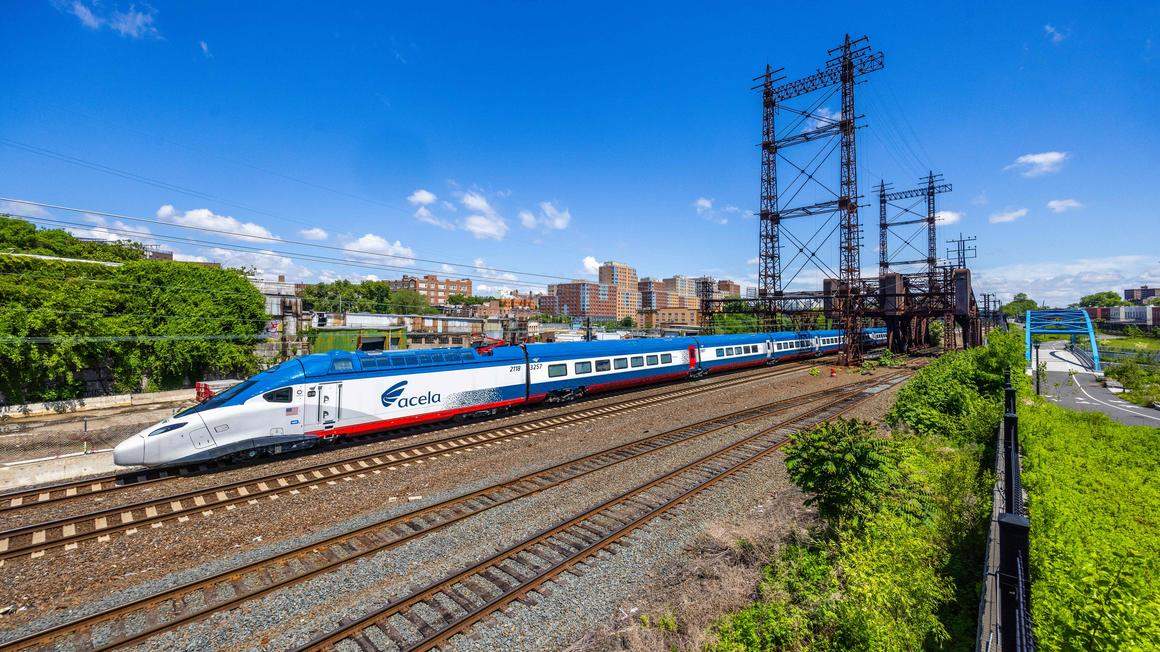
Chris Jagodinski, Vice President of Operations at Amtrak, noted that the original Acela fleet, introduced in 2000, fundamentally transformed intercity travel along the Northeast Corridor. These trains travel up to 900 miles per day and accumulate as many as 28,000 miles per month. The demanding operating cycle prompted Amtrak to decide on procuring a replacement fleet, deliberately opting for proven technology over experimental designs. The new Acela trains will increase seating capacity from 304 to approximately 360, while each trainset is only about 20 feet longer. This design is critical for the space-constrained Northeast Corridor, where platforms, maintenance facilities, and urban real estate offer little room for expansion. Of the planned 28 trainsets, 15 have been delivered, with testing and commissioning ongoing.
The Airo series will replace Amfleet coaches dating back to 1974 and 1975. The base Airo order includes 83 trainsets, with configurations tailored to different corridors across the national network. A notable feature of this replacement plan is the dual-power architecture of the new fleet. Amtrak, in collaboration with Siemens, has adapted the ALC-42 platform into the ALC-42E. An auxiliary power vehicle (APV) located behind the locomotive carries transformers and electrical equipment, allowing the train to draw power from overhead catenary when available, while retaining traditional diesel capability elsewhere. This concept reduces equipment complexity while significantly enhancing operational flexibility. Trains no longer need to change locomotives at Washington Union Station and can switch between electric and diesel operation within minutes. Dual-power operation reduces idle time, simplifies fleet management, and improves resilience during power outages or infrastructure disruptions. Jagodinski stated that dual-mode trains eliminate all locomotive changes; previously in Washington, D.C., the process of changing locomotives took a long time, but now end-of-train operations can be completed in minutes. Of the 83 Amtrak Airo trainsets ordered from Siemens Mobility, 50 are dual-power units.
Amtrak is also laying the groundwork for replacing its long-distance rail vehicles. Procurement efforts are underway, with manufacturer proposals expected later this year, aiming to finalize a contract by the end of 2027. The project could ultimately encompass approximately 800 vehicles, making it one of the largest passenger rail vehicle procurements in North America. This project will replace most of Amtrak's aging long-distance fleet, much of which dates back to the 1970s and 1980s.
The conference also discussed the role of battery technology. Alessandro Vannucchi, Head of Product Portfolio Management at Hitachi Rail, emphasized that battery technology is becoming a practical complement to traditional electrification. He acknowledged that electrification remains the broad solution but noted that battery trains require almost no modifications to existing infrastructure and can bridge non-electrified sections. Consequently, Hitachi Rail's strategy is modular, developing scalable battery packs that can replace diesel power modules or be integrated into new multiple units. This technology is already in commercial service in Europe, including Italy's Blues trains, which combine electric, diesel, and battery operation within a single platform. The latest variant completely eliminates the diesel engine, replacing it with battery packs exceeding 600 kWh, achieving a range of nearly 100 kilometers between charges.
This development is driven by the rapid maturation of battery technology over the past decade. Vannucchi stated that battery energy density has increased by approximately 60%, and improvements in battery management systems, thermal protection, and recovery strategies are making this technology increasingly attractive for regional rail operations. In the United States, where most of the passenger rail network remains unelectrified and full-corridor electrification is often costly, these advancements are significant. Battery-equipped trains offer operators a practical pathway to reduce diesel operations, bridge gaps between electrified sections, and modernize regional services without the cost and disruption of installing full overhead catenary.
As a zero-emission alternative power source, Luv Sehgal, Senior Rail Engineer at Arup, introduced hydrogen technology. Sehgal did not present hydrogen as a universal solution but explored its operationally significant aspects. Much of the world's railways, including those in the United States, remain unelectrified, and on some low-density lines, installing overhead catenary may not be commercially justified. For these corridors, hydrogen can provide a zero-emission alternative to diesel.
Sehgal's presentation highlighted hydrogen's advantages of high energy density and long operating range, while acknowledging the need for substantial infrastructure, including electrolyzers, storage facilities, and specialized refueling stations. He also questioned the assumption that hydrogen should primarily be a retrofit technology. Studies comparing the retrofitting of old diesel multiple units with new electric multiple units suggest that designing purpose-built hydrogen trains offers better system integration than attempting to retrofit aging diesel fleets.
Overall, a recurring conclusion from the three presentations was that there is no one-size-fits-all answer to selecting the right technology. Sehgal summarized that there is no silver bullet technologically; it depends on specific conditions. Low-frequency, medium-to-long-distance routes may favor hydrogen, while high-frequency, high-speed operations remain best suited for traditional electrification. Meanwhile, battery systems are becoming increasingly modular, scalable, and adaptable, allowing operators to tailor vehicles for individual corridors. Amtrak's Airo project reflects this philosophy, as the railroad is not focusing exclusively on one propulsion technology but deploying electric, diesel, and battery capabilities within an integrated fleet architecture.