University of Waterloo Develops 20-Minute 3D Printed Custom Contact Lens Technology
en.Wedoany.com Reported - Researchers at the University of Waterloo in Canada have developed a digital manufacturing platform that combines a novel silicone material with 3D printing technology, capable of producing patient-specific contact lenses in 20 minutes. This technology makes it possible to design, manufacture, and dispense custom lenses during a single optometry visit.
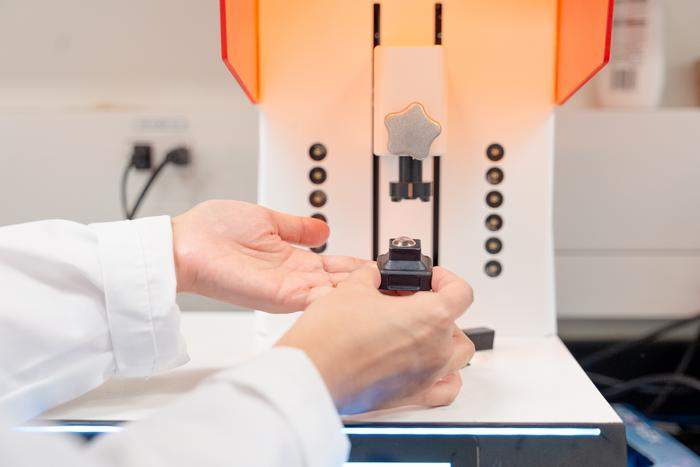
Currently, most contact lenses are available in a limited range of sizes and shapes and are not customized for individual eyes. While soft lenses are suitable for most wearers, patients with irregular corneal shapes often require rigid lenses for clear vision, and the process of finding the right lens can take weeks or months, involving multiple appointments.
A research team from the Department of Chemistry at the University of Waterloo developed a digital manufacturing platform to address this challenge. The platform integrates custom lens design software, a novel hydrophilic silicone material, and advanced 3D printing technology. Traditional silicone materials are typically incompatible with 3D printing, so the team designed a new formulation specifically for additive manufacturing, achieving precise shaping while maintaining the safety, biocompatibility, and high oxygen permeability of silicone. Dr. Sayan Ganguly, a chemistry research associate, explained that the inner surface of the lens designed by the software precisely matches the patient's cornea, while the outer surface provides the required vision correction. To address the tiny step-like defects on curved surfaces generated during the layer-by-layer construction of 3D printing, the team also developed an ultra-thin, non-contact coating process that smooths the surface without altering the lens's custom shape or optical performance.
Dr. Shirley Tang, a professor in the Department of Chemistry, stated that this technology makes truly personalized contact lenses possible, achieving a precise fit while also offering the optical clarity and mechanical properties expected of commercial contact lenses. Laboratory tests have confirmed the material is biocompatible, and the team is preparing for in vivo studies. The researchers have filed a provisional patent for the novel hydrophilic silicone material and are in the process of applying for a formal patent.
The research team is collaborating with the Centre for Vision and Eye Research (CEVR), jointly established by the University of Waterloo and The Hong Kong Polytechnic University, to advance the technology toward commercialization. The project won a gold medal at the Shanghai International Invention Exhibition in June 2026.