Hanwha Systems invests 30 billion won to develop tandem solar cells for satellites
en.Wedoany.com Reported - Hanwha Solutions' Qcells division is collaborating with Hanwha Systems to expand its high-efficiency cell technology, accumulated in the terrestrial solar energy sector, to space applications, jointly developing tandem solar cell and panel technologies for satellites.
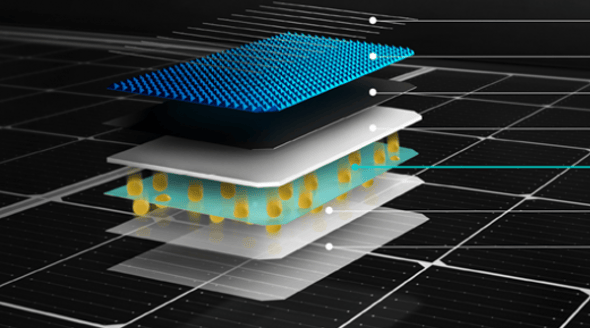
The two companies signed an agreement on July 15, aiming to combine Hanwha Systems' space business capabilities with Hanwha Solutions' high-efficiency solar cell technology. As the global space industry restructures around low Earth orbit satellite constellations and artificial intelligence and data services, the importance of satellite power solutions is increasing.
Under the agreement, Hanwha Systems will invest a cumulative total of 30 billion Korean won in research and development for satellite tandem solar cells over approximately 2.5 years, from 2026 to 2028. Hanwha Solutions will be responsible for core research and development, including high-efficiency cell design, performance enhancement, and reliability verification in space environments, as well as developing power solution technologies suitable for satellite environments to establish a foundation for commercialization.
Hanwha Solutions will focus on customizing power solutions for ultra-low Earth orbit applications. This orbital environment requires a balance of power efficiency, structural lightweighting, and durability against radiation and atomic oxygen. The company plans to master comprehensive space power solution capabilities encompassing high-efficiency tandem solar cells, encapsulation, and panel suitability verification.
Both parties will also conduct space demonstrations using actual launch vehicles, aiming to verify tandem solar cells under space conditions and achieve initial demonstration records. After technical verification through a test satellite, the goal is to secure initial space applicability by 2028. After 2029, tandem cells will be applied to actual satellite missions, entering the commercialization phase in conjunction with Hanwha Systems' project to build a satellite constellation consisting of 64 ultra-low Earth orbit, very high-resolution synthetic aperture radar satellites at the 0.15-meter class.
The two companies plan to extend the technologies obtained from this project to broader future space environments, such as low Earth orbit and medium Earth orbit, aiming to enhance the competitiveness of comprehensive solutions in the global space power market. Park Seung-deok, head of Hanwha Solutions' Qcells division, stated that this collaboration is an important starting point for Qcells to expand its high-efficiency solar cell technology into the space industry. The company will improve the performance and reliability of satellite power solutions and, based on the convergence of the space and renewable energy industries, create new growth opportunities in the global space power market.
Related Products


Industrial and Commercial Point-Type Gas Detector
Jinan Benan Technology Development Co., Ltd.

Floating Boat Water Quality Automatic Monitoring System
Hebei Sailhero Environmental Protection High-tech Co., Ltd.
220kV Composite Outdoor Cable Terminal
Shenyang Guolian Cable Accessories Manufacture Co., Ltd.
G.652.D Wavelength-extended Non-dispersion Shifted Single-mode Optical Fiber
HONGAN GROUP CO., LTD.
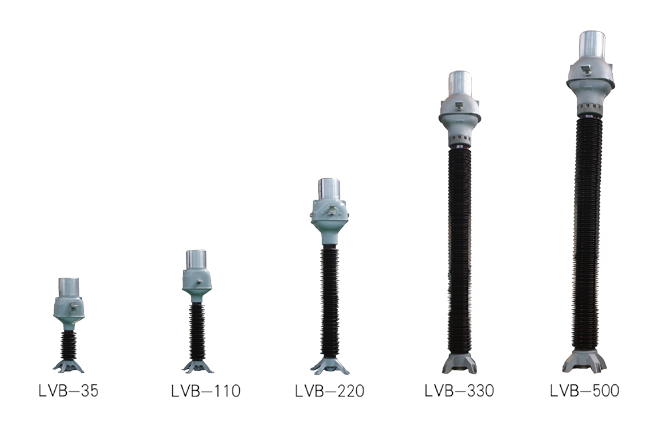
LVB Series 35-500kV Oil-immersed Inverted Current Transformer
Shandong Taikai Instrument Transformer Co., Ltd.