en.Wedoany.com Reported - The School of Engineering at Trinity College Dublin, in collaboration with construction technology company Harcourt Technologies Ltd (HTL.Tech), has demonstrated Ireland's first cement-free 3D-printed geopolymer. Conducted at the HTL.Tech facility, the trial confirmed that this reddish-brown material, made from bauxite refining waste, can be successfully mixed, pumped, extruded, and printed.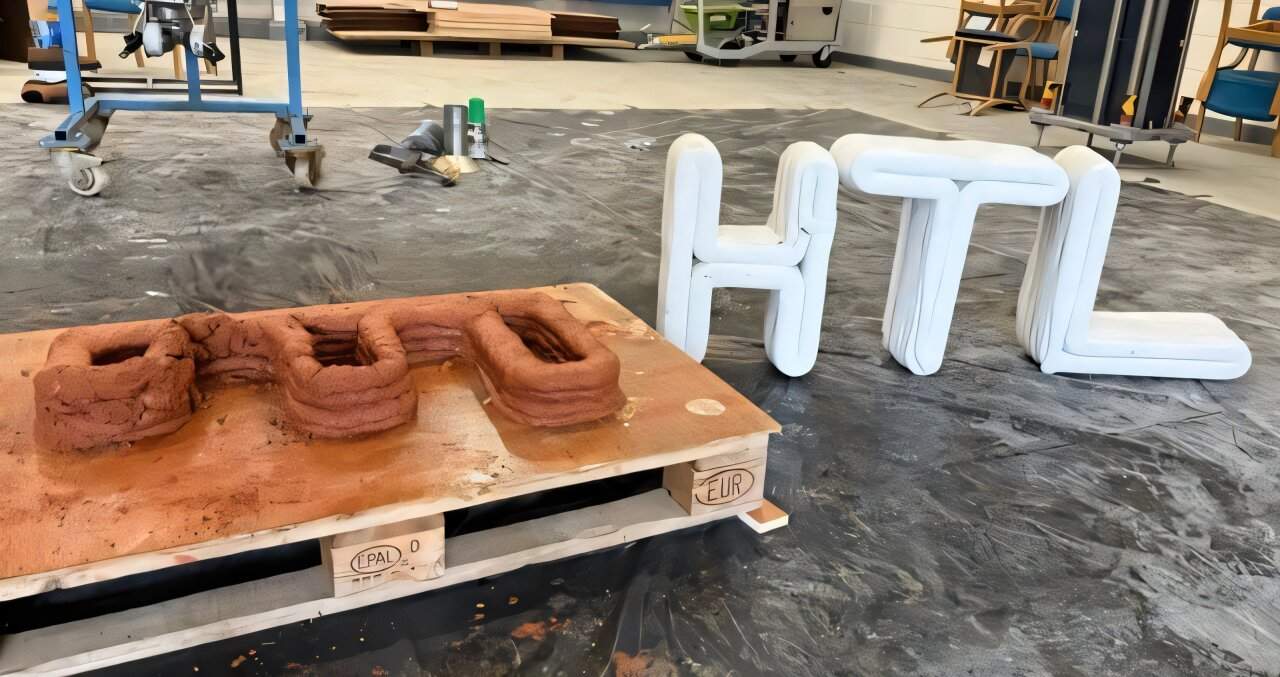
This geopolymer contains no Portland cement, and over 30% of its cement-like composition comes from local industrial waste that would otherwise require treatment, long-term storage, or landfill disposal.
Professor Sara Pavia from the School of Engineering at Trinity College Dublin stated that this successful trial demonstrates how local industrial waste can be transformed into a functional, adaptable, and visually distinctive construction material. Due to the material itself, as well as its production and printing methods, it delivers two environmental benefits: reducing reliance on carbon-intensive clinker cement and creating a high-value use for industrial waste. Preliminary assessments indicate that this material can reduce embodied carbon emissions by approximately 70% compared to traditional Portland cement concrete. The material is not limited to replacing cement; it serves as a flexible binder platform whose composition, rheology, setting behavior, and early-age properties can be tailored for different manufacturing processes and construction applications.
Compared to traditional methods, 3D-printed construction offers several advantages, including shorter project timelines, elimination of formwork and molds, and reduced material waste. The printer builds structures layer by layer based on a digital model, requiring minimal labor and enabling the production of complex curves and geometries that are difficult or costly to achieve with conventional construction.
This geopolymer trial is part of a broader study funded by Research Ireland, with industry partners including SISK, FLI Precast Solutions, McGrath Quarries, Techcrete, and Roadstone, which provide expertise in material development, concrete production, precast manufacturing, construction delivery, and digital fabrication. SISK leads the industry consortium, aiming to advance this low-carbon material from laboratory research to industrial application. The next step is to scale the geopolymer from lab batches to the volume and consistency required for industrial equipment—a step that introduces more variables. The focus will be on mechanical properties, durability, reinforcement, long-term stability, process control, and regulatory compliance.