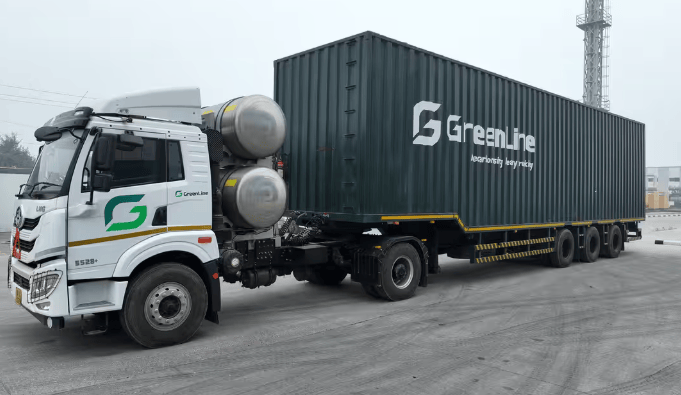
en.Wedoany.com Reported - The Ministry of Transport announced that it will build over 3,000 charging and swapping stations for electric heavy trucks along key sections of the national expressway network, promoting the "connection of points into lines and networks" for recharging facilities. At a press conference held by the State Council Information Office on July 21 on accelerating the construction of a transportation powerhouse, Cai Tuanjie, Director of the Safety Supervision Department and Transport Services Department of the Ministry of Transport, introduced a series of measures to promote the large-scale application of new energy heavy trucks.
A reporter asked at the press conference that in the first half of 2026, sales of new energy heavy trucks in China surged to approximately 140,000 units, a year-on-year increase of 78.6%, and inquired about the measures the Ministry of Transport would take to promote their large-scale application. Cai Tuanjie responded that promoting the large-scale application of new energy heavy trucks can achieve multiple goals simultaneously, including optimizing the industrial structure of new energy vehicles, improving the energy structure, driving adjustments in the transportation structure, reducing logistics costs, and supporting the high-quality development of the road freight industry. The Ministry of Transport will seize the momentum, take proactive measures, and intensify efforts to promote application.
Cai Tuanjie introduced that in May this year, the Ministry of Transport, together with 11 departments including the National Development and Reform Commission, jointly issued the "Implementation Plan for Promoting the Large-Scale Application of New Energy Heavy Trucks." The plan aims to achieve carbon peak in the transportation sector before 2030 as its core goal, proposing that by 2030, the penetration rate of new energy heavy trucks will reach 40%, with a total stock exceeding 1.6 million units. Based on current development trends, the targets may be exceeded, but relevant departments will still strive to implement them.
The Ministry of Transport will focus on four key areas in the next step. First, along the key sections of the "5 Radial, 4 Longitudinal, and 5 Horizontal" national expressway network, it will build 30,000 kilometers of zero-carbon highway transport corridors and improve the recharging network. Second, focusing on busy freight sections of national expressways and ordinary national and provincial highways, urban agglomerations such as the Beijing-Tianjin-Hebei region, the Yangtze River Delta, the Guangdong-Hong Kong-Macao Greater Bay Area, and the Chengdu-Chongqing region, as well as important nodes such as freight hubs, ports, mining areas, factory areas, and industrial parks, it will build over 3,000 charging and swapping stations for electric heavy trucks, enabling recharging facilities to "connect points into lines and networks" and addressing the shortcomings of insufficient infrastructure.
In terms of policy support, in 2026, the Ministry will continue to implement the scrapping and renewal action for old operating trucks, allocating 22 billion yuan in ultra-long-term special government bonds to support this action, with a focus on renewing them with new energy heavy trucks, leveraging the "two new" policies to boost market consumption. Additionally, it will expand the use of new energy heavy trucks in medium- and short-distance transport scenarios, accelerate the replacement of internal transfer vehicles at major freight nodes with new energy alternatives, and encourage key transport enterprises such as large transport companies, express delivery and logistics firms, and large-scale freight fleets to take the lead in adopting new energy heavy trucks on trunk highways, promoting full-scenario application.
Cai Tuanjie stated that during the "15th Five-Year Plan" period, the Ministry of Transport will focus on promoting low-carbon substitution in transportation power, advancing the green transformation of transportation infrastructure, accelerating the optimization and adjustment of the transportation structure, continuing to deepen pollution prevention and control, improving the carbon emission statistical accounting and monitoring system, and intensifying efforts to promote green and low-carbon transformation in the transportation sector.