Chinese Team Achieves Exciton State Switching in Organic Crystals with 62% Low-Temperature Quantum Yield
en.Wedoany.com Reported - A collaborative team led by Liu Hongwei from Nanjing Normal University and Ni Zhenhua from Southeast University has successfully achieved controllable switching from dark exciton states to bright exciton states in two-dimensional organic molecular crystals through precise temperature regulation, and observed superradiance effects at low temperatures.
Strong transition dipole-dipole interactions in two-dimensional organic molecular crystals cause exciton states to split into bright and dark excitons. Dark excitons, characterized by long radiative lifetimes and non-radiative properties, have potential applications in quantum information processing, Bose-Einstein condensation, and light-harvesting systems; bright excitons, due to the superradiance effect generated by spontaneous coherent emission, are suitable for on-chip optical communication, transient light-emitting devices, and high-quantum-yield organic light-emitting diodes. Therefore, precise control of these two exciton states is crucial for achieving high-efficiency luminescence and quantum applications. Recent studies have found that controlling the molecular packing mode to alter intermolecular electronic coupling strength can directly affect the energy level ordering and optical properties of bright and dark states in the exciton band. The team selected a specific aggregated state of the two-dimensional molecular crystal C8-BTBT as the research object, attempting to achieve exciton state switching through temperature regulation.
The team first constructed a specific aggregated state of the two-dimensional molecular crystal C8-BTBT. Experiments revealed that at low temperatures, the aggregation mode of the two-dimensional organic crystal transitions from H-aggregation to Hj-aggregation, thereby converting non-radiative dark excitons into radiative bright exciton states. This transition significantly enhances the material's luminescence efficiency and induces a superradiance effect at low temperatures.
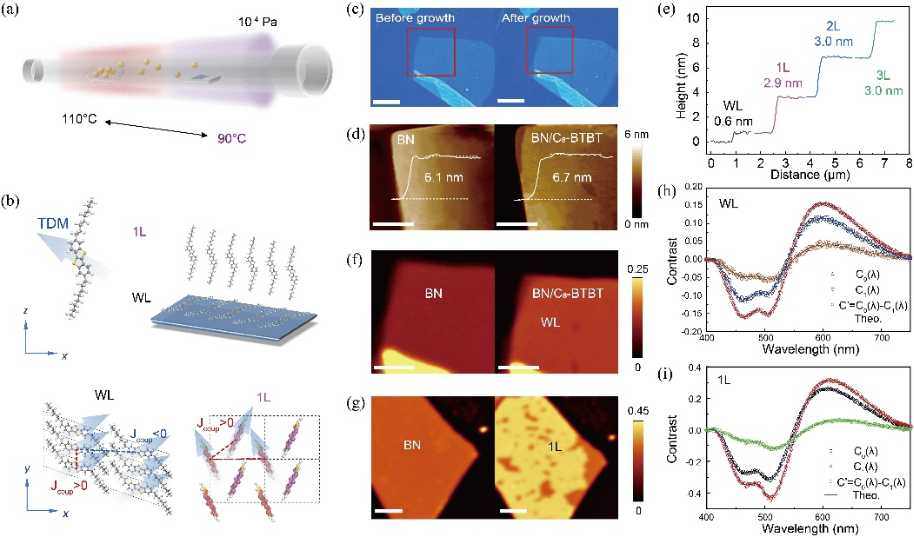
At room temperature, the research team investigated the optical properties of two-dimensional molecular aggregates using photoluminescence (PL) spectroscopy. Compared to the monomer solution, the PL spectra of all aggregated state films exhibited significant red shifts, primarily attributed to the coupling between Frenkel excitons and intermolecular charge-transfer excitons in the aggregated state. According to the Franck-Condon principle, the intensity ratio R01 of the first two PL peaks reflects the electron-vibrational coupling strength. The R01 of the wetting layer (WL, H-aggregation) was 0.75, indicating that its 0-0 transition is not completely forbidden, due to weak thermal activation effects at room temperature. In contrast, monolayer and thicker crystals (J-aggregation) exhibited PL spectra characterized by a prominent 0-0 transition, but the R01 value gradually decreased with increasing layer number.
Time-resolved photoluminescence measurements revealed fundamental differences in the exciton dynamics of the WL and monolayer crystals. The PL decay lifetime of the WL was 720 picoseconds, significantly shorter than the 2.4 nanoseconds of the monolayer, indicating that its luminescence is dominated by shorter-lived charge-transfer states. Photoluminescence quantum yield (PLQY) measurements showed that at low excitation density, the quantum yield of the monolayer was approximately 10%, while that of the WL was below 0.1%, directly attributable to the dominant H-aggregation effect in the WL, where the bottom of the exciton band is a dark state. The study also found an efficiency roll-off phenomenon in the WL at high excitation rates, as excitons cannot radiatively recombine quickly, leading to increased non-radiative channels. These results collectively indicate that the WL is inherently a low-efficiency luminescent system at room temperature.
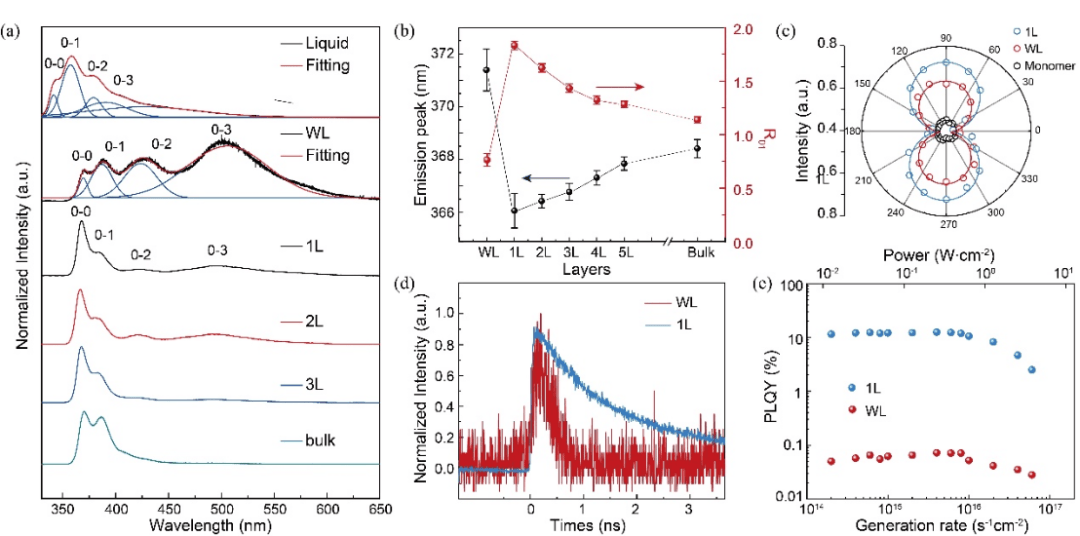
Variable-temperature PL measurements further revealed the temperature dependence of exciton behavior. As the temperature decreased, the intensity of the 0-0 emission band for both the WL and monolayer increased, the spectral linewidth narrowed, and the exciton coherence length expanded. The red shift of the WL peak position was significantly larger than that of the monolayer, suggesting a fundamental change in its band structure. Quantitative analysis showed that the 0-0 peak intensity is proportional to the square of the exciton thermal coherence number NT. At 77 K, the coherence number of the WL reached NT=78, and that of the monolayer was NT=37; at 300 K, these values decreased to NT=3 and NT=9, respectively, highlighting the extreme sensitivity of WL exciton coherence to temperature. Correspondingly, the photoluminescence quantum yield of the WL surged to 62% at 77 K, an increase of over two orders of magnitude compared to room temperature.
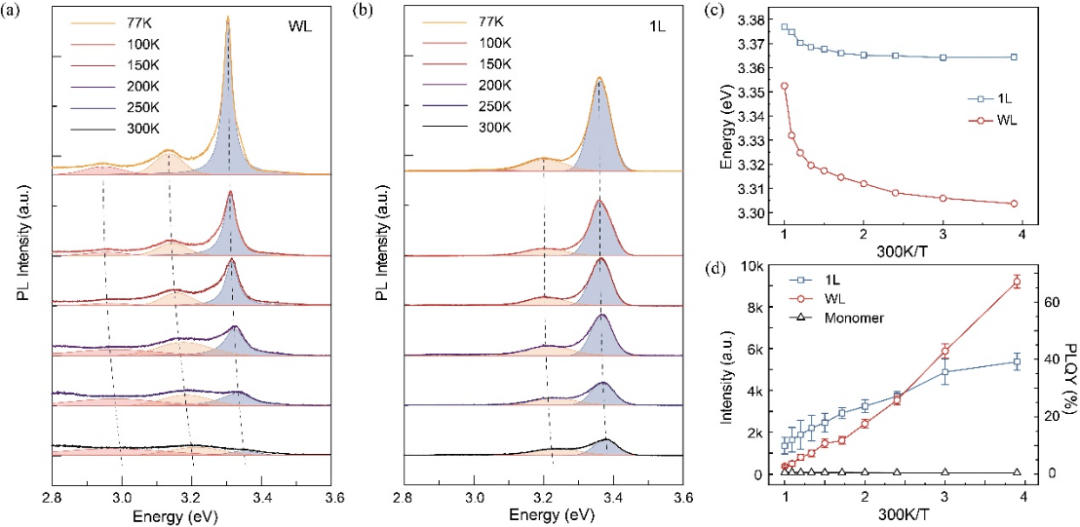
Theoretical fitting based on first-principles calculations was in excellent agreement with the experimental data. The PL intensity of the 1L showed a single-slope relationship with the inverse temperature, indicating that its J-aggregation behavior is primarily influenced by thermal fluctuations. In contrast, the WL exhibited a two-regime behavior, corresponding to two mechanisms: at high temperatures, excitons are localized near individual molecules, and the bottom of the exciton band is a dark state; at low temperatures, the exciton coherence length increases, and the coherent coupling of next-nearest-neighbor dipoles drives the molecular arrangement to transition from H-aggregation to Hj-aggregation, changing the bottom of the band from a dark state to a bright state, thereby opening an efficient radiative channel. Analysis of the intensity ratio R01 of the 0-0 band to the 0-1 band provided direct evidence of superradiance. In the WL, ln(R01) exhibited a perfectly linear variation with the inverse temperature, a characteristic signature of superradiance, indicating collective radiation from a large number of coherent dipoles.
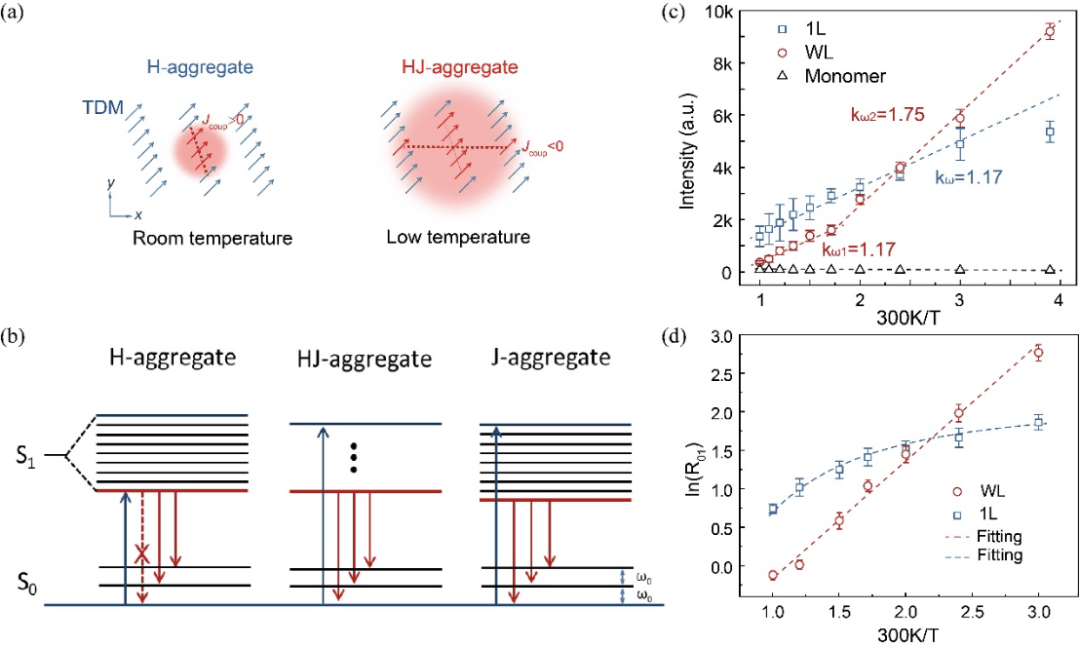
This study systematically reveals the transition from dark exciton states to bright exciton states in WL C8-BTBT crystals at low temperatures, attributed to the transformation from H-aggregation to Hj-aggregation. The material achieves a photoluminescence quantum yield of 62% at 77 K, and the temperature dependence of PL intensity, exciton linewidth, and R01 provides evidence for superradiance. The research demonstrates that through organic aggregation engineering and temperature control, exciton coherence and radiative efficiency can be effectively tuned, providing a theoretical foundation for developing low-temperature photodetectors, high-efficiency OLEDs, and quantum information devices.
Related Products

Hongxing Steel Chemical Pressure Vessel Steel Plate
Gansu JISCO Group Hongxing Iron and Steel Co., Ltd.
High Thermal Conductivity Encapsulating Resin
Nantong BESALL Sealing Technology Company.,Limited


Steel Pipes for Refining and Coal Chemical Industries
YANGZHOU LONTRIN ENERGY EQUIPMENT CO.,LTD.
Gasification Furnace Series: Freely Combinable Aerospace Furnace
CHANGZHENG ENGLINEERING CO., LTD.