en.Wedoany.com Reported - Canadian nuclear fuel supplier Cameco Corporation has announced plans to take its Westinghouse Electric unit public. The company filed a registration statement ahead of its quarterly earnings call, stating that the number of shares to be offered and the price range have not yet been determined, and that the offering will be subject to market and other conditions.
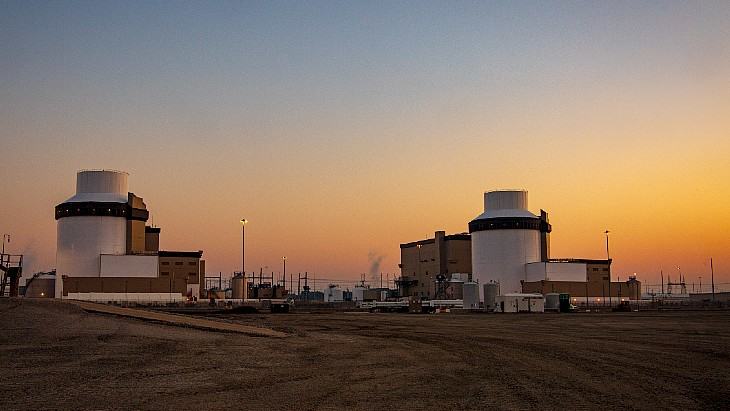
Westinghouse Electric built the world's first commercial pressurized water reactor (PWR) in Shippingport, Pennsylvania, in 1957, and is one of the largest nuclear services companies in the world. A strategic partnership between Cameco and Brookfield Renewable Partners completed the acquisition of Westinghouse Electric in 2023, with a total enterprise value of approximately $8 billion. Previously, Westinghouse Electric was acquired out of bankruptcy by Brookfield Business Partners in 2018. Cameco currently holds a 49% stake, while Brookfield holds 51%.
Cameco CEO Tim Gitzel said during the earnings call that, under U.S. Securities and Exchange Commission rules, the company's comments on the initial public offering (IPO) are "extremely limited." The Westinghouse Electric business segment featured prominently in Cameco's quarterly earnings call and in its Management's Discussion and Analysis (MD&A) filing for the quarter ended June 30.
In its quarterly update, Cameco stated that Westinghouse Electric's technology platform spans the nuclear value chain, with 57% of the 417 operating reactors worldwide using its technology, making it "one of the most strategically important franchises in the global nuclear industry," with its technology presenting "growing opportunities around the world."
The MD&A filing documented a pipeline of deployment opportunities for 91 potential AP1000 reactors, totaling approximately 105 gigawatts of electricity, across its global markets. These include: up to 10 units supported by U.S. nuclear supply chain loans announced by the U.S. Department of Energy earlier this year, with commercial operation windows in the mid-2030s; up to 10 U.S. units supported by the strategic partnership announced in 2025 between Cameco, Brookfield, and the U.S. Department of Commerce, with commercial operation in the mid-to-late 2030s; the restart of the two-unit VC Summer project, with commercial operation in the early-to-mid 2030s; three units at Lubiatowo-Kopalino in Poland, with operation in the mid-2030s; two units each in Bulgaria (Kozloduy Units 7 and 8) and Ukraine (Khmelnytskyi Units 5 and 6), with commercial operation in the mid-to-late 2030s; 11 units described as "FEED-stage projects" (front-end engineering design) in the Netherlands, Slovenia, Finland/Sweden, and the United States, with a timeframe of the late 2030s; and up to 51 units in Canada, India, Saudi Arabia, Slovakia, the United States, and "other European countries," with a deployment timeframe from the late 2030s to the early 2040s.
Dominic Kieran, Managing Director of Cameco UK and Chairman of the Westinghouse Electric Board, stated that the list is ordered by how close these opportunities are to a final investment decision. For the countries and projects further down the list, "it's not that we view them as lower probability, but rather that we view them as being at an earlier stage in the process toward reaching a final investment decision." He added that for "several" of these projects, "we see very, very strong recognition of the need for nuclear in baseload power generation."
The MD&A filing also included an illustrative economic comparison between near-term reactor deployments and so-called "Nth-of-a-kind" deployments, which refer to a scenario following the deployment of five twin-unit reactors—10 units total—at the same project site, with sustained demand for at least two units per year. Nuclear construction duration—from first nuclear concrete to commercial operation—is estimated at approximately 66 months per unit for near-term deployments, with a 20-30% reduction achievable for Nth-of-a-kind deployments. Overnight capital costs decline from $20-26 billion for near-term deployments to $14-17 billion for Nth-of-a-kind deployments.
Kieran stated that with a complete reactor design—with AP1000s already in operation—Westinghouse is well positioned in procurement for new projects, with few bottlenecks in construction. He added that while it is "certainly not without risk," the company has been "prudent" in its assessments.
Cameco President and Chief Operating Officer Grant Isaac discussed the importance of U.S. government funding, including securing long-lead equipment to support construction projects. He added that standardized designs, consecutive construction projects, and "simplified" projects—not by changing the design, but by incorporating lessons learned—are key to reaching Nth-of-a-kind deployment as quickly as possible. "Nobody needs to be afraid of nuclear new build—in fact, we need to embrace it."