PJM Approves 715 New Generation Projects for First Cycle Study in August 2026
en.Wedoany.com Reported - PJM Interconnection announced on August 3, 2026, that 715 new generation projects (with a total generating capacity exceeding 200 gigawatts) have been approved to enter the first cycle of its reformed interconnection process for study. These are the first proposed generation resources accepted under the new process, which is designed to reduce speculative projects, improve predictability, and accelerate the overall pace of interconnection.
The application window closed on April 27, with PJM receiving a total of 811 new resource proposals. All proposals were required to pass initial screening, including review of technical information and financial guarantees. Under the new rules, projects must demonstrate their viability before entering cycle studies, make meaningful upfront financial commitments, and provide proof of site control. Projects are reviewed on a cycle basis, with each cycle designed to last one to two years depending on individual project impacts; there is no longer a backlog of projects from the previous queue.
Jason Connell, PJM's Vice President of Planning, stated that PJM is encouraged by the number and quality of applications moving forward, which will help address the long-term electricity supply shortfall. He said the new process is designed to encourage projects that can ultimately be built.
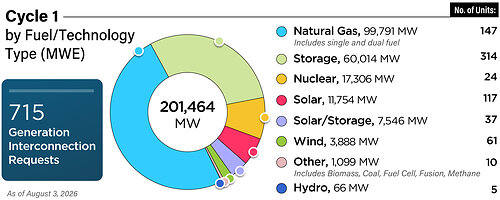
The accepted projects span a diverse mix of generation resources: 314 energy storage, 147 natural gas, 117 solar, 61 wind, 37 solar-storage hybrids, 24 nuclear, 10 other, and 5 hydro.
The combined nameplate capacity of these projects is 201.5 gigawatts, including 99.8 GW of natural gas, 60.0 GW of energy storage, 17.3 GW of nuclear, 11.8 GW of solar, 7.5 GW of solar-storage hybrids, 3.9 GW of wind, 1.1 GW of other, and 0.07 GW of hydro. The "other" category includes biomass, coal, fuel cells, fusion, and methane.
Connell said the number and diversity of projects demonstrate developers' willingness to build in the PJM region, and PJM will continue to streamline the process to meet the industry's need for timely grid connection. Bringing new generation online is critical to supporting grid reliability and controlling electricity costs through balancing supply and demand.
PJM is using advanced tools and pathways introduced in recent years to enhance large-scale processing efficiency during the cycle, including HyperQ, an AI tool developed by Google Tapestry, to assist in reviewing large volumes of application data. PJM will evaluate the tool's impact throughout the first cycle.
PJM projects that regional electricity demand will increase by up to 70 gigawatts by 2038, driven primarily by data centers and other large load customers. Demand growth has outpaced new supply, threatening grid reliability. Nameplate capacity represents the maximum potential output a resource can deliver to the system; based on historical performance, typically only a portion of projects applying for interconnection ultimately sign interconnection agreements and enter operation. Timely completion of new resource interconnection is critical to the continued power supply for 67 million people across 13 states and the District of Columbia.
Since 2020, PJM has processed more than 300 gigawatts of projects, with over 100 gigawatts signing interconnection agreements. Currently, 51 gigawatts of generation capacity have signed agreements, but many projects have not broken ground or are progressing slowly due to obstacles such as state permitting and supply chain backlogs. PJM, stakeholders, and state and federal policymakers are working together to address these challenges. PJM expects a significant increase in the number of projects signing agreements upon completion of Transition Cycle 2, expected in early 2027, and Cycle 1, expected in 2028.
PJM will release the summer peak model on August 28, with winter peak and light load cases released on September 11, allowing developers to understand the potential system impacts of the first phase studies and decide whether to proceed or withdraw. Project details are available on the Cycle Service Request Status page at PJM.com.
Founded in 1927, PJM Interconnection ensures the reliability of the high-voltage power system, serving 67 million people in all or parts of Delaware, Illinois, Indiana, Kentucky, Maryland, Michigan, New Jersey, North Carolina, Ohio, Pennsylvania, Tennessee, Virginia, West Virginia, and the District of Columbia. PJM coordinates and directs the operation of the regional transmission grid, which includes 88,417 miles of transmission lines; operates the competitive wholesale electricity market; and plans regional transmission expansion and improvements to maintain grid reliability and alleviate congestion. PJM's regional grid and market operations save $5 billion annually.