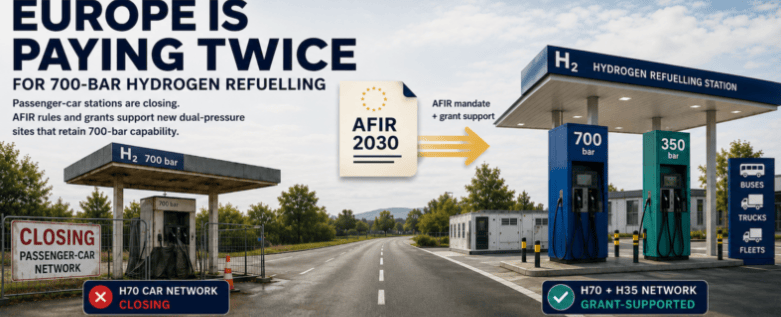
en.Wedoany.com Reported - Europe's public hydrogen refueling network is not growing but slightly contracting, and is undergoing internal restructuring: small 700-bar stations serving passenger cars are gradually being phased out, while large dual-pressure stations supporting both 350-bar and 700-bar have become the mainstream for new builds.
Germany closed 36 first-generation hydrogen refueling stations in 2025, 22 of which were tied to the 700-bar passenger car market, with another 14 exiting by the end of 2025. Operator H2 Mobility's explanation is based on market realities: the actual scale of passenger vehicles fell short of expectations, and early stations struggled economically to adapt to the throughput demands and technical requirements of buses and trucks.
Replacing these early stations are a new generation of dual-pressure refueling stations. H2 Mobility and other European operators are deploying large stations offering both 350-bar and 700-bar refueling capabilities—some as part of routine modernization, others as commercial vehicle infrastructure replacing former passenger car facilities. A policy-level open question is whether the high-pressure refueling capacity originally supported by hydrogen fuel cell passenger cars will continue to be retained at many replacement sites.
The shift in station composition is visible in data from the European Hydrogen Observatory. In 2023, Europe had 108 pure H70 (700-bar) public refueling stations, 50 dual-pressure stations, and 20 pure H35 (350-bar) stations; by May 2026, these figures had changed to 32, 129, and 18, respectively. The total went from 178 to 179 stations—the network has not substantially expanded but has been rebuilt internally.
High-pressure refueling is no longer exclusive to passenger cars. Some heavy-duty truck developers favor 700-bar because higher pressure allows more hydrogen to be stored in limited vehicle space, though these models have yet to be delivered; other truck and bus manufacturers use 350-bar, while Daimler has been researching supercooled liquid hydrogen. This fragmentation of technology pathways increases planning risk for public infrastructure: a refueling station may be costly and compliant, but if the market moves in a different direction, it could ultimately serve too few vehicles or mismatched types.
Compared with battery-electric trucks, the gap in hydrogen truck fleet size continues to widen. European Commission market assessments show that by the end of 2024, the EU had over 15,000 battery-electric trucks in operation versus just 170 hydrogen trucks; that year, more than 7,500 battery-electric trucks were newly registered, compared with only 106 hydrogen trucks. The same assessment counted over 250 public and private hydrogen refueling stations serving approximately 4,700 cars, 320 vans, 140 trucks, and 320 buses, concluding that the existing hydrogen refueling network is broadly sufficient for current vehicle numbers—the real bottlenecks are limited available models and high hydrogen prices, not insufficient station coverage.
Retaining H70 is not without cost. A 700-bar vehicle cannot achieve fast, complete refueling from equipment that only delivers 700-bar; fast refueling requires compression and storage pressures significantly above the vehicle's rated pressure, along with hydrogen cooling, dedicated components, inspection, and maintenance. Dual-pressure stations can share hydrogen supply, civil works, safety systems, and some compressor units—adding H70 does not double total costs, but it does add a high-pressure storage and refueling pathway requiring boosting, cooling, and dedicated hardware.
This pathway persists due to direct regulatory requirements. The Alternative Fuels Infrastructure Regulation (AFIR) requires that by the end of 2030, public hydrogen refueling stations on the core road network of the Trans-European Transport Network (TEN-T) be spaced no more than 200 km apart, with corridor stations designed for a minimum daily capacity of 1 tonne and equipped with at least one 700-bar dispenser; TEN-T urban nodes must also have hydrogen refueling stations. Although the explicit high-pressure requirement applies only to corridor stations, developers receiving funding still generally opt for dual-pressure designs to maximize eligibility, compatibility, and regulatory protection.
Subsidies are turning regulatory signals into concrete assets. In Polish energy company ORLEN's second Clean Cities hydrogen programme, eligible costs for 5 refueling stations amount to €25.6 million, with €12.8 million in EU subsidies; the programme's third phase includes a production and distribution hub plus 16 public refueling stations offering both 350-bar and 700-bar refueling, with eligible project costs of €124.6 million and EU subsidies of €62.3 million. Such stations can support actual bus operations and future truck fleets, but without regulation and public funding, whether current demand could finance equivalent coverage and technical specifications remains an open question.
Rough estimates suggest that the lifecycle cost of replacing the old network with new stations ranges from approximately €1 billion to €6 billion, with a mid-case scenario of around €3 billion. The mid-case roughly corresponds to 400 new stations or major retrofits, averaging €5 million per station, plus ten years of operation and maintenance costs, as well as closure, decommissioning, and replacement expenses. This cost is not borne entirely by the EU budget but is spread across EU subsidies, national subsidies, state-owned enterprises, private capital, and users; the estimate also excludes hydrogen production subsidies, distribution equipment, vehicle subsidies, fuel discounts, and operating support for low-throughput stations.
The premium paid specifically to retain 700-bar capability cannot be precisely isolated from total costs, because many components of dual-pressure stations are shared. On a scale of several hundred stations, the incremental per-station cost for high-pressure compression, storage, cooling, dispensing, and integration falls within a reasonable engineering range of €0.5 million to €1.5 million, corresponding to an overall H70 premium in Europe of roughly €200 million to €700 million. This is not a list of approved project costs but a test of the scale of a policy choice.
Not all hydrogen refueling station projects lack economic viability. A 350-bar station built alongside a contracted bus fleet can achieve predictable utilization; depot-based or mobile refueling units can supply hydrogen for limited commercial uses without masquerading as part of a broad public network; and where 700-bar trucks have already been ordered, financed, and delivered, equipping stations with 700-bar dispensers makes sense. None of these scenarios require building a geographically complete public network before vehicle demand is validated, pressure standards converge, or duplicate procurement is avoided.
The 2026 AFIR review is therefore seen as a window to adjust the rules. The review should move away from hydrogen rules with hard mandates on pressure and spacing, instead linking public support to contracted demand, utilization thresholds, pressure flexibility, and phased construction—letting infrastructure follow vehicles that have been ordered, delivered, and put on the road, rather than building stations first and then trying to create a vehicle market.
Europe has already funded a 700-bar network whose market demand has yet to be validated. The next network should first prove that its customers already exist.