Kazakhstan's automotive industry output hits record 2.4 trillion tenge in 2025
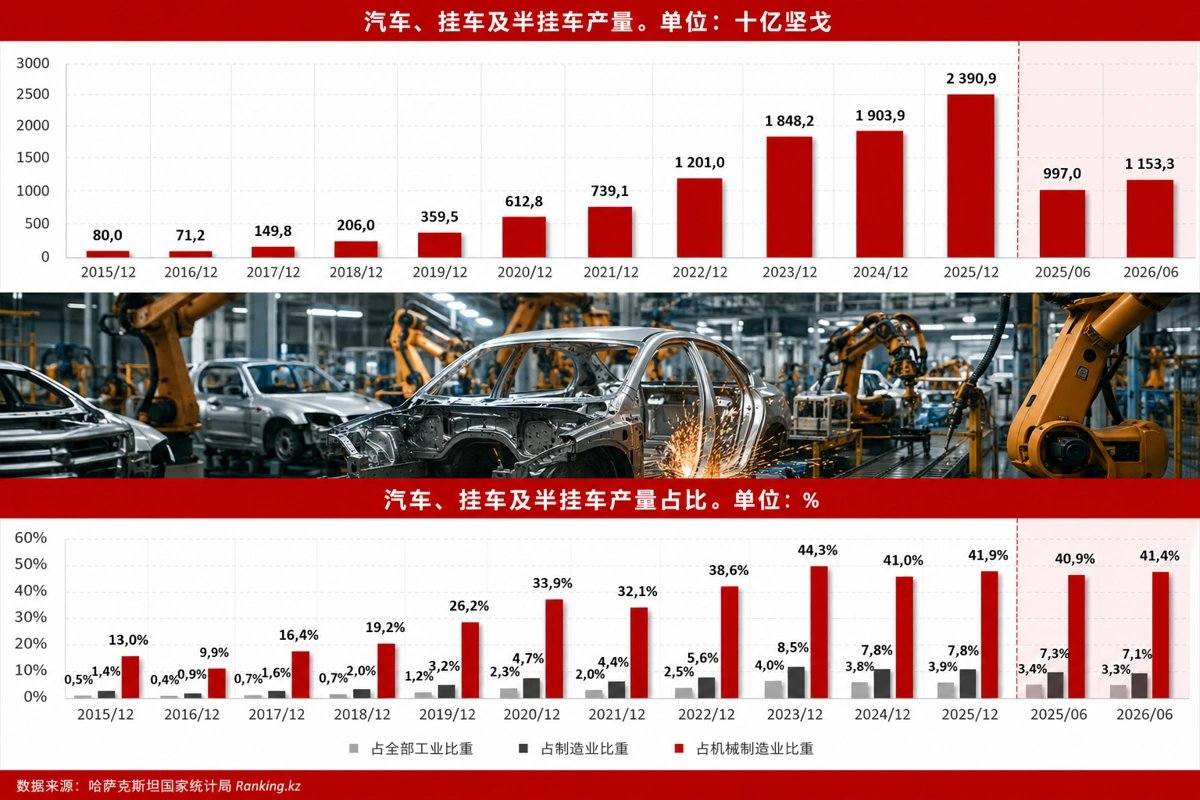
en.Wedoany.com Reported - Kazakhstan's automotive industry continues its growth trajectory. Industry output reached 1.8 trillion tenge in 2023, surpassed 1.9 trillion tenge in 2024, and grew by 25.6% year-on-year in 2025 to a historic high of 2.4 trillion tenge. In 2015, the national automotive industry output stood at just 80 billion tenge.
In the first half of 2026, national automobile manufacturers produced products worth 1.2 trillion tenge, up 15.7% year-on-year; the corresponding growth rate for the same period in 2025 was 22.4%.
The automotive industry's position within the machinery manufacturing sector continues to strengthen. In 2015, the industry accounted for 13% of total machinery manufacturing output, rising to 33.9% in 2020 and 41.9% in 2025; in the first half of this year, it stood at 41.4%, higher than the 40.9% recorded in the same period last year. During the same period, the manufacture of motor vehicles, trailers, and semi-trailers accounted for 7.1% of national manufacturing output and 3.3% of total national industrial output, roughly on par with the same period last year.
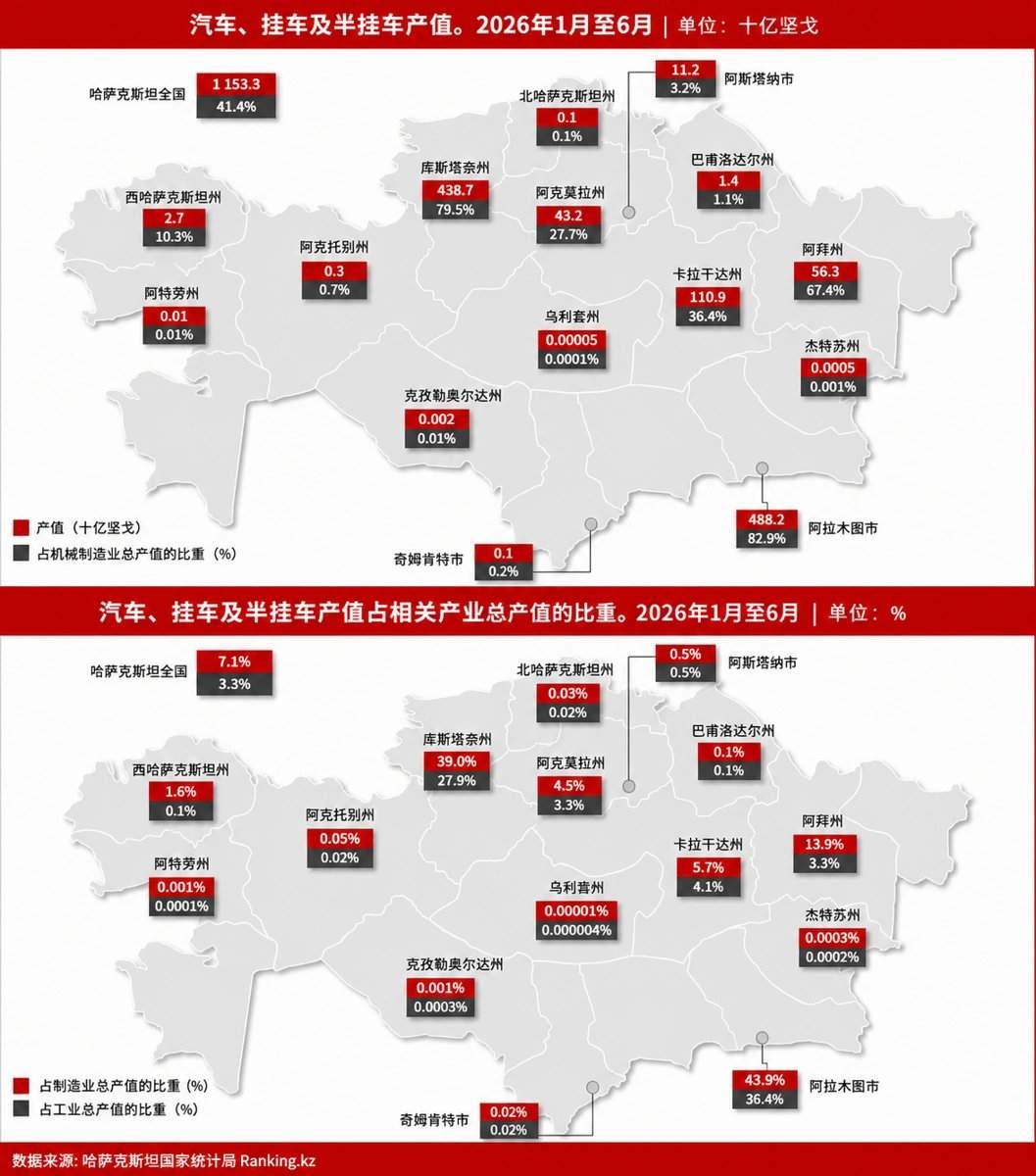
By regional distribution, Kazakhstan's automobile manufacturing is concentrated in a small number of major industrial centers. In the first half of 2026, Almaty led the country with an output of 488.2 billion tenge, accounting for 42.3% of the national total output of motor vehicles, trailers, and semi-trailers; Kostanay Region ranked second with 438.7 billion tenge, representing 38%, with the two regions together contributing over 80%. Karaganda Region produced 110.9 billion tenge, accounting for 9.6%; Abai Region 56.3 billion tenge; Akmola Region 43.2 billion tenge, with the top five regions collectively accounting for 98.6%. Astana, West Kazakhstan Region, and Pavlodar Region recorded outputs of 11.2 billion tenge, 2.7 billion tenge, and 1.4 billion tenge respectively, with some regions also hosting small enterprises engaged in the production of specialized vehicles, trailers, and automotive components.
The automotive industry is particularly significant to the local economies of Almaty and Kostanay Region. In Almaty, automobile manufacturing accounts for 82.9% of local machinery manufacturing output, 43.9% of total manufacturing output, and 36.4% of the city's total industrial output; the corresponding figures for Kostanay Region are 79.5%, 39%, and 27.9%. In Abai Region, Karaganda Region, Akmola Region, and West Kazakhstan Region, the industry's share of machinery manufacturing stands at 67.4%, 36.4%, 27.7%, and 10.3%, respectively.
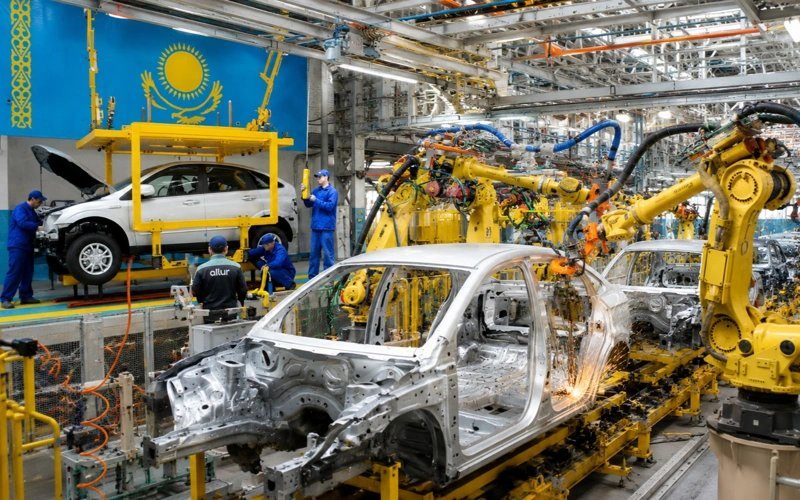
Currently, 11 enterprises in Kazakhstan produce passenger cars, commercial vehicles, buses, and specialized vehicles. In 2025, the Astana Motors Manufacturing Kazakhstan and KIA Qazaqstan plants, with a total investment exceeding 346 billion tenge, officially commenced operations, deploying 119 industrial robots. According to the Ministry of Industry and Construction of Kazakhstan, production capacity in the commercial vehicle segment continues to expand. In addition to the Scania and Howo projects, plans are in place to assemble 500 Volvo highway tractors annually at the Hyundai Trans Auto plant starting from the fourth quarter of this year; Barys Truck Manufactory is collaborating with XCMG to advance an electric heavy-duty tractor production project.
Under agreements reached during President Kassym-Jomart Tokayev's state visit to China, Kazakhstan plans to launch production of Li Auto, OMODA, and JAECOO brand vehicles, build a production line for SITRAK brand autonomous highway tractors, and develop a high-speed charging network in partnership with BYD. In his State of the Nation Address, Tokayev noted that a number of machinery manufacturing projects have been commissioned in Kostanay Region, Karaganda Region, and elsewhere, and that Almaty has seen the completion of the country's largest multi-brand automobile manufacturing plant. He also pointed out that autonomous vehicles, specialized vehicles, and cargo drones are developing rapidly worldwide, and that Kazakhstan should accelerate the adoption of such advanced technologies — the aforementioned cooperation agreements will help fulfill this strategic objective.
Physical output growth outpaced value growth. In the first half of 2026, the country produced 96,100 motor vehicles, trailers, and semi-trailers, up 34.4% year-on-year; full-year output in 2025 reached 174,900 units, up 18.7% year-on-year, setting a historic record. Between 2023 and 2024, annual output remained stable at 147,000–149,000 units, compared to just 15,200 units in 2015.
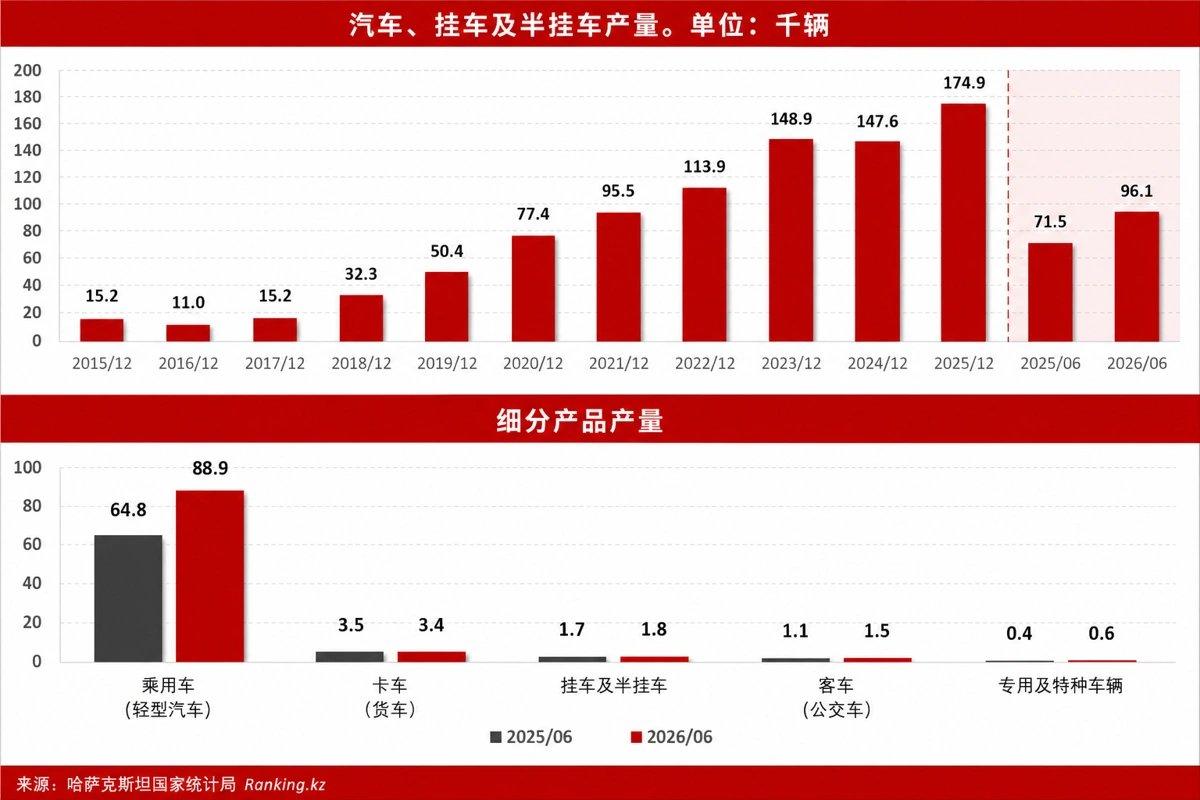
Passenger cars are the main pillar of industry growth. In the first half of the year, passenger car production increased from 64,800 units in the same period last year to 88,900 units, up 37.2% year-on-year, accounting for 92.5% of total output; bus production reached 1,500 units, up 36.4%; specialized vehicles 557 units, up 50%; trailers and semi-trailers 1,800 units, up 5.9%; truck production remained stable at 3,400 units. The KIA Qazaqstan plant, which commenced operations in October 2025, produced 9,800 vehicles in the first half of the year. The plant has a designed annual capacity of 70,000 vehicles, with a production process covering welding, painting, final assembly, and quality inspection.
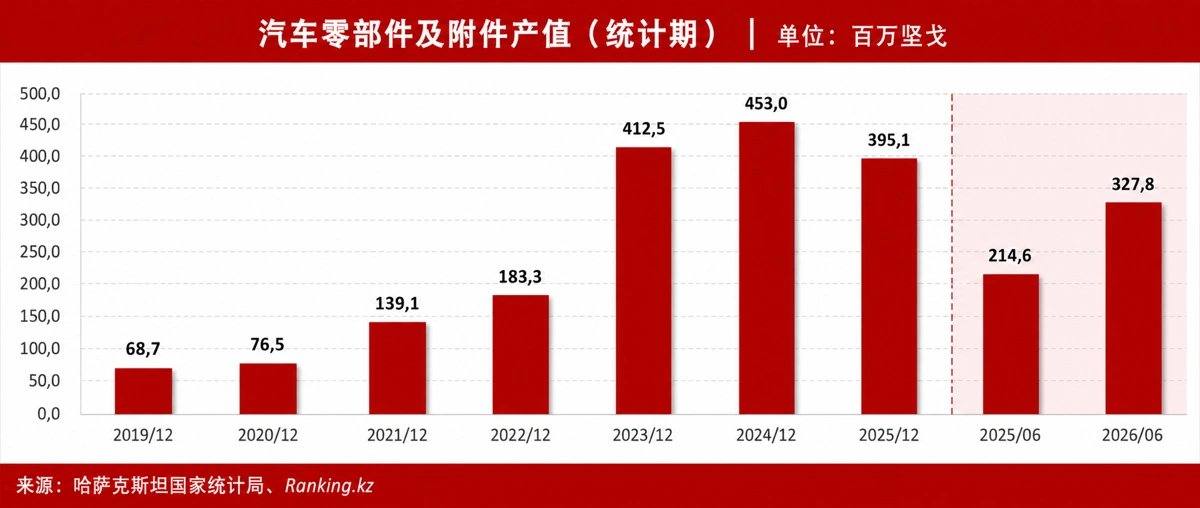
The components industry is growing in tandem. In the first half of 2026, the output value of automotive parts and accessories nationwide reached 327.8 million tenge, up 52.7% year-on-year, already reaching 83% of the full-year 2025 level. In 2025, component output stood at 395.1 million tenge, a decline from previous levels; in 2020 and 2021, it was 76.5 million tenge and 139.1 million tenge respectively. This year, the industry has largely resumed growth. Local enterprises now produce automotive seats, multimedia systems, mufflers, bumpers, fuel lines, brake lines, wheel hubs, tires, batteries, plastic parts, floor coverings, and automotive wiring harnesses.
Investment in localization capacity continues to advance. In Kostanay Region, a localization center for automotive components with a total investment of 67.2 billion tenge is under construction, designed to produce 60,000 component kits annually and expected to create 600 jobs. Astana Motors is investing 16 billion tenge in Almaty to build a components industry cluster covering multimedia systems, automotive seats, air conditioning systems, interior trim coverings, mufflers, piping, and wiring harnesses; according to the company's plans, the localization rate is expected to rise to 51% over the next five to seven years. In bus manufacturing, the QazTehna plant has launched its own stamping production using Kazakhstan's Qarmet steel and is advancing the localization of passenger seats, handrails, batteries, and tires. After project implementation, the localization rate is expected to increase from 27.3% to 48.3%.
Several plants have adopted technologies such as intelligent video analytics systems, automated quality inspection systems, rapid-response systems for production incidents, and digital twins. In talent development, Allur University trained 4,200 people between 2025 and 2026, of whom 1,900 employees completed training in small-unit assembly manufacturing. The company is also collaborating with educational institutions to promote industry-education integration and dual-system talent cultivation.
Overall, the automotive industry has further consolidated its position as a pillar of Kazakhstan's machinery manufacturing sector. Passenger cars remain the primary driver of industry growth, while buses, specialized vehicles, and the components industry continue to develop steadily. The next phase will focus on raising localization levels, improving the domestic supply chain system, and promoting more advanced manufacturing technologies.
Related Products


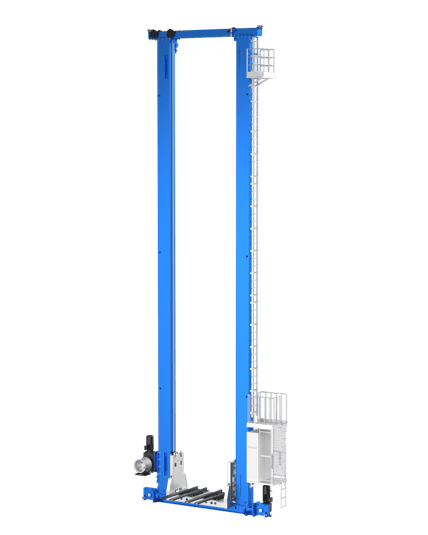
Pallet Solutions Product Line: HD3000 Double-Column Stacker Crane
Zhongding Intelligent (Wuxi) Technology Co., Ltd.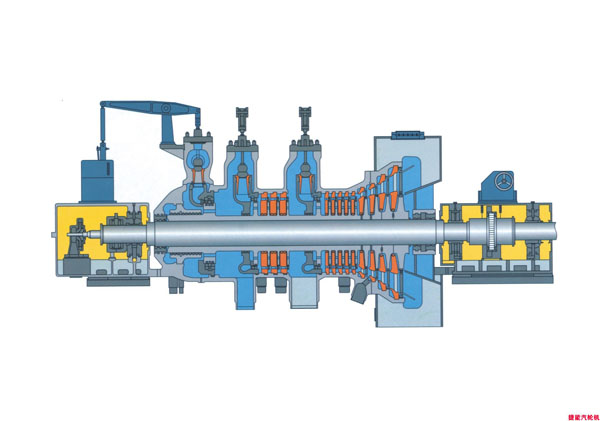
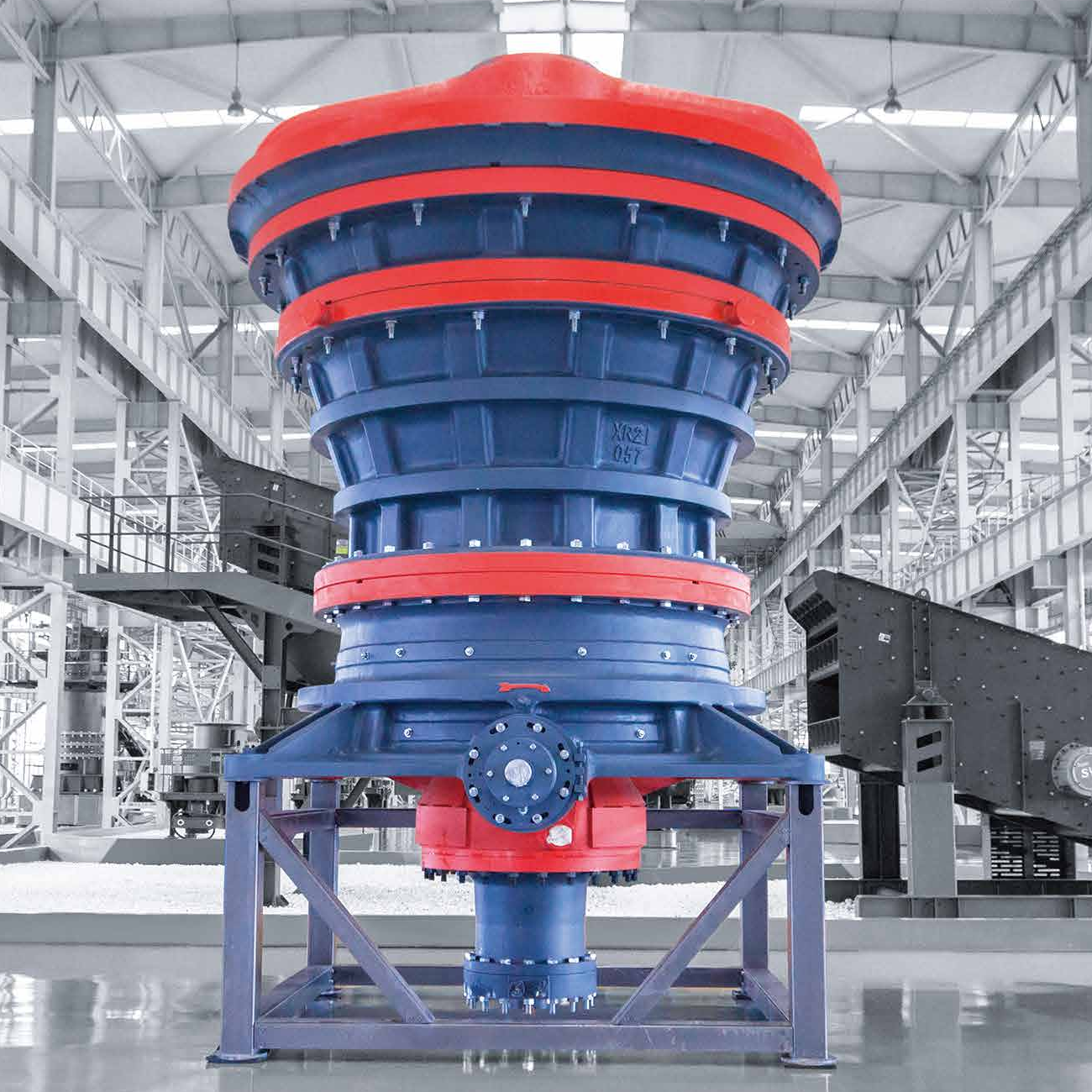
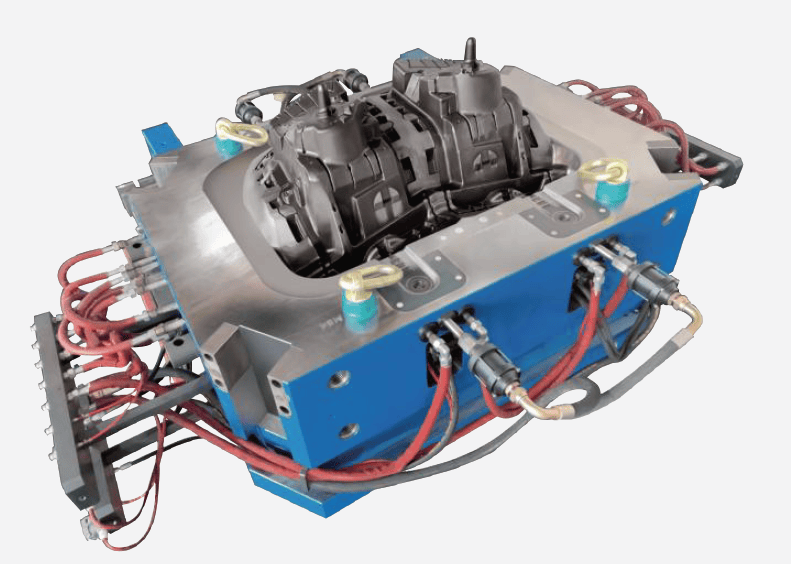
Aluminum-Magnesium Alloy High-Pressure Die-Casting Molds
NINGBO HELI TECHNOLOGY CO., LTD.
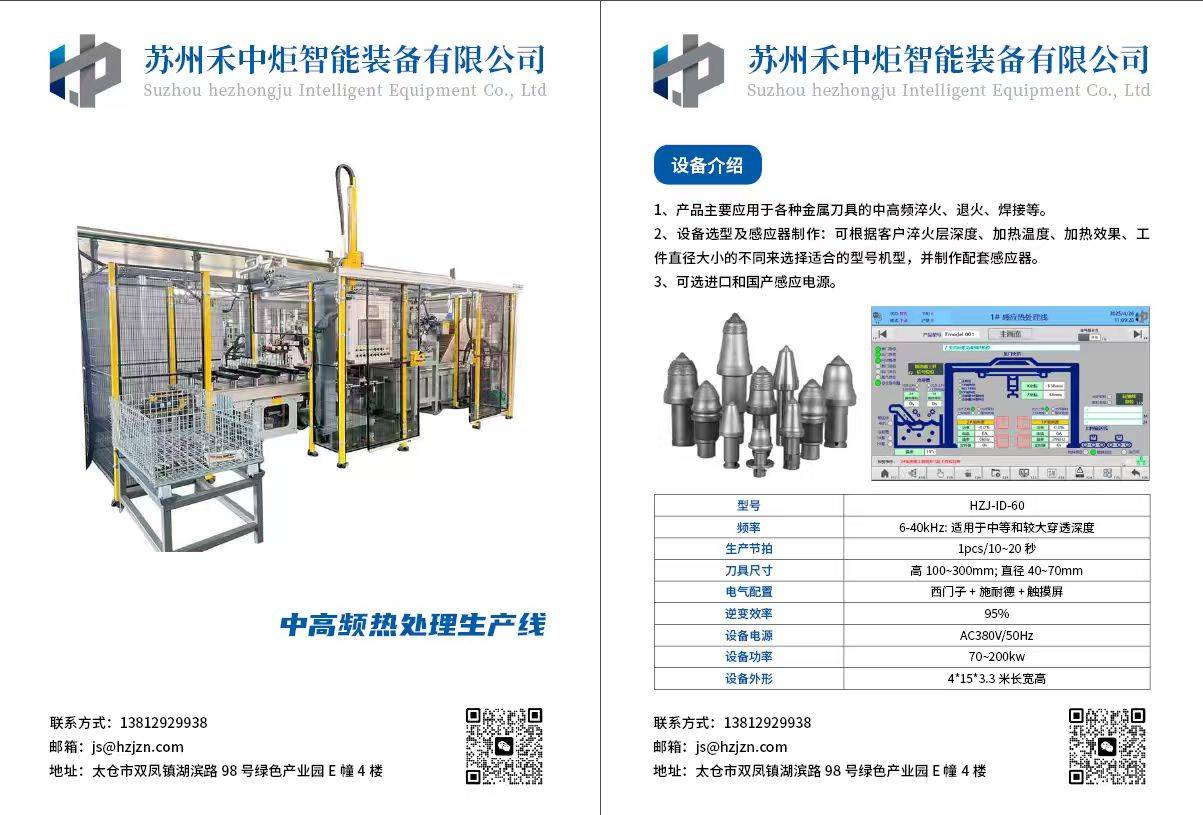
Excavator Bucket Teeth Heat Treatment Production Line
Suzhou Hezhongju Intelligent Equipment Co., Ltd.