Wedoany.com Report-Jun 19, The first concrete for Unit 1 of the Nuclear Power Corporation of India's (NPCIL) Gorakhpur Haryana Anu Vidyut Pariyojana (GHAVP) is scheduled to be poured by October 2025, according to Power Minister Manohar Lal Khattar. The plant is located in Gorakhpur village, Fatehabad district, Haryana, and is designed to house four 700 MWe pressurised heavy water reactors (PHWRs) developed in India. The project will be implemented in two phases, with Units 1 and 2 forming the first phase.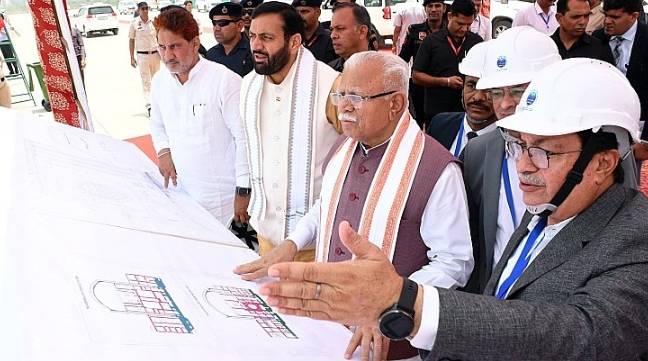
The minister reviewed progress at the Gorakhpur site
The Atomic Energy Regulatory Board (AERB) granted the siting license for the project in 2015 and approved excavation work for the first two units in 2018. Originally, the first concrete pour for Unit 1 was expected in 2019, with a projected construction period of five and a half years. In 2020, the AERB gave formal consent for the concrete pour.
During his visit to the GHAVP site on 14 July 2025, Minister Khattar reviewed the project's progress and stated: "The first pour of concrete for Unit 1 is targeted by October 2025." He also confirmed the current timeline, which aims for Unit 1 to achieve first criticality by June 2030, and begin commercial operation by March 2031. Unit 2 is expected to follow approximately six months after Unit 1.
While the Indian government categorizes Units 1 and 2 at Gorakhpur as under construction, the International Atomic Energy Agency (IAEA) considers a unit under construction only after the first major concrete placement for the base mat of the reactor building.
Units 3 and 4 at Gorakhpur will be part of the project’s second phase. These are included in a group of ten reactors sanctioned under India’s "fleet mode" construction strategy. The other reactors in this group include Mahi Banswara units 1-4 in Rajasthan, Kaiga units 5 and 6 in Karnataka, and Chutka units 1 and 2 in Madhya Pradesh.
India currently operates 24 nuclear power reactors with a combined installed capacity of 8.88 GW. In addition, six reactors with a total capacity of 4,768 MWe are under construction. The country aims to significantly expand its nuclear power generation capacity to 100 GW by the year 2047.