South Korean research team develops process to convert photovoltaic recycled silicon into silicon nitride ceramics
en.Wedoany.com Reported - A South Korean research team has developed a process to convert silicon recovered from end-of-life photovoltaic modules into silicon nitride (Si₃N₄) ceramics. This material, known for its high strength, thermal stability, wear resistance, and electrical insulation properties, is used in automotive, aerospace, electronics, medical, energy, and manufacturing sectors.
According to the research team, to their knowledge, this is the first demonstration of producing silicon nitride from silicon recovered from actual end-of-life (EoL) photovoltaic modules. Corresponding author Jin-Seok Lee told pv magazine that the goal of this work is not merely to recover silicon as an ordinary secondary raw material, but to demonstrate a practical pathway for silicon to achieve higher-value applications. Lee stated that the team's next step is to move from proof-of-concept research toward practical, scalable recycling and upcycling processes.
The team is collaborating with Wonkwang S&T, a South Korean photovoltaic recycling company, to develop mobile photovoltaic recycling technology that enables processing to be completed near the site where end-of-life modules are generated. Lee noted that, compared to traditional centralized recycling routes, this approach aims to reduce transportation costs by approximately 30% and carbon emissions by more than 10%.
The experiment used an end-of-life photovoltaic module of the Suntech STP200-18/Ub model, containing 54 multicrystalline silicon cells based on aluminum back surface field (Al-BSF) structure. After removing the junction box and aluminum frame, the researchers used a hot knife to separate the glass layer from the ethylene-vinyl acetate (EVA)/cell/EVA/backsheet composite, then cut the composite into cell-sized samples and ground them at speeds of 400 rpm, 600 rpm, and 800 rpm, respectively, to investigate the effect of grinding speed on particle agglomeration and impurity removal. Subsequently, 3 mm and 0.5 mm sieves were used to remove larger backsheet fragments and residual EVA, followed by combustion in air at 600°C for 1 hour to eliminate remaining organic matter.
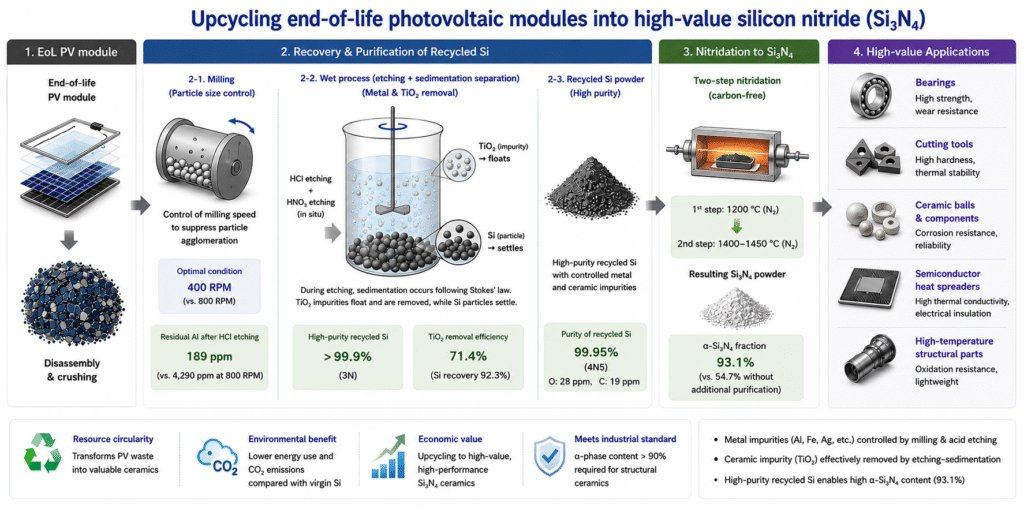
Particle agglomeration was then assessed using particle size analysis and scanning electron microscopy (SEM). The recovered silicon underwent a two-stage acid washing: first treated in 36 wt% hydrochloric acid (HCl) for 20 minutes to remove aluminum, copper, tin, and lead; then treated in 36 wt% nitric acid (HNO₃) for 30 minutes to dissolve silver. Both processes were carried out under stirring and ultrasonic conditions.
To remove acid-resistant titanium dioxide (TiO₂) from the backsheet, the researchers dispersed 10 grams of powder in 1 liter of water for 20 minutes, then allowed it to settle for 5 to 20 minutes, after which 800 milliliters of supernatant was removed, and 5 minutes was determined as the optimal settling time. After characterization, the team selected the highest-purity powder obtained at 400 rpm as the nitridation feedstock; purified and unpurified powders were each ball-milled in ethanol for 20 hours, achieving an average particle size of approximately 1 micrometer. Nitridation was then carried out in a flowing atmosphere of 95% nitrogen and 5% hydrogen, first at 1350°C for 1 hour, followed by treatment at 1450°C for 10 minutes.
The researchers used X-ray diffraction (XRD) to calculate the silicon conversion rate and determine the phase ratio of α-Si₃N₄ and β-Si₃N₄ in the silicon nitride; SEM was used to compare particle morphology; and inductively coupled plasma optical emission spectrometry (ICP-OES) was used to measure the final ceramic purity. Results showed that particle agglomeration induced by higher-speed grinding significantly interfered with subsequent impurity removal: the 800 rpm sample retained an aluminum concentration of 4290 ppm after hydrochloric acid etching, while the 400 rpm sample had a corresponding residual aluminum concentration of only 189 ppm. Lee believes this indicates that optimization of the recycling process cannot simply rely on more intense grinding.
Settling proved highly effective in impurity removal: just 5 minutes removed 71.4% of TiO₂ while maintaining a 92.3% silicon recovery rate. After achieving effective control of metallic and ceramic impurities, the recovered silicon reached a purity of 99.95%, and the silicon nitride produced from it contained 93.1% α-Si₃N₄; in contrast, silicon nitride synthesized from recovered silicon that did not undergo this purification process contained only 54.7% α-Si₃N₄. This result is consistent with the assessment that impurities in discarded photovoltaic modules directly affect the performance of high-value recycled products.
The related paper, titled "Upcycling silicon recovered from photovoltaic waste into silicon nitride via the field-applicable control of metal and ceramic impurities," was published in the journal Materials Today Sustainability. Researchers from the Korea Institute of Energy Research and Chungnam National University participated in this work.
Related Products

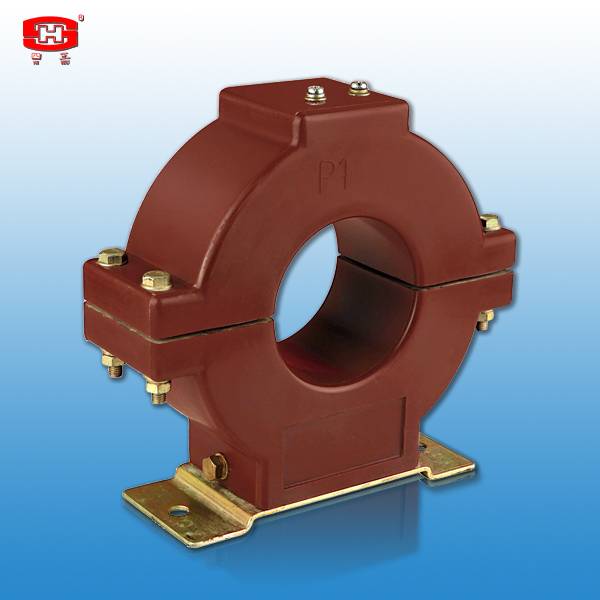
0.66kV Power Supply Instrument Transformer
Guangdong Sihui Instrument Transformer Works Co., Ltd.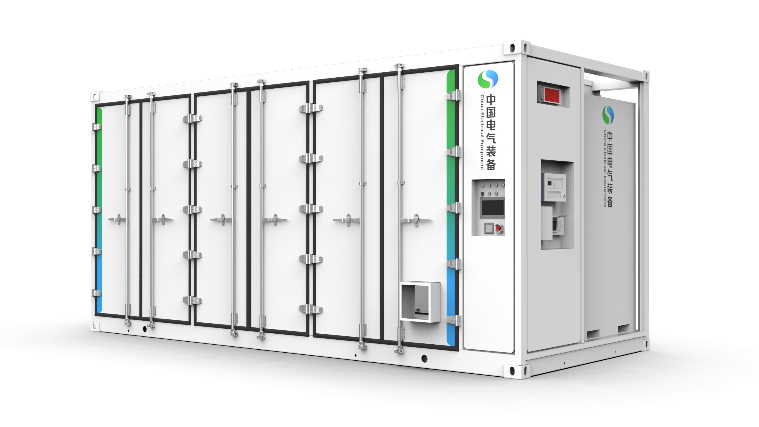
MESS8201-2507/5015-BN Prefabricated Liquid-cooled Energy Storage Battery Container
Xuchang Xuji Electric Science Energy Storage Technology Co., Ltd.
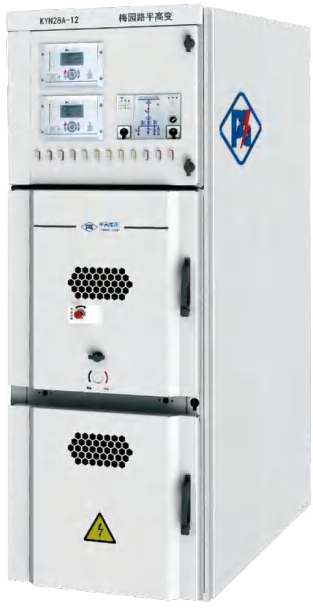
KYN28A-12 Metal Armored Removable Switchgear
Tianjin Ping Gao Intelligent Electric Co., Ltd.

TAI Slew-drive Single-axis Independent 1P Tracking Bracket System
ANTAI TECHNOLOGY CO., LTD.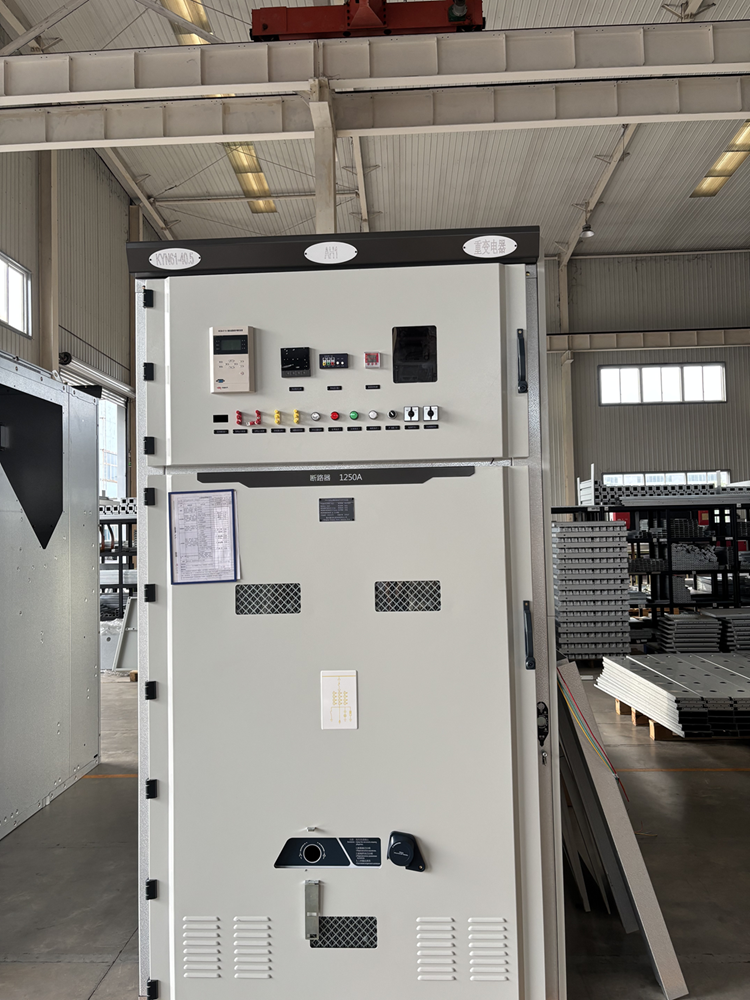
KYN61-40.5 Indoor AC Metal-clad Removable Switchgear
Chongqing Transformer Co., Ltd.