Wedoany.com Report-Oct. 28, Indonesia’s Public Works Ministry plans to build 34 waste-to-energy (WTE) facilities nationwide, advancing President Prabowo Subianto’s green energy agenda. The initiative is part of Presidential Regulation No. 109/2025 on Urban Waste Management through Environmentally Friendly Waste-to-Energy Technologies. Public Works Minister Dody Hanggodo emphasized that integrated waste treatment facilities (TPST) and community-based 3R (reduce, reuse, recycle) centers are crucial for mid-sized cities lacking large-scale processing capacity.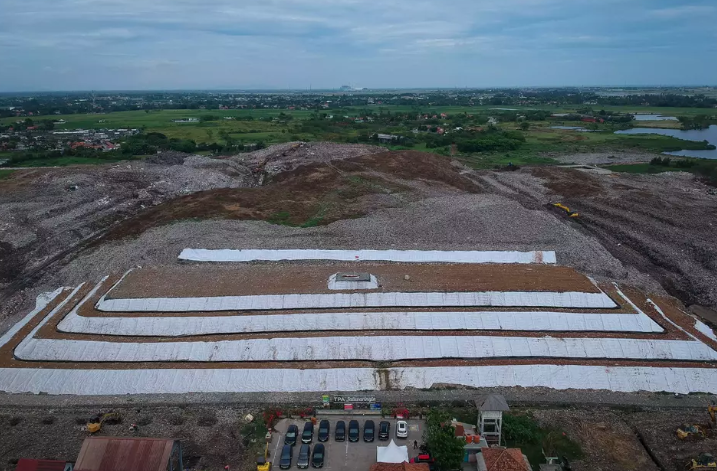
An aerial photo taken on Oct. 24, 2025, shows the Jatiwaringin Landfill and surrounding piles of waste in Tangerang Regency, Banten. The government has ordered local authorities to cover the landfill to prevent the spread of microplastics and other airborne pollutants harmful to nearby communities.
“Major cities like Jakarta, Surabaya, and Bali can process more than 1,000 tons of waste daily and convert it into energy. But mid-sized cities still rely on TPSTs and community-based 3R waste processing centers,” Dody said on Monday.
Construction of pilot WTE plants will begin in March 2026 in seven regions: Bali, Yogyakarta, and Semarang in Central Java; Medan in North Sumatra; and Bogor, Tangerang, and Bekasi in Greater Jakarta. Each facility, processing about 1,000 tons of waste per day, could generate 15–25 megawatts of electricity depending on waste composition. Funding and project management will be handled by the sovereign wealth fund Danantara, which has opened tenders to developers. CEO Rosan Roeslani said 204 companies, including 66 international firms, have shown interest.
Throughout 2025, the ministry, via the Directorate General of Human Settlements, developed 979 community-based infrastructure projects across 29 provinces and 105 cities and regencies. These include 841 sanitation facilities expected to create 11,774 jobs under a cash-for-work program. Sanitation projects at religious educational institutions cover 107 locations, generating 642 jobs. In addition, 31 new 3R facilities are being built this year with a total investment of Rp 22 billion ($1.3 million), creating 465 jobs.
The ministry is also advancing the Jakarta Sewerage Development Project (JSDP), a national strategic project aimed at improving water quality and sanitation access. Phase 1 of Zones 1 and 6, with a combined capacity of 240,000 cubic meters per day, is expected to be completed in 2027, serving nearly 1 million residents or 220,000 households. As of September 2025, construction reached 39.42 percent completion.
Key waste management facilities recently completed include TPST Sentiong in Cimahi (50 tons/day, RDF technology), TPST Lebak Saat (10 tons/day, BSF system), and TPST Cicukang Holis II in Bandung (46 tons/day). The Mamitarang Regional Landfill in North Minahasa was upgraded to handle 350 tons per day.
Between 2020 and 2024, the ministry constructed 33 landfills (TPA), 26 waste treatment sites (TPST), 833 3R facilities, 12 wastewater treatment plants (IPAL), and 33 sludge treatment plants (IPLT), while strengthening national waste management policies.
The program supports Indonesia’s goal of achieving 100 percent national waste management coverage by 2029 through improved source segregation, sanitary landfills, and optimized landfill permits.
“As we mark World Habitat Day, it’s a reminder that sustainable cities begin with cleanliness, order, and community care for waste and sanitation,” Minister Dody said, highlighting the link between effective waste management and sustainable urban development.