Wedoany.com Report-Nov. 13, Canada has announced an additional C$1.2 billion investment to strengthen its forest‑products industry, boost mass-timber use in public buildings, and reduce dependence on U.S. imports. The announcement was made at Kalesnikoff’s mass-timber plant in Castlegar, British Columbia, under Budget 2025. The package includes C$700 million in loan guarantees available immediately through the Business Development Bank of Canada, and C$500 million from 2026–27 to renew and expand Natural Resources Canada programs supporting product and market diversification.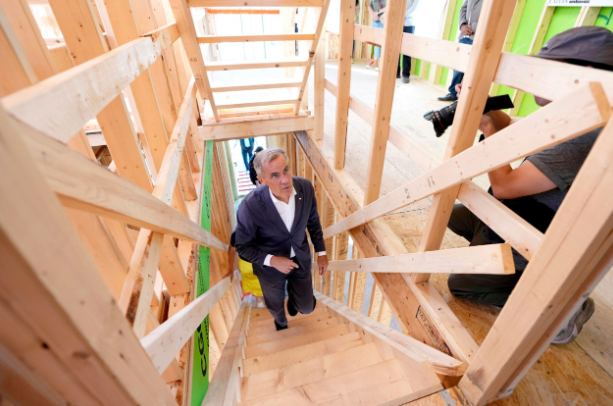
Tim Hodgson, Minister of Energy and Natural Resources, said: “Canada’s forest sector is a cornerstone of our economy and a source of pride and livelihoods in communities across the country. When the government spends, we will select Canadian suppliers by default — backing Canadian lumber, Canadian jobs and Canadian leadership in sustainable construction.” Stephen Fuhr, Secretary of State for Defence Procurement, added: “Budget 2025 is not just a response to disruption — it’s a blueprint for renewal.”
During the visit, ministers toured lines transforming local lumber into low-carbon building components, including cross-laminated timber panels, glulam beams, and prefabricated wall and floor systems. These components are already used in projects supported by Natural Resources Canada’s Green Construction Through Wood program. Chris Kalesnikoff, COO of Kalesnikoff Mass Timber Inc., said: “These panels are already being fully assembled into site‑ready modules ideal for multi‑storey homes, schools and community infrastructure.”
The investment supports the federal Build Canada Homes programme, designed to create a new housing industry emphasizing mass timber. According to Mark Carney, the agency aims to use federal funding, public land, regulatory support, and private-sector incentives to deliver a CA$13 billion programme accelerating homebuilding nationwide. Carney said: “We will create an entirely new housing industry using Canadian technology, Canadian workers, and Canadian resources—and give builders the tools they need to build more, build sustainably, and build at scale.”
The agency will oversee housing delivery across urban and rural communities, including emergency shelters, supportive housing, and market-rate projects. Public lands will be opened, and bureaucratic hurdles removed to cut construction timelines by up to 50% and reduce costs by up to 20%, using factory-built, modular, and mass-timber technologies. A Buy Canada policy will prioritise domestically produced lumber, steel, and other materials.
For its first build-out, Build Canada Homes will construct 4,000 homes on six federal sites in Dartmouth (NS), Longueuil (QC), Ottawa and Toronto (ON), Winnipeg (MB), and Edmonton (AB). In addition, C$1.5 billion will be allocated to acquire at-risk rental buildings to maintain affordability, and C$1 billion is earmarked for transitional and supportive housing. Former Toronto Deputy Mayor Ana Bailão has been appointed as the inaugural CEO of Build Canada Homes, bringing extensive experience in municipal and housing policy.
This initiative is designed to stimulate Canada’s forest sector, advance sustainable construction, and provide a large-scale boost to housing supply nationwide, leveraging local resources, technology, and skilled labour.