The development of Argentina's Vaca Muerta shale is reshaping South America's energy landscape. This change stems from the large-scale exploitation of the Vaca Muerta formation, transforming Argentina from an energy importer to a major producer, impacting regional energy security and competitive dynamics.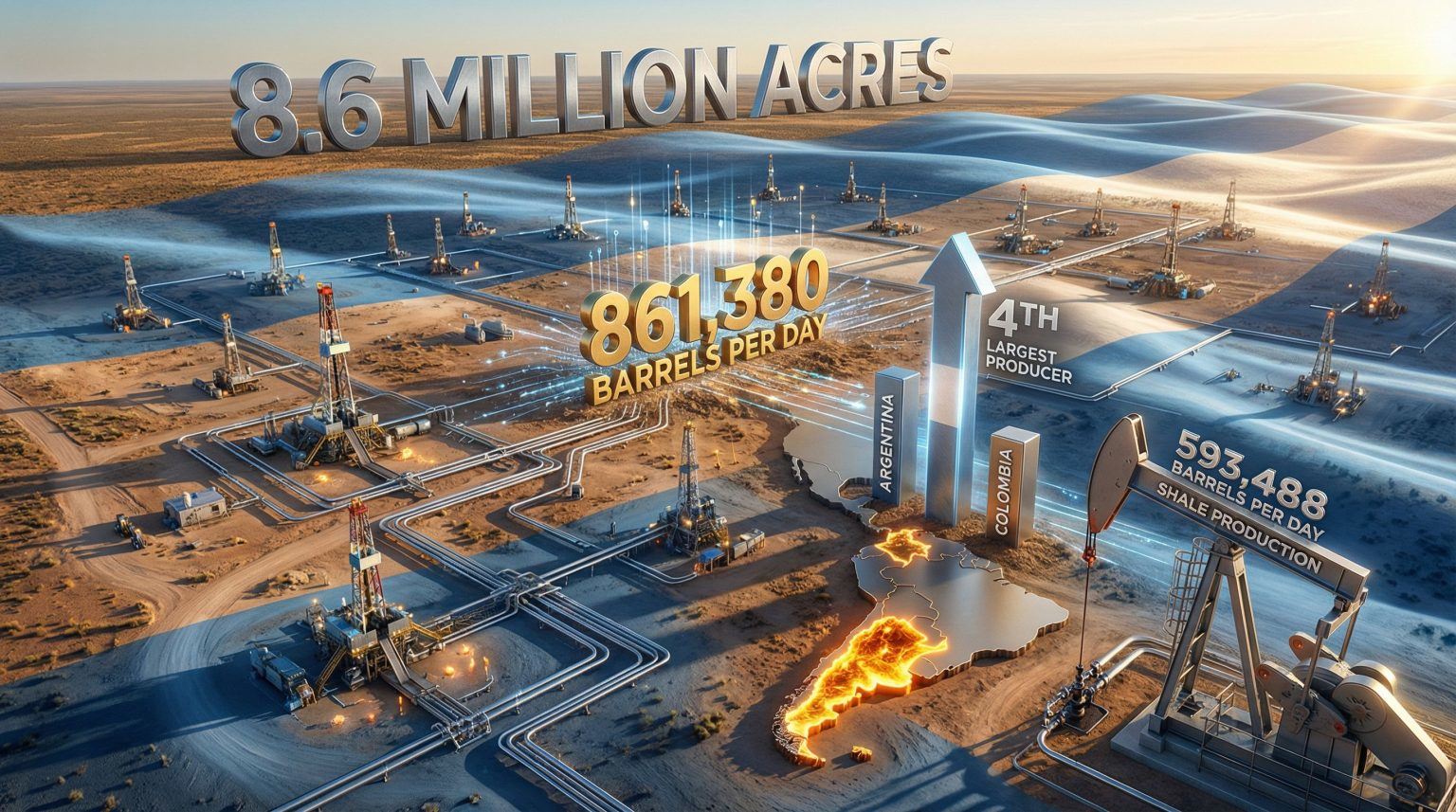
Data shows Argentina's oil production has grown significantly. Daily output in December 2015 was 494,721 barrels, increasing by approximately 174% by December 2025, making Argentina one of the world's fastest-growing oil producers. Natural gas production also shows strong momentum, reaching 4.6 billion cubic feet per day in December 2025, with a monthly increase of 7.4% and an annual increase of 5.7%. The Vaca Muerta formation covers 8.6 million acres and is estimated to hold 16 billion barrels of recoverable shale oil and 308 trillion cubic feet of recoverable shale gas. Currently, only about 10% of its potential has been developed, indicating substantial room for expansion.
By the end of 2024, Argentina became South America's fourth-largest oil producer, replacing Colombia, while maintaining an annual growth rate of 14%. The energy deficit peaked at $7 billion in 2013 before shifting to a surplus, representing an economic fluctuation of about $7 billion annually. YPF, Argentina's state oil company, was 51% owned by federal and provincial governments after its nationalization in 2012 and plans to become a purely unconventional oil and gas company by the end of this decade. Total investment in the oil and gas sector is projected to reach $11 billion in 2026, a 17% increase from 2025.
In terms of infrastructure, pipelines and port facilities are key bottlenecks. Natural gas infrastructure development focuses on import substitution and export capacity building. Domestic production costs range from $2 to $3.5 per million British thermal units (MMBtu), while imports from Bolivia cost $11.4 per MMBtu, highlighting the economic incentive for investment. The government of President Javier Milei has implemented economic restructuring policies, improving the regulatory and investment environment. Analysts note that the development of Argentina's Vaca Muerta shale creates opportunities across the entire energy value chain, including upstream drilling, midstream infrastructure, and downstream processing, with a potential shift towards liquefied natural gas (LNG) exports.
Despite favorable fundamentals, operational, market, and political-economic risks need to be assessed. Argentina's Vaca Muerta shale development, combining geological resources, economic improvements, and policy support, has become a transformative force in South America's energy market. Current production levels represent only an early stage, with the potential to further reshape regional energy security and create investment opportunities in the future.