
A joint research team from Skolkovo Institute of Science and Technology and Moscow Institute of Physics and Technology has published their findings in the Colloids and Surfaces A: Physicochemical and Engineering Aspects, successfully developing a novel molecular simulation algorithm. This petroleum molecular simulation algorithm, by constructing a complex oil model containing 15 components, significantly improves the simulation accuracy of petroleum flow behavior in porous media.
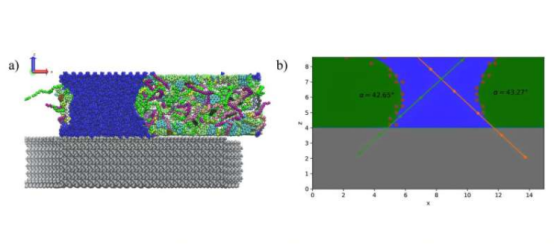
The research team focused on the precise calculation of contact angles in the quartz-oil-brine system, establishing a molecular dynamics model that accounts for key components such as asphaltenes and methane. First author Peter Khovanskii, a PhD student at Skolkovo Institute of Science and Technology, stated: "The new numerical contact angle calculation method uses linear complex angle determination at each system step, eliminating the need for separate algorithm fine-tuning for dissolved methane and water." This approach ensures computational accuracy while enhancing data processing efficiency.
The petroleum molecular simulation algorithm simulates the effects of variables such as temperature, methane content, and brine salinity on contact angles, revealing the intrinsic correlations between these factors and wettability. The study shows that increasing temperature reduces the contact angle, while higher methane content increases the contact angle and decreases wettability. Senior researcher at the Center for Computational Physics, Moscow Institute of Physics and Technology, Ilya Kopanichuk, noted: "The research confirms the critical role of asphaltenes in wettability studies; neglecting components with significant mass fractions would affect simulation accuracy."
The novel petroleum molecular simulation algorithm has low application costs and controllable system parameters, allowing adjustments to crude oil component configurations based on specific oilfield data. Although the algorithm currently cannot simulate structures larger than 0.1 micrometers, its computational results closely match experimental data, demonstrating practical value in microfluidics research. The research team plans to establish a unified contact angle calculation standard based on this work and ultimately develop a universal digital petroleum model applicable to new production and refining technologies.
This innovative research on the petroleum molecular simulation algorithm provides new solutions for optimizing petroleum recovery strategies and filtration processes. By precisely simulating intermolecular interaction mechanisms, it lays a scientific foundation for technological advancements in the petroleum extraction industry.