
Concrete, an indispensable material in the construction industry, has a limited lifespan and requires regular monitoring to ensure structural safety. To enable rapid, low-cost on-site analysis, researchers from the Institute of Physics at the University of São Paulo, in collaboration with the University of Leuven in Belgium, have developed a novel luminescent material that, under ultraviolet light, reveals the presence of compounds associated with concrete deterioration. The findings have been published in the journal Chemical Communications.
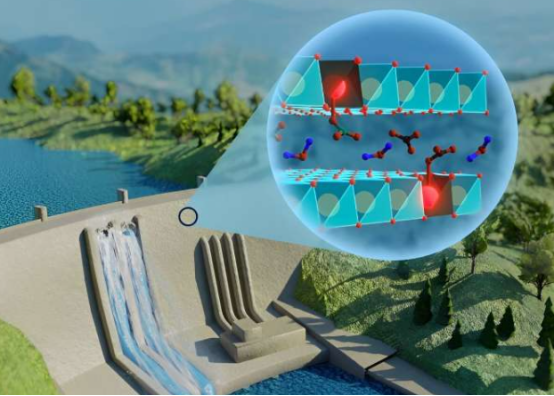
Concrete structures have an average lifespan of approximately 50 years and are susceptible to acidification caused by moisture, salts, and gases in the atmosphere, which can lead to steel reinforcement corrosion and reduced load-bearing capacity. Traditional detection methods involve drilling samples for laboratory analysis, which is time-consuming, costly, and labor-intensive. In hard-to-reach areas, such methods are particularly challenging, and drilling may alter the structure, potentially weakening its strength.
Researchers at the Nanomaterials and Applications Laboratory of the Institute of Physics at the University of São Paulo developed a catalyst based on layered double hydroxides (LDH), doped with trivalent europium (Eu³⁺) to produce an orange-red luminescence. Laboratory tests demonstrated that the material's luminescence color under ultraviolet light shifts with the content of absorbed carbonates, enabling detection of concrete deterioration levels: the greater the redshift, the higher the carbonate content, and the more severe the deterioration. The study's lead author, Alison Ferreira Morais, stated, "This technology can determine the degree of concrete deterioration and maintenance timing in real time, without the need for drilling or waiting for laboratory analysis, facilitating preventive maintenance and avoiding accidents."
The scientists noted that the next step is to develop sensors capable of detecting the luminescent material and to test its weather resistance and stability under real-world conditions. Beyond enhancing building safety, this new method also contributes to cost reduction and a smaller carbon footprint. Professor Danilo Mustafa from IF-USP highlighted, "The longer the lifespan of buildings, the less need for new construction investments, and the greater the construction industry's contribution to reducing greenhouse gas emissions, which accounts for 8% of global emissions, primarily from concrete production and construction itself." Researchers from Kiel University in Germany also participated in this study.