
As air travel becomes increasingly prevalent, the greenhouse gas emissions from aviation fuel pose a growing challenge. Recently, researchers at the University of Illinois Urbana-Champaign have developed a new method to convert food waste into sustainable aviation fuel (SAF) that meets industry standards, reducing reliance on fossil fuels. The findings, published in Nature Communications, offer a new pathway for the aviation industry to achieve its 2050 net-zero carbon emissions goal.
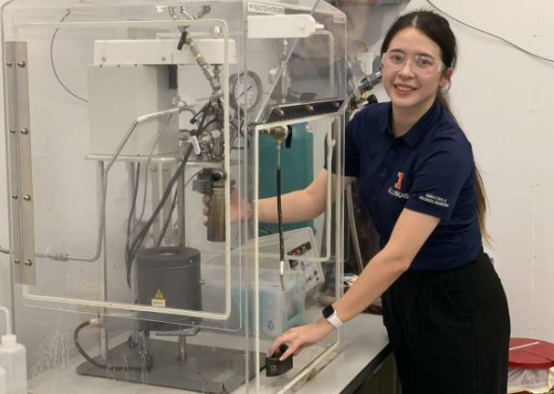
The researchers employed a hydrothermal liquefaction (HTL) thermochemical conversion process to transform food waste into biocrude, followed by impurity removal and catalytic hydrotreating steps to produce standard-compliant sustainable aviation fuel. Lead author Sabrina Summers stated, "The HTL technology mimics the natural formation process of crude oil on Earth, and our goal is to upgrade this biocrude into a transportation fuel that can be directly used in existing energy infrastructure."
In this project, the researchers utilized waste from a nearby food processing plant. HTL technology can process a variety of biowaste feedstocks, including food scraps and sewage sludge. Professor Yuan-Tseh Zhang from ABE noted, "To achieve the aviation industry's jet fuel decarbonization goals, we need a diverse range of renewable energy sources, and agriculture will play a key role in providing feedstocks." After testing dozens of configurations, they identified cobalt-molybdenum as the most effective catalyst for driving the necessary chemical reactions to refine the oil into sustainable aviation fuel.
Following optimization of the hydrotreating process, the SAF samples produced by the researchers passed rigorous testing, meeting all specifications for conventional jet fuel without the need for additives or blending with fossil fuels. Zhang emphasized that this technology has the potential for large-scale commercialization and can be applied to other types of fuels, offering significant commercial opportunities and economic development potential. He also developed an index to measure the circular bioeconomy, believing that SAF makes a valuable contribution to the circular economy.