
Scientists from the University of Southern California (USC) and the California Institute of Technology (Caltech), in collaboration with the startup Calcarea, have developed a promising shipboard system that could significantly reduce carbon dioxide emissions from ships, offering new hope for decarbonizing the shipping industry. The research findings were published in the journal Science Advances.
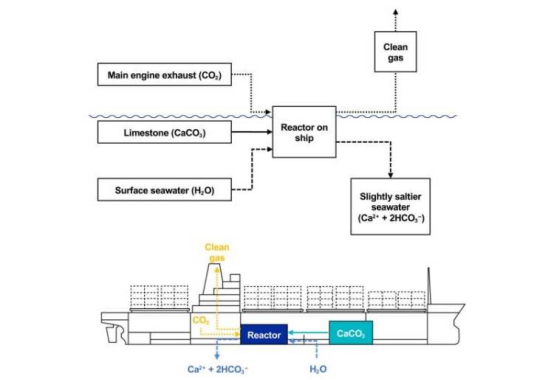
The system cleverly mimics natural ocean chemical reactions to achieve efficient CO2 removal. As ships navigate, CO2 from exhaust gases is pumped into onboard seawater, slightly increasing its acidity. The seawater then flows through a limestone layer, where the acidic substances react with the limestone to form bicarbonate—an alkaline, stable, and naturally occurring compound in seawater. The treated seawater, with CO2 removed, is then discharged back into the ocean. The entire process is simple and effective.
"The beauty of this research is how simple it is," said William Berelson, professor of earth sciences at USC Dornsife College of Letters, Arts and Sciences and co-corresponding author of the study. "We're accelerating the CO2 buffering process that the ocean already uses, but doing it on a ship, and it's effective at reducing emissions on a large scale." Berelson also noted that it started as a pure scientific question about how the ocean buffers CO2, and later they realized it could lead to a real-world solution to combat climate change.
The shipping industry is a major global greenhouse gas emitter, accounting for nearly 3% of total emissions. However, current solutions like low-carbon fuels and electrification are costly or impractical for long-haul voyages. Jess Adkins, co-founder and CEO of Calcarea and the Smits Family Professor of Geochemistry and Global Environmental Science at Caltech, described their approach as a complementary strategy that could help ships reduce environmental impact without major design overhauls.
In the laboratory phase, researchers tested key elements of the process using controlled amounts of seawater, limestone, and CO2, with results closely matching theoretical predictions, providing confidence for scaling up to real ship experiments. The study also used complex ocean models to assess the impact of discharging treated water back to sea, with simulations showing negligible effects on ocean pH and chemistry, fully demonstrating the technology's environmental safety. Researchers estimate that widespread adoption could reduce shipping-related CO2 emissions by 50%.
Currently, this academic research is advancing in parallel with Calcarea's efforts to bring the technology to market. The company is in preliminary talks with commercial shipping operators and exploring pilot projects to test the technology on operational vessels. Previously, Calcarea announced a collaboration with Lomar Shipping's corporate venture lab, Lomar Labs, to commercialize and deploy their shipboard carbon capture system. "Scalability is built into our design," Adkins said. They are developing a system that can integrate with existing ships and apply to entire fleets, accelerating the transition from lab to ocean through direct partnerships with industry players. As Calcarea's co-founder and scientific advisor, Berelson will continue researching the underlying science, including reaction rates and long-term impacts on ocean chemistry.