
A team of engineers led by the University of Sheffield has developed micro-robots capable of inspecting water pipes, diagnosing cracks, and autonomously repairing them, thereby reducing leaks and avoiding costly excavation work.
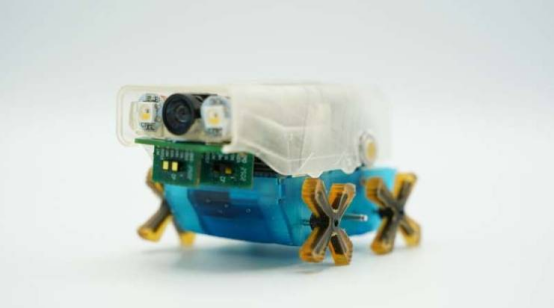
These micro-robots, named Pipebots, could revolutionize the management of water infrastructure and help save the 3 billion liters of water lost daily in England and Wales due to pipeline leaks.
The UK's water supply network spans approximately 350,000 kilometers, with some parts dating back to the Victorian era. As underground infrastructure ages, cracks and faults lead to continuous water leakage, with losses sufficient to fill 1,200 Olympic-sized swimming pools.
Even the smallest leaks can cause significant problems. Currently, the only way to identify defects manually is to excavate and locate leaks within the complex pipeline network. This can require days of searching, resulting in high costs, road closures, and disruptions to nearby businesses and residents. Utility street works cost the UK economy at least £4 billion annually and can cause disturbances to businesses and residents.
To address this issue, researchers from the University of Sheffield's Faculty of Mechanical, Aerospace, and Civil Engineering, in collaboration with the Universities of Birmingham, Bristol, and Leeds, have developed a series of micro-robots equipped with new sensors that can navigate through pipes and autonomously inspect defects.
The smallest robots are just 40 millimeters wide, comparable to the size of a toy car. These robots are equipped with high-specification miniature acoustic sensors and cameras, enabling them to navigate freely and detect faults.
Without the need to excavate roads or pavements, Pipebot swarms can be deployed from a central hub, inserted into water pipes via fire hydrants by engineers. These micro-patrol robots then explore the area, scan for faults, and transmit data back to engineers on the surface.
The pipe robots are highly intelligent, capable of avoiding restricted areas (such as customer connections) and working collaboratively to clear areas quickly and efficiently. They are equipped with all-terrain legs, enabling them to navigate any complex paths encountered in underground operations. They can also communicate with each other over short distances, allowing coordinated task execution and problem-solving.
Professor Kirill Horoshenkov, project director and professor of acoustics at the University of Sheffield, said: "Leaking pipes are one of the biggest challenges facing the water industry, not only in the UK but globally, as businesses and governments strive to address aging infrastructure. While pipeline inspection technology has improved, monitoring pipe conditions and detecting leaks in these vast networks remains extremely difficult, especially for smaller-scale leaks."
The pipe robots we've developed will transform the way we maintain water infrastructure and significantly reduce the approximately 3 billion liters of water lost daily in England and Wales. These robots will alleviate resource pressures and could potentially save the UK economy the £4 billion lost annually due to utility street works and related disruptions.
Beyond water pipes, these robots can operate in a range of other environments, including sewers, gas pipelines, and hazardous locations inaccessible to humans.
The Sheffield researchers are collaborating with partners from the UK water industry and local governments on three projects to refine the robots to meet specific industry needs. These include:
Pipebot Patrol: This project aims to develop, build, and test an autonomous sewer robot that resides in sewers, continuously monitoring for blockages and issuing alerts when blockages begin to form.
Riser Pipe Robot: This project focuses on developing technology for real-time condition assessment and inspection of sewage riser pipes, enabling repair work to be planned and prioritized, thus reducing the risk of pollution from failures.
No-dig Leak Repair: This project aims to develop technology for repairing leaks in live water pipes without destructive excavation, minimizing water supply disruptions.
The Sheffield team is also working on a project called Pipeon, aimed at developing advanced robotics and artificial intelligence technologies for automated sewer inspection and maintenance.
Professor Horoshenkov added: "The Pipebots project fully demonstrates the importance of collaboration between universities and industry. Our research has already proven the effectiveness of this technology, and our industry partners are helping us align it closely with end-user needs, testing, refining, and ultimately deploying it to address critical challenges facing the water industry."