
Solar and wind power generation is highly variable, influenced by the date, weather, and facility location. When generation exceeds demand or during peak usage periods, excess energy is often wasted due to a lack of effective long-term storage methods. To enhance U.S. energy security, innovation in energy storage and distribution is needed alongside reliable energy sources.
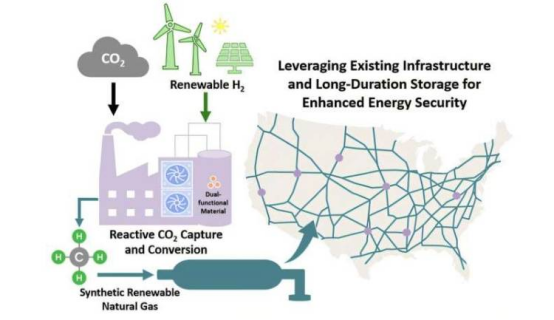
Recently, researchers at Lawrence Livermore National Laboratory (LLNL) published a new study in Cell Reports Sustainability, exploring the use of reactive carbon dioxide capture and conversion (RCC) processes to produce synthetic renewable natural gas for long-term energy storage.
LLNL scientist and lead author Alvina Aui explained that RCC does not source carbon from underground but treats above-ground carbon as a resource. Synthetic renewable natural gas, as an energy storage option, can mitigate grid instability caused by the intermittency of sources like wind and solar.
The proposed RCC process uses dual-function materials to integrate carbon capture and conversion on a single platform, eliminating the energy-intensive intermediate CO₂ purification steps common in traditional methods. Corresponding author and principal investigator Simon Pang, an LLNL scientist, noted that this dual-function material incorporates the chemical components needed for both CO₂ capture and conversion. Once captured, the CO₂ is converted and released, differing markedly from conventional processes that require separate materials for each function.
In the second conversion stage of the RCC process, excess solar and wind energy-generated electricity can electrolyze water into hydrogen and oxygen. The captured CO₂ then reacts with hydrogen to produce methane, the primary component of synthetic natural gas. Methane can be stored, transported, and used in the same manner as conventional natural gas, leveraging existing infrastructure.
The study also assessed the economic feasibility of the RCC process, proposing key performance targets for dual-function materials to remain competitive, along with methods to reduce costs and improve process efficiency. Aui stated that the research team collaborated closely with experimental teams, using modeling informed by underlying chemistry and material behavior to provide a realistic and balanced evaluation of RCC's potential and limitations.
The findings indicate that, in many cases, the RCC process is cheaper than other utility-scale long-term energy storage solutions and offers portability and dispatchability, with natural gas products easily transported via existing pipelines.
Currently, LLNL's experimental team is focused on developing dual-function materials, executing the proposed RCC process in the lab, and partnering with industry to scale the technology. This research holds promise for breakthroughs in U.S. energy storage and distribution, contributing to enhanced energy security.