
A new study led by Eugénie Hébrard from the French Research Institute for Development (IRD) indicates that since the mid-19th century, human activities have rapidly driven the widespread dissemination of Rice Yellow Mottle Virus (RYMV) across Africa. The study was published in the open-access journal PLOS Pathogens.
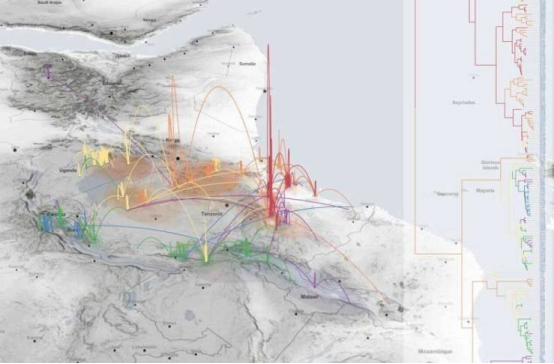
RYMV is a pathogen that infects rice and related Poaceae plants, posing a major threat to rice production in Africa. In this study, researchers delved into the impact of human history on RYMV transmission and examined the evolutionary patterns of different RYMV strains across various locations and periods.
The research group analyzed 335 virus samples collected from 1966 to 2020 across more than 770,000 square miles in East Africa, comparing gene sequences encoding viral proteins or full-length viral genomes.
Based on variations and similarities in the gene sequences, the researchers found that RYMV originated in the mid-19th century in the Eastern Arc Mountains, a biodiversity hotspot located in present-day Tanzania, where local residents practiced slash-and-burn rice cultivation. Subsequently, RYMV spread from several wild grass species to cultivated rice and rapidly dispersed to nearby rice-growing areas, including the Kilombero Valley and Morogoro region in southern Tanzania.
The study also shows that humans have historically transmitted RYMV over long distances through infected rice plants during multiple periods. The virus spread along caravan routes: in the second half of the 19th century from the Indian Ocean coast to Lake Victoria; at the end of the 19th century from East Africa to West Africa; in the second half of the 20th century from Lake Victoria to northern Ethiopia; and in the late 1970s to Madagascar. Surprisingly, near the end of World War I, RYMV migrated from the Kilombero Valley to the southern end of Lake Malawi, possibly related to rice being a staple food for the military.
Overall, the study results indicate that transporting contaminated rice seeds was the primary factor driving long-distance RYMV transmission, not only within East Africa but also from East Africa to West Africa and Madagascar.
The researchers conclude that due to human activities, RYMV's transmission efficiency rivals that of some high-mobility zoonotic viruses transmitted from animals to humans. Additionally, the study highlights the risk of RYMV and other plant viruses spreading from Africa to other continents.
The study authors add: "This paper emphasizes the role of human history in the transmission of plant pathogens and underscores the risks of intercontinental transmission. From the perspectives of rice biology and agronomy, this paper explains the paradoxical role of seeds in the transmission of major rice pests—such pests are not transmitted through seeds but are associated with them." At the same time, the authors state that this study is a major achievement of long-term, multilateral, and interdisciplinary collaboration.