
Recently, researchers from Rice University, in collaboration with Oak Ridge National Laboratory and the University of Technology Sydney, achieved a significant breakthrough by fabricating low-noise, room-temperature quantum emitters in hexagonal boron nitride (h-BN) for the first time using a scalable growth technique. This advancement opens new pathways for quantum technology development, particularly in quantum computing and communication.
Qubits, the basic units of information in quantum computing, require reliable generation for large-scale quantum technology applications. Hexagonal boron nitride has garnered attention as a potential qubit platform due to its ability to host solid-state single-photon emitters (SPEs). SPEs are atomic structures in solid materials capable of producing individual photons, crucial for quantum computing and communication.
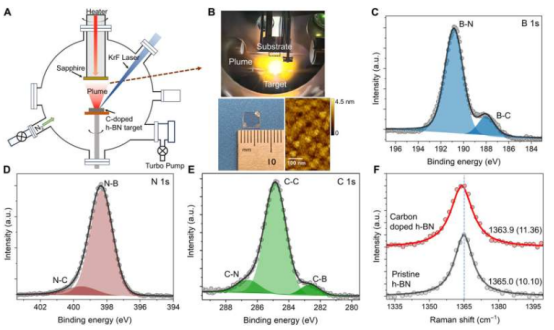
In a new study published in Science Advances, the research team synthesized h-BN thin films using pulsed laser deposition (PLD) and intentionally incorporated carbon atoms during deposition. These carbon atoms are woven into the h-BN atomic lattice, creating defects or irregularities that function as robust and reliable SPEs.
"Our work demonstrates a scalable method for creating high-performance SPEs in h-BN, marking an important step toward practical quantum light sources," said Arka Chatterjee, a postdoctoral researcher in Rice University's Electrical Engineering Lab. He emphasized that this breakthrough paves the way for integrating quantum emitters into real-world photonic and quantum information systems.
To validate the performance of carbon-doped h-BN thin films, the team conducted photoluminescence spectroscopy, photon correlation measurements, and theoretical modeling. The results showed that carbon-doped h-BN films exhibit exceptionally pure and stable single-photon emission, approaching ideal conditions. These emitters also demonstrated high brightness, strong polarization, and robust photostability.
This discovery is expected to enable the integration of SPEs into chip-based quantum devices and sensors, driving transformation in quantum communication, information processing, and sensing technologies. Associate Professor Huang from Rice University's Departments of Electrical and Computer Engineering and Materials Science and Nanoengineering stated that the combination of purity, scalability, and operational stability sets a new benchmark in the field, addressing long-standing challenges.