
Recently, astronomers using the European Southern Observatory's Very Large Telescope (ESO's VLT) have successfully produced an extremely sharp image of the Sculptor Galaxy, revealing previously unobserved features within it. Captured in thousands of colors, this image provides detailed information about the stars, gas, and dust inside the galaxy.
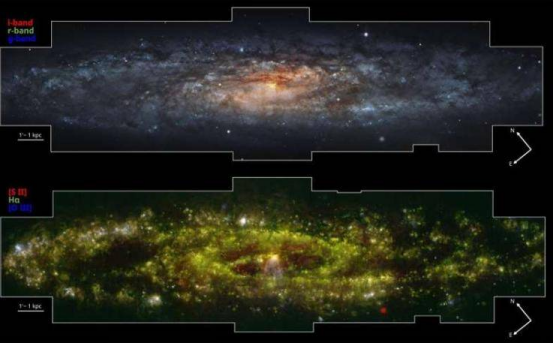
ESO researcher Enrico Congiu led this new astronomical and astrophysical study of the Sculptor Galaxy. He stated: "Galaxies are extremely complex systems, and we are still trying to understand them." The Sculptor Galaxy has drawn significant attention due to its unique position—it is close enough to Earth for astronomers to resolve its internal structure and study its components in remarkable detail, yet large enough to be observed as a complete system.
To create this star map, the researchers used the Multi-unit Spectroscopic Explorer (MUSE) on the VLT to observe the Sculptor Galaxy for over 50 hours. They stitched together more than 100 images to cover a region approximately 65,000 light-years wide. This image not only includes thousands of colors but also provides critical data on the age, composition, and motion of stars, gas, and dust within the galaxy.
In their initial data analysis, the research team discovered about 500 planetary nebulae in the Sculptor Galaxy. These regions of gas and dust ejected by dying Sun-like stars serve as distance markers for their host galaxy, offering key information to verify its distance from Earth.
In the future, astronomers plan to use this star map to further explore how gas flows throughout the galaxy, how its composition varies, and how stars form. Enrico Congiu noted: "How such tiny processes can have such a massive impact on a galaxy thousands of times larger in scale remains a mystery."