
Semiconductor manufacturing processes have long been regarded as one of the greatest challenges in modern engineering due to their requirement for extreme precision and hundreds of complex steps. Researchers at Australia's national science agency, the Commonwealth Scientific and Industrial Research Organisation (CSIRO), have for the first time applied quantum machine learning (QML) technology to semiconductor manufacturing, with results published in the journal Advanced Science. This groundbreaking study opens a new path for chip fabrication by improving the modeling of ohmic contact resistance.
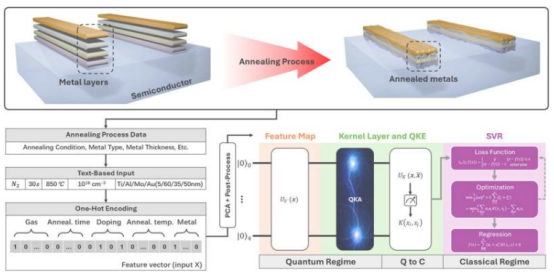
The research team focused on a critical aspect of semiconductor design: ohmic contact resistance simulation. This resistance reflects the current conduction efficiency at the interface between a semiconductor and metal. Traditional modeling relies on classical machine learning (CML) algorithms, which suffer from limitations such as the need for massive datasets and degraded performance in small-sample scenarios. The team led by Professor Muhammad Usman, head of CSIRO's quantum systems, took a different approach by adopting quantum machine learning. They analyzed experimental samples from 159 gallium nitride high-electron-mobility transistors (GaN HEMTs). The team first identified core variables with significant impact on performance, then developed a quantum kernel alignment regressor (QKAR) architecture that encodes classical data into quantum states to initiate the machine learning process. After feature extraction, classical algorithms retrieve information and train the model, ultimately achieving optimization of the manufacturing process.
Experiments showed that QKAR technology significantly outperformed seven traditional CML algorithms in high-dimensional, small-sample regression tasks. The researchers stated: "This achievement validates the potential of quantum machine learning in the semiconductor field. As quantum hardware matures, its practical application prospects are vast." This technology not only promises to reduce manufacturing costs and improve device performance but could also drive quantum computing to solve complex problems that traditional computers struggle with, bringing profound change to the semiconductor industry.