
In an office with gray carpeting at the University of Colorado Boulder, a three-wheeled robot named "Armstrong" is using its robotic arm to grasp plastic blocks. What appears to be an ordinary scene is actually an innovative practice by the university's aerospace team to solve the challenge of training lunar robots. By building hyper-realistic virtual reality (VR) environments, the team enables operators to simulate lunar missions from an Earth-based lab, laying the foundation for future human-robot collaborative exploration of the Moon.
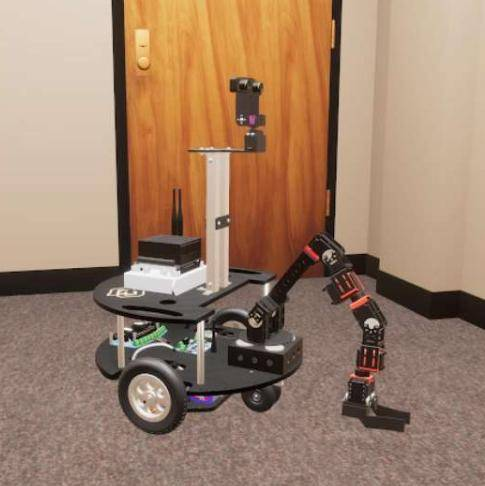
The research is led by Professor Emeritus Jack Burns from the Department of Astrophysical and Planetary Sciences, with core team members including undergraduate Zev O'Keefe, master's student Katie McCatchen, and alum Alexis Muniz. The team found that traditional training methods cannot replicate the complex lunar environment, including one-sixth gravity, craters, and permanently shadowed regions. To address this, they used the Unity game engine to create a "digital twin" of the office and robot, matching everything from wall colors to the robot’s movement speed with high fidelity to reality. In the experiment, 24 participants were divided into two groups: one operated the physical robot directly, while the other first practiced in the VR digital twin. Results showed that participants who trained virtually completed tasks 28% faster and exhibited significantly lower stress levels. "The digital twin allows us to precisely simulate details like shadows and dust texture, dramatically improving training efficiency," O'Keefe explained.
This technological breakthrough stems from the team's insight into the differences between the Apollo program and the Artemis program. Burns noted: "21st-century lunar exploration requires efficient collaboration between astronauts and robots, rather than relying solely on human effort." Currently, the team is collaborating with Lunar Outpost to extend digital twin technology to lunar rover models, with a focus on tackling the challenge of lunar dust simulation. "Dust kicked up by wheels can obscure sensors, but directly measuring the lunar environment is extremely costly. Digital twins provide a safe and economical solution," McCatchen added. As a project participant, she and her classmates have deeply experienced the complexity of real-world research: "Human operation always introduces surprises, which drives us to continuously optimize the model."