
A joint research team from Tokyo Institute of Technology and the University of Fribourg (Switzerland) has published groundbreaking results in Angewandte Chemie International Edition, successfully developing a smart molecule called PC-Py1 based on [2.2]paracyclophane. This molecule can display the internal mechanical stress state of polymer materials in real time through fluorescence changes, providing a new solution for early warning of material damage.
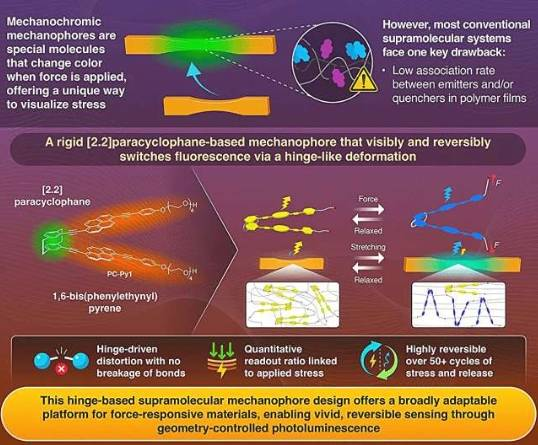
The team ingeniously exploited the rigid framework of [2.2]paracyclophane to connect two pyrene luminophores, constructing a hinge-like molecule. Associate Professor Yoshimitsu Sagara from Tokyo Institute of Technology explained: "When the material is stressed, the molecular hinge opens, causing the fluorescence to change from yellow to blue-green; this change is directly proportional to the magnitude of the stress." Tests showed that the sensing system can withstand more than 50 stress cycles without failure, demonstrating excellent reversibility and durability.
The technology features three major breakthroughs:
High sensitivity: Responds to mechanical stress at the molecular level
Real-time visualization: Color change is visible to the naked eye
Broad applicability: Can be embedded in a wide variety of elastomeric materials
Compared with traditional methods, this supramolecular design avoids the problem of covalent bond breakage. Professor Christoph Weder, leader of the Swiss team, noted: "The hinge mechanism achieves a linear correspondence between stress and optical signal, which is crucial for engineering applications." The researchers are currently exploring applications of the technology in smart coatings, flexible electronic devices, and other fields.