
UK inertial fusion company First Light Fusion has for the first time generated X-rays on its largest pulsed-power machine, Machine 3 (M3), demonstrating that its low-cost, simple "long-pulse" driver technology can produce extreme states of matter. This milestone comes as the company continues to scale its capabilities from the smaller pulsed-power machine M2 to M3.
In February this year, First Light Fusion, founded in 2011 and spun out from the University of Oxford, announced a strategic shift: it would explore new inertial confinement fusion approaches, halt development of the demonstration facility Machine 4, and instead focus on advancing and commercializing its patented amplifier technology. In March, the company unveiled the next phase of its commercial and technical strategy, partnering with leading industry players to deliver a faster, cheaper, and more scalable route to commercial inertial fusion energy, while also developing an end-to-end "low-power driver" inertial fusion method.
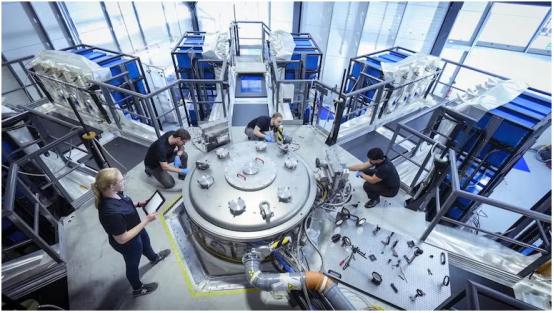
The First Light team has now successfully recorded X-ray production on M3 for the first time, a critical step in developing a cylindrical implosion platform for multiple commercial applications. The capability was first developed on M2, which served as a testbed before the technique was demonstrated on M3. This marks an important milestone for the company in validating its "long-pulse" driver technology for generating extreme states of matter and X-rays.
Currently, First Light is taking new steps toward offering high-intensity X-ray radiation production services, attracting interest from industries that need to harden electronic equipment or simulate space environments. Access to high-intensity radiation sources is of major importance to UK national security, and First Light's pulsed-power facilities have clear advantages in this area.
Ryan Ramsey, Chief Operating Officer of First Light Fusion, said the new strategy focuses on early commercialization and that the company is excited by the pace of progress. This milestone represents an important step toward delivering sovereign capability to adjacent markets and strengthening the UK's position in critical technologies. He added that the M3 architecture aligns with the requirements of future fusion power plants, making it a practical step toward practical fusion energy. First Light's pulsed-power experiments also provide opportunities to probe extreme states of matter, advancing the fundamental physics essential for inertial fusion.
Meanwhile, First Light Fusion co-founder and former CEO Dr. Nicholas Hawker has stepped down and left the company. The company expressed gratitude for Nick's years of dedication, innovation, and leadership, noting that his legacy has positioned First Light as a leader for the next energy era. Under his guidance, Nick transformed an idea conceived at the University of Oxford into a globally recognized fusion energy company, achieved key technical milestones, and established a unique approach to fusion, with projectile-based power amplification remaining central to the strategy.
In a post on X, Dr. Hawker said he is proud of what the company has built during his time leading R&D and that truly novel ideas are rare. He stated he is no longer considering working in the fusion field and wishes to apply his knowledge in practice, remaining open to other opportunities.