
Argentine astronomers have conducted high-resolution radio observations of the nearby spiral galaxy NGC 4527 using the upgraded Giant Metrewave Radio Telescope (uGMRT). The results of these observations were published on July 2 on the arXiv preprint server, revealing more about the galaxy's properties and indicating that it harbors an active galactic nucleus.
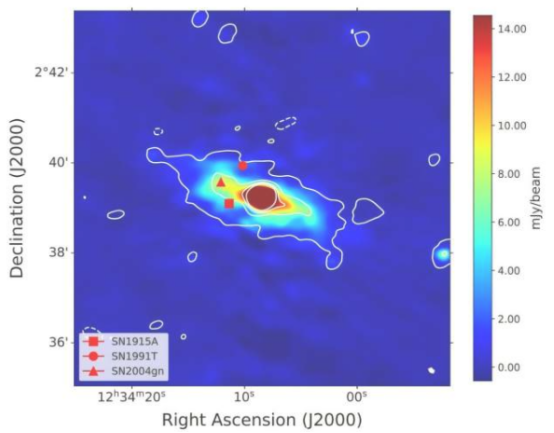
NGC 4527, discovered in 1783, is an edge-on spiral galaxy located in the constellation Virgo, approximately 49 million light-years away. With an estimated diameter of 104,000 light-years, it is classified as a starburst galaxy due to its high infrared luminosity (about 26 billion solar luminosities) and a star formation rate of roughly three solar masses per year.
Previous observations of NGC 4527 have detected three supernovae in its galactic disk, providing evidence of recent large-scale star formation activity. Additionally, the nuclear region of NGC 4527 has been found to contain a massive reservoir of molecular gas and exhibits kinematic features characteristic of a gravitationally unstable disk. However, compared to classic starburst galaxies such as M 82 and NGC 253, NGC 4527 shows unusually low star formation efficiency.
These peculiar characteristics suggest that NGC 4527 may be in a "pre-starburst" phase, where gas accumulation precedes an impending burst of star formation. A team of astronomers led by Camila Alan Galante from the National University of La Plata in Buenos Aires, Argentina, decided to further investigate this using uGMRT.
The researchers wrote: "This paper presents new radio continuum observations of NGC 4527 using the upgraded Giant Metrewave Radio Telescope (uGMRT) at 700MHz (Band-4) and 1,230MHz (Band-5), complemented by archival infrared and X-ray data."
Galante's team successfully explored the large-scale emission and the central region of NGC 4527. On large scales, the radio emission at 700MHz and 1,230MHz was found to follow the stellar disk, with no evidence of a radio halo. The spectral index across the entire stellar disk suggests the presence of polycyclic aromatic hydrocarbons (PAHs).
In the central region of NGC 4527, three compact radio sources were detected. One is located at the galaxy's center and exhibits a non-thermal spectral index. The other two sources appear symmetrically positioned along the galaxy's major axis, at a projected distance of approximately 1,300 light-years, and both show relatively flat spectral indices. The collected data also indicate the destruction of PAHs in the galaxy's higher-energy regions.
The astronomers conclude that the observational characteristics of NGC 4527 suggest the presence of a star-forming ring surrounding the galactic nucleus. Furthermore, they note that the destruction of PAHs in the central region, the non-thermal radio emission, and recently detected X-rays can all be explained by the presence of an active galactic nucleus (AGN).
The researchers explained: "Moreover, the AGN scenario provides a plausible mechanism for the formation of the nuclear ring: if the accretion flow is (or was) super-Eddington and drives dense winds that cannot escape the galaxy's gravitational potential, material falling back onto the disk could inject fresh gas at a distance of a few hundred parsecs from the center, thereby triggering star formation in a ring-like structure."
However, the paper's authors emphasize that confirming the presence of an AGN will require variability studies and higher-resolution observations of the innermost central region of NGC 4527.