
Scientists at the Max Planck Institute for Plasma Physics have achieved a major breakthrough in controlled nuclear fusion. The German Wendelstein 7-X experimental reactor has set a new world record, sustaining high-performance plasma for 43s—longer than any other fusion reactor in history.
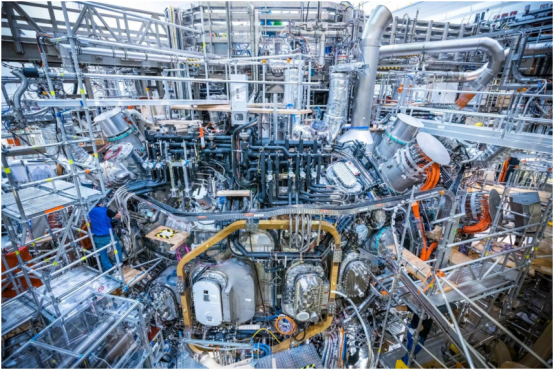
In plasma physics, 43s may seem brief, but it is a milestone achievement. This experiment reached a critical figure of merit known as the "triple product," which determines how close a reactor is to "breakeven" (producing more energy than is input).
Professor Thomas Klinger from the Max Planck Institute for Plasma Physics called the new record a tremendous success for the international team, impressively demonstrating the potential of Wendelstein 7-X. Achieving a triple product at tokamak levels with long plasma pulses marks an important step for stellarators toward becoming suitable for power plants.
Unlike standard tokamaks with their characteristic doughnut shape, stellarators have a more complex magnetic coil configuration but offer the advantage of sustaining plasma with less energy and are inherently easier to control due to their design.
During the experiment, scientists from Oak Ridge National Laboratory in the United States injected 90 frozen hydrogen pellets using a specially designed fuel injector for the reactor. A microwave heating system raised the plasma temperature to 30 million degrees Celsius—about twice the temperature at the Sun's core.
Nuclear fusion powers stars: hydrogen nuclei collide and fuse into helium under immense pressure and heat, releasing vast amounts of energy. Replicating this process on Earth promises clean, nearly limitless energy with no carbon emissions and minimal harmful radioactive waste.