
Researchers from McGill University, in collaboration with the SLAC National Accelerator Laboratory at Stanford University in the US and the Korea Advanced Institute of Science and Technology (KAIST), have jointly developed a new method for manufacturing high-performance lithium-ion battery materials. The approach focuses on the production of "disordered rocksalt" (DRX) cathode particles, potentially replacing expensive and hard-to-source metals like nickel and cobalt, paving the way for sustainable lithium-ion battery development.
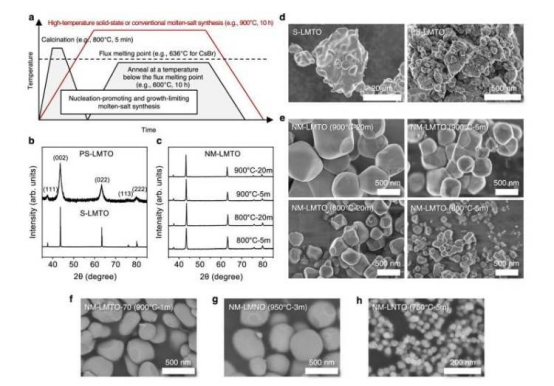
DRX cathode particles, as an alternative battery material, have previously been limited by difficulties in controlling particle size and quality, resulting in poor stability and challenges for widespread adoption in production environments. However, the research team has overcome this issue by innovatively developing a method to produce uniform-sized, highly crystalline particles without the need for grinding or post-processing.
According to the paper's corresponding author, Assistant Professor Jinhyuk Lee from McGill University's Department of Mining and Materials Engineering, this method enables large-scale production of stable-quality DRX cathodes, which is crucial for their application in electric vehicles and renewable energy storage. The team designed a two-step molten salt process to synthesize DRX particles, promoting particle nucleation while limiting growth to successfully produce battery-viable particles smaller than 200 nanometers.
In battery testing, the new material demonstrated excellent performance, retaining 85% capacity after 100 charge-discharge cycles—more than double the performance of DRX particles produced by older methods. This achievement not only improves battery performance but also enhances consistency in large-scale DRX cathode production.
The research received partial support from the US battery company Wildcat Discovery Technologies, which is interested in commercializing DRX technology. The team stated that the new method improves process scalability and energy efficiency while addressing key barriers to widespread DRX cathode adoption, potentially triggering significant ripple effects on global battery demand.
Hoda Ahmed, a PhD student in McGill University's Department of Materials Engineering and the paper's first author, noted that the acceptance of these findings highlights the method's fundamental insights and industrial potential, driving the field toward scalable manufacturing.
The related research results have been published in Nature Communications under the title "Nucleation-Promoted and Growth-Restricted Synthesis of Disordered Rocksalt Lithium-Ion Cathode Materials." The study was co-authored by Hoda Ahmed, Moohyun Woo, Raynald Gauvin, George Demopoulos, Jinhyuk Lee, and colleagues, opening the door to sustainable, cost-effective, and large-scale production of next-generation lithium-ion batteries.