
Albert Einstein once said, "God does not play dice," expressing his criticism of the probabilistic nature of quantum mechanics. However, relativity—his other major contribution—has become an essential tool for understanding the behavior of electrons, a core object of quantum mechanics. The tiny size of electrons requires quantum mechanics for analysis, while their high-speed motion necessitates relativity. The two theories have vastly different starting points, making unified description challenging.
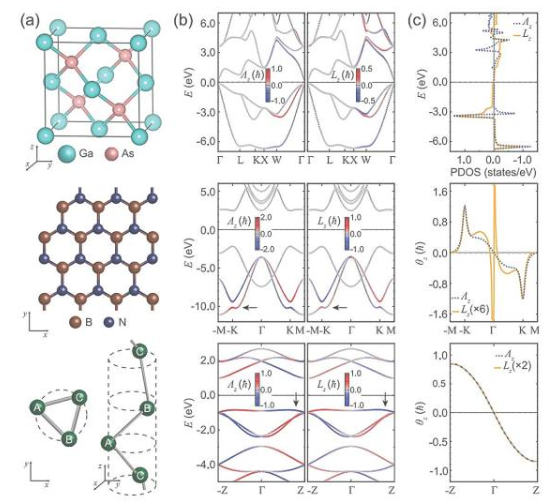
Recently, a new study published in Physical Review Letters offers fresh ideas for bridging this gap, potentially reshaping our understanding of electron dynamics in solids. The research, led by Professor Noejung Park from Ulsan National Institute of Science and Technology and Professor Kyoung-Whan Kim from Yonsei University in Korea, proposes a new theoretical framework for more accurately describing electron spin in solid materials.
Electrons possess two forms of angular momentum—spin and orbital—which interact through spin-orbit coupling, critical for material magnetism and conductivity. However, spin-orbit interactions often stem from relativistic effects at high energies, while low-energy quantum mechanical phenomena dominate in solid-state systems, limiting the ability to uniformly simulate spin-orbit effects. To address this, the research team innovatively proposed describing spin-orbit coupling without relying on the orbital angular momentum operator, instead introducing the concept of spin-lattice interaction to directly incorporate relativistic effects into the quantum mechanical description of electrons.
By applying the new method to various physical systems—including one-dimensional conductors, two-dimensional insulators, and three-dimensional semiconductors—the team verified its effectiveness. Results showed higher accuracy and efficiency in predicting spin distribution, spin current, and magnetic response compared to traditional models. The joint research team stated: "Our method resolves computational inconsistencies between quantum mechanics and relativity, laying the foundation for spintronics and next-generation memory device research."
This advancement, led by postdoctoral researcher Dr. Bumseop Kim from the University of Pennsylvania, provides a new approach for more precise simulation of spin phenomena and serves as a foundational theory for designing advanced spintronic devices and quantum information technologies.